Last Updated on April 26, 2026 by Monica Castillo
Here’s the thing about “Desert Warrior” I wanted to love it. I really did. You sit down, the desert opens up on screen like something out of a painting, the scale hits you immediately, and for a brief moment you think, okay, this is going to be something special. And then… you wait. And you wait. And just when you start checking how much runtime is left, it finally gives you what you came for. By then, though, you’ve already done most of the emotional work yourself.
This film has had a rough road to your eyeballs. Shot five years ago, stuck in production hell, reworked God knows how many times before anyone was allowed to see it. And honestly? You can feel every one of those five years on screen. Not in a charming, rough-around-the-edges way. More in a clearly went through too many hands before anyone called it done kind of way.
Rupert Wyatt directs the same guy who gave us Rise of the Planet of the Apes, which was genuinely great, and you can tell he had a real vision here. Ancient Arabia, warring territories, a princess-turned-revolutionary, a reluctant antihero with a camel and a bad attitude. On paper, that’s a movie I’m buying a ticket for without hesitation. The bones are good. The bones are really good.
Recommended: Half Man (2026) Parents Guide
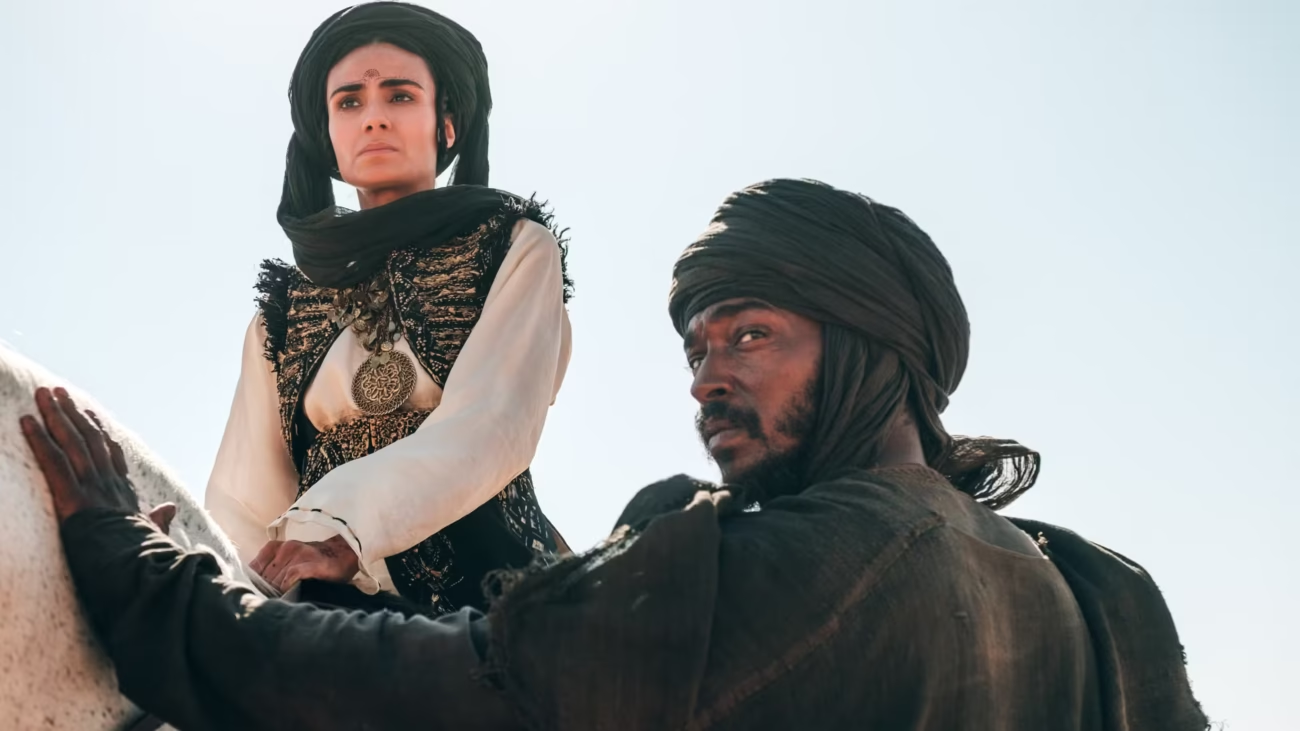
So here’s what actually happens. Emperor Kisra II, played by Ben Kingsley doing his full “I have decided I am royalty and no one can tell me otherwise” thing, rules over Arabia with an iron fist and a deeply unsettling obsession with collecting women from across the kingdom. King Al-Numan refuses to hand over his daughter, Princess Hind, and suddenly father and daughter are running for their lives across the desert. They fall in with the Bandit, Anthony Mackie, charming as ever, riding a camel like he’s done it his whole life, who agrees to help them, but only if there’s gold in it for him. They find shelter with Chief Hani, and it’s here that Hind starts becoming someone genuinely worth watching. She meets a medicine woman, she starts thinking bigger than just survival, and slowly, very slowly she begins building toward something that could change everything.
Chasing them the whole time is Commander Jalabzeen, played by Sharlto Copley, who is having an absolute blast being terrible. The man plays unhinged military villain like it’s his natural resting state, and every scene he’s in has an edge to it that the rest of the film honestly could’ve used more of.
And that’s where I start having my problems.
Aiysha Hart as Hind is the best thing in this movie, full stop. Her journey from a girl being protected to a woman doing the protecting is the emotional spine of the whole story, and she carries it with a quiet intensity that genuinely pulls you in. There’s a version of “Desert Warrior” that centers entirely on her arc and becomes something really powerful. This version keeps wandering off to check on the Bandit, who and I say this with all due respect to Anthony Mackie doesn’t actually have much to do. He’s set up as this classic torn-between-gold-and-glory antihero, the kind of character you root for precisely because he’s pretending not to care. But the script never quite commits to him. He drifts through the story like he’s waiting for someone to give him a proper scene to sink his teeth into. It never really comes.
The middle of this film is a lot of atmosphere and not enough momentum. Wyatt leans hard into the visual and sensory experience of the world the heat, the silence, the vast emptiness of the desert, and look, it’s beautiful. There are shots in this movie that belong in a photography exhibit. But there’s a difference between a film that breathes and a film that stalls, and “Desert Warrior” crosses that line more than once. You feel the re-edits. You feel scenes that were probably longer and got chopped, and scenes that probably should’ve been shorter but weren’t. The pacing has this awkward, uneven quality that keeps pulling you slightly out of the story every time you start to settle in.
And then the third act happens.
Elephants. Thousands of soldiers. Hand-to-hand combat across a massive battlefield. And I promise I am not making this up, weaponized hyenas. The final battle in “Desert Warrior” is genuinely spectacular in a way that made me lean forward in my seat for the first time in a while. Wyatt knows how to stage chaos on a massive scale, and when he finally lets himself go here, the movie transforms into exactly what it promised to be from the very first frame. It’s visceral and enormous and completely committed, and for those twenty or so minutes, everything clicks.
The tragedy is that it took so long to get there.
If you’re the kind of person who can settle into a slow-burn epic who appreciates world-building and visual craft and doesn’t need something exploding every ten minutes there’s a genuinely rewarding experience buried in here. Hind’s story alone is worth your time. The final battle alone is worth your time. But between those two things, “Desert Warrior” asks for a patience that not everyone’s going to have, and it doesn’t always earn it.
Recommended: Michael (2026) Parents Guide
I didn’t hate this movie. I’m not even sure I disliked it. I’m just a little sad it wasn’t the film it so clearly wanted to be. Five years in the making, and it still feels like it’s one more edit away from greatness.
6.5 out of 10. Come for the battle. Stay for Aiysha Hart. Bring something to keep your hands busy during the middle hour.
Desert Warrior Parents Guide
Violence & Intensity: This is where the R rating earns itself, and it doesn’t apologize for it. “Desert Warrior” is a war epic set in ancient Arabia, and Wyatt doesn’t sanitize what that means. There are sword fights, executions, and brutal hand-to-hand combat throughout, and the final battle is on a completely different level. We’re talking large-scale warfare with soldiers being trampled by elephants, hyenas tearing through people, and bodies dropping with real visual weight. It’s not gratuitous torture-porn style violence, but it’s also not clean Hollywood action where everyone conveniently misses. People get hurt, people die, and the camera doesn’t always look away. A few images are genuinely jarring, particularly around the treatment of imprisoned women in Kisra’s stronghold. The intensity builds slowly, but when it arrives, it hits hard.
Language: Honestly, nothing here that’s going to make you spit out your coffee. The dialogue leans into the formal, ancient-world register of the story, so you’re not getting a parade of modern profanity. There are moments of harsh, threatening language particularly from Jalabzeen, who delivers menace more through tone than actual words but nothing that pushes into extreme territory. Not a major concern for most parents, but worth knowing the overall tone is dark and heavy, even when the language itself isn’t explicit.
Sexual Content & Nudity: The entire premise of the film revolves around an emperor who kidnaps women across the kingdom to force into concubinage, so the theme of sexual exploitation is present and impossible to ignore it’s literally what drives the plot. That said, Wyatt handles it with more restraint than you might expect. There’s no graphic nudity or on-screen sexual violence. What you get instead are implications, women held captive, stripped of autonomy, treated as property. It’s disturbing precisely because the film doesn’t dramatize it explicitly, but rather lets the weight of what’s happening sit in the background. Older teens will understand exactly what’s being conveyed. Younger kids may not fully grasp it, but that almost makes it more uncomfortable to explain afterward.
Drugs, Alcohol & Smoking: Nothing significant here. A couple of scenes involve what appears to be wine or ceremonial drinking in a period-appropriate context, but there’s no glorification of substance use and it’s never a focal point of any scene. You can more or less set this category aside when deciding whether the film is appropriate for your household.
Age Recommendation: This one’s pretty clear — the R rating is warranted, and it’s not a soft R. The combination of sustained war violence, a climactic battle that is genuinely intense and bloody, and the heavy thematic undercurrent of women being captured and controlled makes this one firmly for older teens and adults. I’d say 15 and up is a reasonable starting point, with the caveat that maturity matters more than age here. A thoughtful 14-year-old who handles dark historical content well? Probably fine. A sensitive 16-year-old who doesn’t do well with warfare and physical brutality on screen? Maybe sit this one out. The film isn’t trying to traumatize you, but it’s not holding your hand either.
