Last Updated on April 23, 2026 by Monica Castillo
Michael 2026 honest Review & Parental Guidance
I’ll be honest: I went in looking for reasons to defend it.
Not because I’m soft on biopics, I’m not, and the genre has been coasting on goodwill it stopped earning sometime around Ray, but because Michael Jackson is genuinely one of the most psychologically strange figures American pop culture ever produced, and that strangeness, handled right, is the stuff of real cinema. A man who may have been both victim and predator. A child who became the world’s most famous person before he understood what the world was. That’s not a biopic. That’s a Greek tragedy waiting for a filmmaker brave enough to step into it.
You notice it almost immediately, not in any single scene, but in the accumulation of them. The film moves the way a highlight reel moves: efficiently, frictionlessly, landing on the approved moments and then hustling past before anything inconvenient can take root. Gary, Indiana. Joe’s belt. Motown. The Ed Sullivan circuit. Diana Ross. And on and on, each beat checked off with the mild satisfaction of a man completing a form. By the time we’ve reached the Thriller era, I realized I hadn’t leaned forward once.
Colman Domingo plays Joe Jackson, and I want to be careful here because Domingo is a genuinely gifted actor who has done extraordinary things with far less. But there’s nothing to grab onto in this performance because the script hasn’t written a person, it’s written a function. Joe exists to be the thing Michael is escaping. That’s it. No scene asks us to understand why Katherine stayed, or what Joe believed he was building, or whether he ever looked at his youngest son and felt something other than the urge to extract a performance. Real cruelty is specific. This version is generic, and generic cruelty teaches us nothing.
Nia Long is wasted so completely I started feeling bad about it around the forty-minute mark.
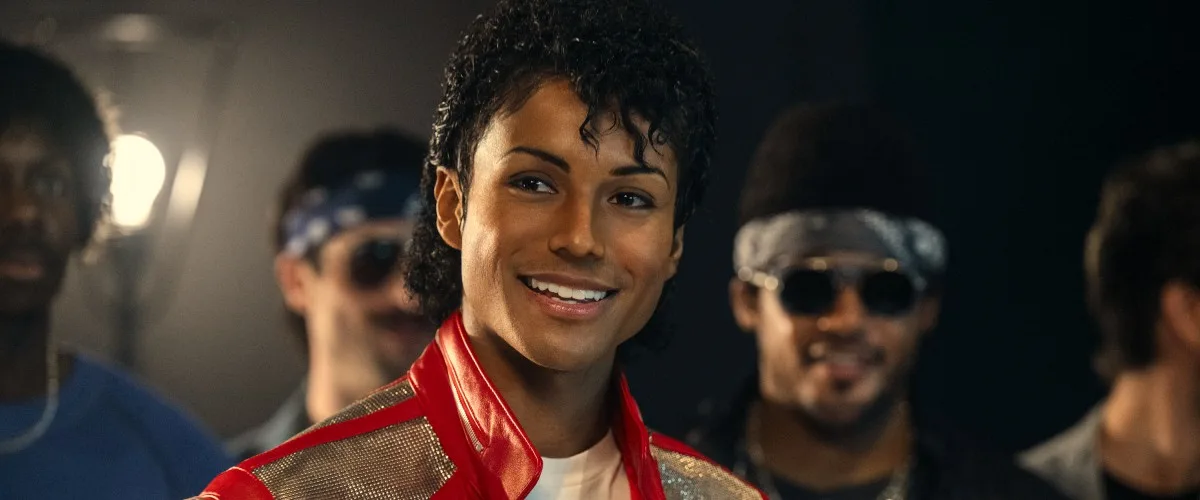
Jaafar Jackson, though. There’s something there. He has his uncle’s physical grammar in a way that goes beyond imitation, the slight inward collapse of the shoulders, the eyes that seem to be receiving information from somewhere else. In a scene where Michael decides to reshape his nose, quietly and without ceremony, to look more like Peter Pan than Joe Jackson, Jaafar finds a grief that the script doesn’t quite earn but can’t fully suppress either. Those moments stick. They’re outnumbered, but they stick.
Highly Recommended: Over Your Dead Body (2026) Parents Guide
The camera finds Michael’s feet in one early shot, restless, already searching, and it’s a genuinely alive image. Fuqua knows where to look. The problem is he keeps looking away. The Motown 25 “Billie Jean” sequence has the raw materials of something electric, and then he cuts to a crowd pan, and then another, and the electricity just… drains out. Michael himself tells a cameraman in one scene that you can’t film a dancer by pulling the energy out of the movement. I wrote that line down. I’m still thinking about who on set failed to notice what they were being told.
What the film can’t survive is its own sanctioned timidity. Janet Jackson doesn’t exist here. The legal accusations don’t exist. The strangeness of Neverland is played mostly for gentle laughs, look at the chimp, look at the giraffe, rather than as the genuine cry for help it almost certainly was. I understand why the estate wanted it this way. I don’t understand why a filmmaker with Fuqua’s track record agreed to these terms without demanding something in return. Some access to the actual man. Some permission to wonder.
Because Michael Jackson was worth wondering about. That’s the thing. He didn’t need to be exonerated or condemned on screen, he needed to be examined. He needed a film that could hold two uncomfortable thoughts at once, the way real life does, the way real people do. Instead he gets hagiography dressed in a leather jacket, moving to a playlist, mistaking the songs for a story.
The songs are still miraculous. They were miraculous before this film, and they’ll outlast it without trying. But sitting in the dark watching Michael, I kept feeling the ghost of a better movie haunting the edges of this one, restless, a little heartbroken, wondering why nobody let it in.
Michael (2026) Parents Guide
Rated PG-13 for some thematic material, language, and smoking.
Violence & Intensity: The hardest material here isn’t physical, it’s the atmosphere of dread that surrounds Joe Jackson. Fuqua doesn’t linger on the belt, but he doesn’t have to. The threat of violence hums underneath nearly every scene in the film’s first act, and younger viewers will feel it even if they can’t name what they’re feeling. The Pepsi commercial incident is depicted, briefly, but with enough visceral jolt to land. Nothing here approaches graphic, but the emotional weight of a parent terrorizing his children is rendered clearly enough that sensitive kids will notice.
Language: Mild to moderate, and mostly contained. A handful of uses of “damn,” “hell,” and “ass” scattered across a 127-minute runtime. No slurs. The more pointed language comes not from profanity but from Joe’s cold, cutting dismissals of his children, the kind of words that don’t need to be obscene to do damage. That register might land harder on some kids than an f-bomb would.
Sexual Content & Nudity: Essentially none. The film gestures at the strangeness of a nine-year-old performing sexualized lyrics in adult venues, and to its credit doesn’t look away from how wrong that was, but it handles it with restraint. No nudity, no explicit content.
Drugs, Alcohol & Smoking: Cigarettes appear, which accounts for the rating’s smoking notation. Alcohol surfaces in the backdrop of adult industry scenes without being glamorized. No drug use depicted in this first installment, though the film’s timeline ends at 1988, before the periods of Michael’s life where substance dependency became part of the public record.
Age Recommendations: Twelve and up is a reasonable floor, less because of content and more because of context. The abuse storyline requires some emotional maturity to process, and the film’s portrait of childhood talent being systematically exploited by adults, without the narrative ever fully reckoning with it, is the kind of thing that benefits from a conversation afterward.
Highly Recommended: Mother Mary (2026) Parents Guide
