Last Updated on May 1, 2026 by Monica Castillo
Renny Harlin directed this. I mention that not to pile on the man but because it genuinely matters. Harlin made Deep Blue Sea back in ’99, which was dumb and knew it was dumb and had a great time being exactly that. Samuel L. Jackson got swallowed mid-monologue. There was a parrot. LL Cool J survived. It wasn’t trying to be Jaws and it didn’t need to be. Deep Water seems to have learned nothing from that experience, it’s got the same basic ingredients (sharks, water, people who probably shouldn’t be there) but none of the self-awareness that made the earlier film watchable on a rainy Saturday.
What you get instead is an hour of disaster-movie setup so familiar it practically fills itself in. Ben Kingsley plays the pilot who’s close to retirement, because of course he does.
Aaron Eckhart plays the co-pilot with a messy personal life he’s running away from. There’s a sulky teenage girl. There’s a stepbrother named Finn, named Finn, in a shark movie, I’ll just leave that there. And then there’s Dan, played by Angus Sampson: loud, obnoxious, chain-smoking, and apparently incapable of packing electronics without generating enough sparks to bring down a 747, which is eventually exactly what he does.
Recommending: Mother Mary (2026) Parents Guide
Dan is, genuinely, the only reason to stay awake in the first half. Not because he’s written with any depth he isn’t but because Sampson commits to the awfulness in a way nobody else in this film bothers to. You hate him immediately and completely, which means you’re at least feeling something. The rest of the characters exist mainly to raise or lower the eventual body count.
The crash sequence is where Harlin wakes up briefly. It’s chaotic and disorienting and has a kinetic energy the rest of the film never recovers. Fuselage splitting, water rushing in, bodies, it’s ugly in a way that briefly feels real. And then it’s over, and the survivors are in the water on pieces of wreckage, and the movie goes very, very quiet again.
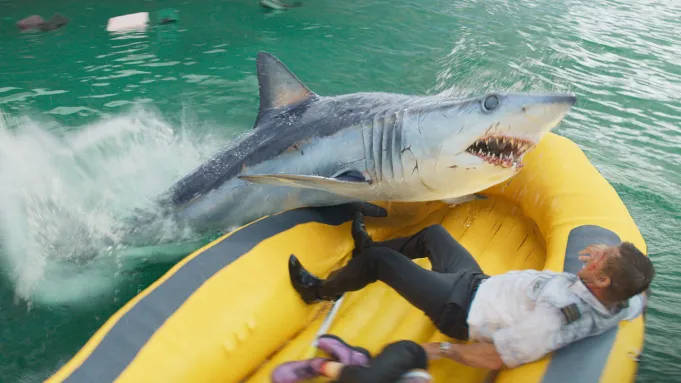
Here’s the thing about shark movies. The shark is almost never the point. What you’re actually watching is human beings in the water, their panic, their bad decisions, their moments of strange selflessness or cowardice. Jaws understood this. Even The Shallows, which is essentially a one-woman play on a rock, understood this. Deep Water doesn’t. It treats its characters as placeholders, so when a CGI mako lunges out of the frame with all the menace of a screensaver, you feel nothing. Not fear. Not even the cheap thrill of a good jump scare. Just: oh, that person’s gone.
Four writers worked on this script. I’m not sure what they were each responsible for, because there’s maybe twenty minutes of actual story here stretched across two hours. At some point in the second half I caught myself thinking about Under Paris, the French shark movie from last year which wasn’t perfect by any measure but at least had a sense of escalating madness that felt earned. Deep Water doesn’t escalate. It just continues.
Recommending: Over Your Dead Body (2026) Parents Guide
Eckhart does what he can. He’s a capable actor in the wrong film, which is different from being a bad actor. There’s a scene early on where he tells a nervous crew member that hippos are statistically more dangerous than air travel, and he delivers it with this tired, been-here-before sincerity that made me think: in a smarter film, this guy could have been interesting. This isn’t that film.
What stays with me if anything does is the strange confidence of it all. The film doesn’t seem to know it’s failing. It moves through its paces with the steady self-assurance of something that believes the formula will be enough. Sometimes formula is enough. Not here.
Deep Water (2026) Parents Guide
Rated R by the MPA for violent content/bloody images and some language.
Violence & Intensity: The crash sequence is the film’s most visceral stretch, and Harlin doesn’t look away from it. Bodies are thrown through fuselage. People drown in flooded cabin sections. It’s disorienting by design, and younger viewers will find it genuinely distressing rather than thrilling. Once the sharks arrive, the kills are quick but bloody limbs gone, water turning red, the occasional scream cut short. None of it is lingered over with any real gore-craft, but it’s blunt enough to earn the R. The threat of attack hangs over the second half in a way that builds low-grade dread, even when the film itself isn’t doing much with it.
Language: The moviedrops a handful of hard profanities, mostly in moments of panic or frustration, which at least feels contextually honest, if your plane just broke apart over the ocean, you probably aren’t watching your language either. No slurs. Nothing that stands out as aggressive or particularly pointed.
Sexual Content / Nudity: Two of the adult passengers apparently decide that a long-haul flight is the moment for intimacy, which is how they miss the early signs of trouble. It’s implied rather than shown the film cuts away before anything explicit, but it’s played for a kind of grim irony that parents of younger children should know is there.
Drugs, Alcohol & Smoking: Dan, the film’s resident antagonist, smokes constantly and without apology. It’s practically a character trait. His cigarettes are, in a roundabout way, responsible for the entire disaster, the electrical fire in the cargo hold starts with his luggage. So if nothing else, the film makes a fairly grim case against carry-on violations. Alcohol appears in the background of the pre-crash scenes without much emphasis.
Age Recommendation: The combination of a large-scale disaster, shark attacks, and sustained threat makes it genuinely unsuitable for children under thirteen. For teenagers, it depends entirely on their tolerance for this kind of thing, seasoned horror and thriller viewers in the fourteen to fifteen range will likely find it tame; kids who still flinch at jump scares won’t have a good time. Adults accompanying younger teens should know the crash sequence, in particular, hits harder than the rest of the film suggests it will.
Recommending: The Devil Wears Prada 2 Parents Guide
