Last Updated on April 29, 2026 by Monica Castillo
Sitting in that theater, I kept thinking this is either the most accidentally timely movie of the year, or someone in the writers’ room has been laid off before. Probably both.
The Devil Wears Prada 2 opens with Andy Sachs standing at a podium, accepting a journalism award, and just as the applause dies down, her phone buzzes. Everyone at her table gets the same text simultaneously. They’ve all been fired. No call. No warning. Just a mass notification, the way you’d cancel a food delivery order. I actually laughed, not because it’s funny, but because anyone who’s worked in media in the last five years recognized it instantly. I know people who got locked out of their work emails mid-assignment, still physically on the road, still on the company’s dime. The movie earns that scene completely.
What it doesn’t always earn is everything that comes after it.
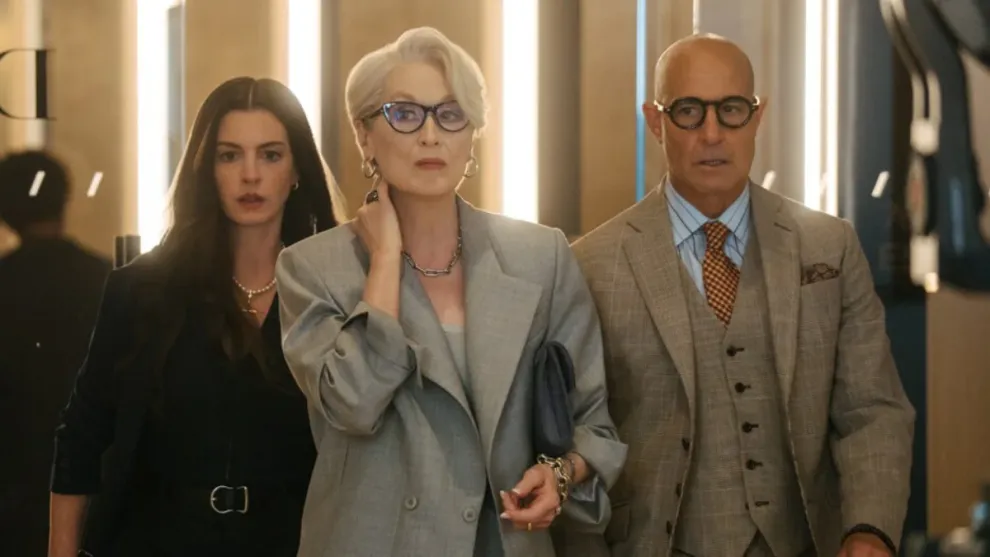
Anne Hathaway slides back into Andy like she never left, and that’s genuinely the film’s greatest asset. She’s warmer now, more settled, Andy’s become the journalist she always wanted to be, before Runway and Miranda Priestly derailed her in the most glamorous way imaginable. Watching her re-enter that world, getting stuck in what looks like a repurposed supply closet while Miranda’s new assistants float around in the actual offices, there’s a pleasure in that. The film knows how to use its cast. It just doesn’t always know what to do with them once it has them.
Meryl Streep is the most interesting case. She’s not playing the same Miranda. That Miranda ran rooms on pure terror, you felt it. This one carries something quieter, almost melancholy. There’s a scene where she says “the September issue is so thin you could practically floss with it,” and she delivers it not with contempt but with the flat affect of someone who already knows the ending. It’s a fascinating choice, and Streep commits to it. But the script keeps undercutting her, tossing in the occasional sharp remark to remind you this is still Miranda, without building those moments into anything. They feel like habit. Like the writers didn’t fully trust the more vulnerable version they were reaching for, so they kept hedging. That uncertainty shows.
Recommended: Mermaid (2025) Parents Guide
Emily Blunt is wonderful and criminally underused. Stanley Tucci gets the film’s best emotional beat, I won’t spoil it, but Nigel’s moment of reckoning is the one scene that feels fully earned, character and story clicking together the way the original did routinely. The new additions, Simone Ashley and Caleb Hearon as Miranda’s assistants, are interesting enough on screen, but they’re given so little that “interesting enough” is about as far as it goes.
The big plot engine is Andy chasing a definitive interview with Sasha Barnes, a billionaire philanthropist played by Lucy Liu, who’s freshly divorced from some tech-world villain and wants to do something meaningful with her money. The film positions this as the story, the modern equivalent of the unpublished Harry Potter manuscript from the original. But it never quite convinces you that Sasha Barnes matters the way that manuscript did. Liu is doing her best work with the material, but the character exists more as a plot function than a person. You don’t feel the stakes the way you should.
Patrick Brammall and Kenneth Branagh show up as romantic interests for Andy and Miranda respectively, and they’re fine fine being the operative word. Brammall and Hathaway share scenes that are pleasant without generating much warmth. You’re not rooting for them so much as acknowledging their presence.
The fashion is a mixed bag, which feels strange to type about a movie that exists largely as a delivery mechanism for extraordinary clothing. Molly Rogers steps in for Patricia Field and mostly does right by Andy, there’s an Armani Privé jumpsuit that genuinely stops the scene cold, in the best way. But some of Andy’s suits feel stiff rather than sharp. Miranda’s wardrobe is on stronger ground when it leans into fitted, classical silhouettes and goes sideways in a Dries Van Noten tassel jacket that I genuinely cannot explain. And Emily Blunt’s character apparently works at Dior while wearing a shirt with the word DIOR printed across it in foot-high letters. I stared at that for a while.
What I keep coming back to, though, is the ending. The film spends a good portion of its runtime talking honestly sometimes bracingly so about the state of media. The layoffs, the consolidation, the way billionaires absorb legacy publications and strip them for parts. It’s bleak because it’s accurate. So when the resolution arrives and it turns out a good billionaire will swoop in and save the day… I don’t know. It felt like the movie flinched. You’ve just spent two hours telling me the truth, and now you’re handing me a fairy tale. Those two things don’t sit comfortably together, and the film never really reconciles them.
Recommended: Outcome (2026) Parents Guide
That said and I mean this, the final scene between Andy and Emily is completely shameless fan service, and I was fully on board for every second of it. The cerulean sweater makes a reappearance. The grudges get their due. There’s an energy in those closing minutes that the rest of the movie is chasing and only occasionally catches.
Is it worth watching? Yes especially if the first one meant something to you. Hathaway is a genuine joy, Streep is doing something quietly interesting even when the script fails her, and there are enough flashes of the original’s wit and warmth to make it worth your time. But you’ll leave the theater wishing it had been braver. The first film took fashion seriously when the culture told it not to. This one takes the media crisis seriously right up until the moment it decides not to, and that choice, more than any underdeveloped subplot or chemistry-free romance, is what keeps it from being something really special.
The Devil Wears Prada 2 Parents Guide
Rated PG-13 by the MPA for strong language and some suggestive references.
Violence & Intensity: The most intense moments in this film are emotional, not physical, a mass layoff text message, a tearful award speech, the quiet devastation of watching an institution slowly die. If your kid has ever watched the news or, worse, had a parent come home after a bad day at the office, they’ve seen harder stuff. The drama is boardroom-level, not battlefield.
Language: There’s strong language scattered throughout enough to justify the PG-13 on its own. It’s not relentless, but it’s present, and some of it lands with the kind of sharp delivery you’d expect from characters who’ve spent careers weaponizing words. Miranda’s cutting remarks are precise rather than profane, but the film around her isn’t quite as restrained. Younger kids will notice. Teenagers, honestly, have heard worse.
Sexual Content / Nudity: Minimal. There are romantic storylines for both Andy and Miranda, but the film handles them with a light touch more suggestion than anything explicit. A few moments lean into mild flirtation, nothing beyond what you’d find in a standard network drama. No nudity. The most revealing thing on screen is the fashion, and even that is more editorial than provocative.
Drugs, Alcohol & Smoking: Cocktails make their expected appearances at industry events and social settings, this is a film about the fashion and media world, after all, and nobody is drinking sparkling water at a Dior dinner. It’s ambient rather than glorified. No drug use. No smoking of note. Nothing that reads as endorsement, just atmosphere.
Age Recommendations: Comfortably fine for 13 and up. Honestly, a mature 11 or 12-year-old who caught the first film with a parent would follow this without issue, the content isn’t the obstacle, some of the industry commentary might just go over younger heads. For fans of the original who’ve been waiting twenty years for this, bring your teenager.
Recommended: Apex (2026) Parents Guide
