Last Updated on April 17, 2026 by Monica Castillo
My father never talked about his brother. Not once, not in any way that felt like talking, there were references, oblique ones, the way you might refer to a country you’d left as a child and had no plans to return to. I thought about that watching Blue Heron. I thought about it a lot.
Sophy Romvari’s film is about a family with a son they can’t reach, and a daughter who watches, and the forty-year shadow that casts. It’s set in the ’90s on Vancouver Island, in a house that sounds exactly right , lawn mower in the distance, cereal crunching, blinds being cracked open on a gray morning. Romvari has been open about how much of this is her own life, and you believe her, not because the film announces its authenticity but because nobody invents details like these. Invented details are always slightly too meaningful. These are just true.
The brother is named Jeremy. Edik Beddoes plays him, and he’s given almost nothing to work with in the obvious sense, no monologues, no breakdown that the screenplay has positioned carefully for maximum impact. We just watch him. He wanders off. He comes home one night in handcuffs. Someone finds gasoline in his room. The film never tells you what’s wrong with him, which is exactly right, because his sister Sasha didn’t know either. She was a kid. She noticed things, a keychain stolen from a gift shop, a shift in the air before her parents’ voices dropped — and she filed them away in the way children file things away, without context, without resolution, to be retrieved later and made sense of by someone older and sadder.
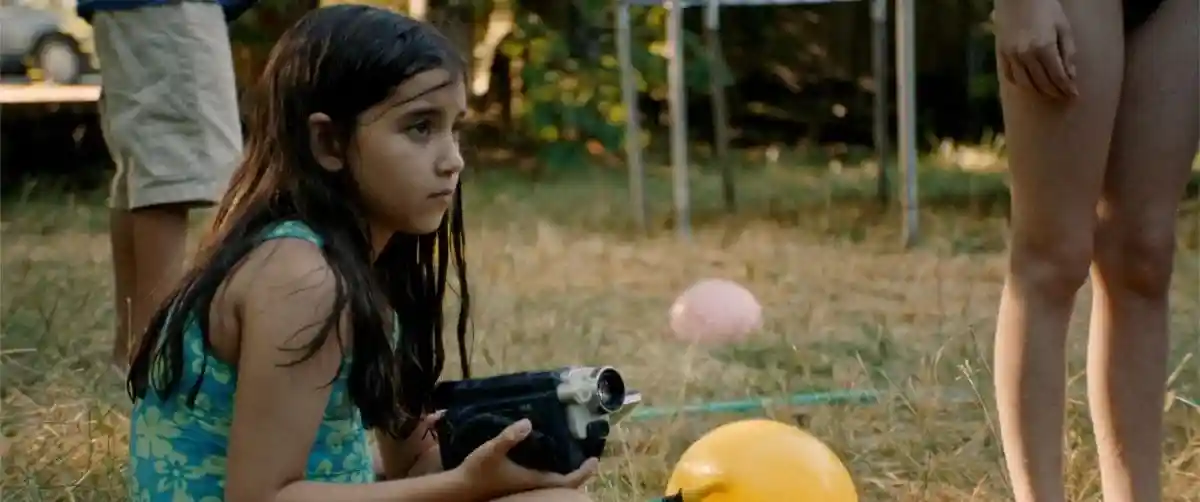
There’s a moment I can’t stop thinking about. The family is out, and Dad has a video camera, filming a day they’ll want to remember. Then something happens with Jeremy — there’s an incident, Dad has to go deal with it , and he hands the camera to Sasha without breaking stride. She keeps filming. Romvari holds on that. Doesn’t comment on it, doesn’t score it for feeling. Just lets you sit with what it means that the recording of this family’s life passed, in that moment, from parent to child.
That’s the whole film, really, in one image.
The parents, Iringó Réti and Ádám Tompa, unnamed throughout, because Sasha would have known them only as Mom and Dad, are handled with a care that I didn’t expect and found genuinely difficult to watch. They’re not failures. They’re not villains. They’re people in the 1990s with a child whose needs exceeded every resource available to them, and they did what people do: they loved him, they panicked, they failed him, they kept going. Romvari doesn’t let them off the hook so much as she insists on understanding them as actual human beings, which in some ways is harder than condemnation.
The film shoots itself as memory, camera outside rooms, outside windows, at the eavesdropping distance of a child who isn’t supposed to hear this. It doesn’t feel stylized. It feels accurate. That’s how you know things at eight or nine: partially, from the hallway, through a closed door.
Then, maybe two-thirds through, Blue Heron does something I didn’t see coming, and I’m not going to describe it except to say it involves an adult Sasha , played with real quietness by Amy Zimmer, and it collapses the wall between the film you’re watching and the act of making it. Romvari then goes one step further still, in a direction that should feel like a trick but doesn’t, because by that point you understand why she needed to do it. This is a film about how you eventually have to stop waiting for the story to resolve itself and build a container for it yourself. The container, in her case, is cinema.
What it arrives at isn’t really a revelation. It’s something smaller and more honest than that, a kind of reckoning with two parents who were overwhelmed and imperfect and doing the thing that overwhelmed, imperfect people do, which is their best and not enough simultaneously. Romvari forgives them. Or maybe forgive is too simple a word. Maybe she just finally sees them.
I walked out of this film and called my mother. I’m not telling you that to make the review about me. I’m telling you because that’s what good films do, they send you somewhere you weren’t expecting to go. Blue Heron sent me somewhere I’d been avoiding for years.
