Last Updated on April 17, 2026 by Monica Castillo
I need to tell you something embarrassing. I’ve seen maybe a dozen Egyptian films in my life. Maybe. And that number includes the ones I’m pretty sure I fell asleep during during a festival marathon a decade ago. So when I say that Tarik Saleh might be the most vital political filmmaker working anywhere right now, understand that I’m not speaking from some deep well of regional expertise. I’m speaking as someone who just watched a movie about a silk-pajama-wearing movie star named George whose biggest credit is “First Egyptian in Space,” and I haven’t stopped grinning at how Saleh pulls that off.
You want the complication up front? Fine. Saleh lives in Sweden because his mother is Swedish. He was born there. Fares Fares, his lead actor and creative north star, moved to Sweden to escape Lebanon’s civil war. So no, it’s not a simple case of artists fleeing Mubarak or Sisi or whoever’s turning the screws this year. But here’s what the clean version gets right anyway: these movies could not get made in Cairo. Not these movies. Not the ones where a corrupt police detective finds his conscience at exactly the wrong moment, or where a student gets swallowed by the machinery of a rigged election, or where a pampered fool runs afoul of a mustachioed observer who advises him, with that particular bureaucratic menace that makes your skin crawl, “I advise you to be very careful when you talk about the President.”
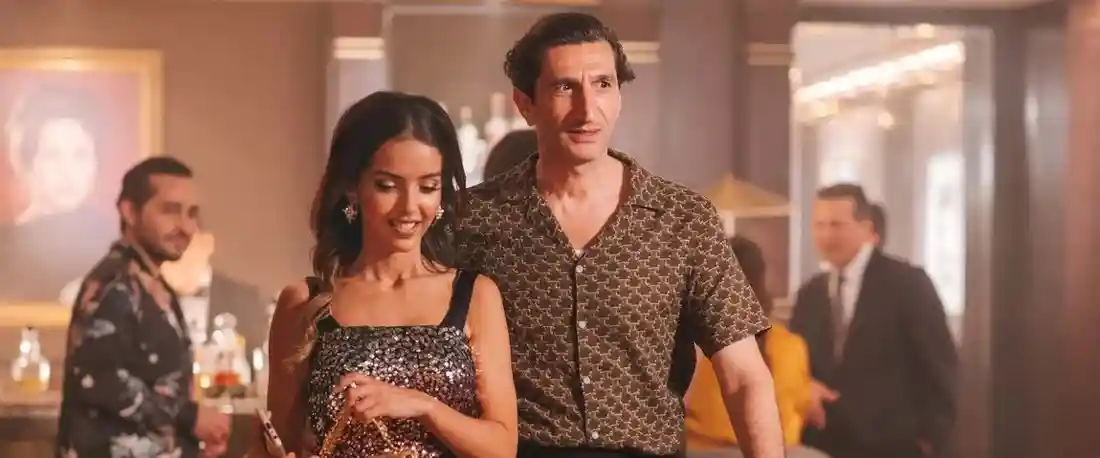
“Eagles of the Republic” and yes, that title drips with the kind of irony Saleh specializes in — opens not with George in crisis but with George in repose. Lounging. Silk pajamas, gorgeous mistress, the whole decadent westernized fantasy that certain factions in his country would like to scrape off the earth. He’s not a hero. He’s not even particularly likable. He’s a man who has arranged his life to require nothing of him except showing up and being famous, and watching him, I kept thinking about how rarely we see protagonists this passive in American movies. We’d force him to have an arc by minute twenty. Saleh just lets him be soft, lets him make a sarcastic remark about something sacred, lets the walls start closing in not because he’s brave but because he’s stupid.
The woman on the committee tells him he and his degenerate friends have plunged their country into the mud. That word ,degenerate, lands different when you’ve seen what happens to people accused of degeneracy in places where morality is enforced at the state level. George laughs it off at first. You can see the mistake calcifying in real time.
There’s a scene maybe two-thirds through where George is just trying to get through a shoot and Mahmoud is standing there, mustache perfectly still, not threatening anything specific but threatening everything. Saleh holds the shot longer than you expect. Long enough for the silence to get heavy. Long enough for you to remember that in some countries, a man with a mustache and a vague official capacity doesn’t need to say the threat out loud. The looking is the threat.
I won’t spoil how George gets from that trailer to the end credits. I’ll say this: the movie tips its hat to Milan Kundera’s “The Joke,” where one offhand line derails an entire life, but Saleh is after something more immediate, more pulpy. There’s an assassination attempt. A kidnapping. The stakes escalate in ways that feel almost ridiculous until you remember that Saleh isn’t inventing this escalation — he’s just translating it into the language of a thriller because the documentary version would be unwatchable.
Fares plays George with the resigned shrug of a man who has spent his whole life learning exactly how far he can push before the system pushes back, and who has just discovered that the system moved the line while he wasn’t paying attention. It’s a smaller performance than his work in the earlier Cairo films — less righteous fury, more weary calculation — and it works because George never wanted to be a symbol. He wanted to be left alone in his silk pajamas. The fact that he can’t have that anymore is, in Saleh’s telling, not a tragedy but a punchline. A dark one. The kind Voltaire would have appreciated.
The ending doesn’t resolve so much as exhale. Tentatively. George arrives somewhere that looks like safety but probably isn’t, and the movie just stops pushing. I sat there in the dark for a minute afterward, thinking about how that must feel — to build a career making movies about a country you can’t go home to, using actors who also can’t go home, telling stories that the people living through those stories will likely never see in a theater. Saleh doesn’t dwell on that irony. He doesn’t have to. It’s in every frame.
Eagles of the Republic 2025 Parents Guide
Violence & Intensity: This is where the movie earns its political-thriller bones, but it’s not an action picture. You won’t get John Wick body counts or choreographed blood ballets. What you get is worse in some ways: the specific, queasy violence of authoritarianism. There’s an attempted assassination, gunshots, a body hitting the ground, genuine panic in the framing. Later, a kidnapping involving a grown son, and the threat of what will happen to him hangs over everything like a smell you can’t locate. Saleh shoots these moments not for thrills but for dread. A character gets beaten off-screen; you hear the sounds and see the aftermath.
Language: Here’s a surprise: the movie is fairly clean by American R-rated standards. Some English profanity, a few “shits,” maybe one “fuck” if I’m remembering right. The Arabic dialogue carries different weight. Characters call each other “degenerate” and “dog” and use religious slurs that won’t register the same way for English-speaking audiences but cut deep in context. What matters more than the actual words is the tone of the language, the bureaucratic menace, the sarcasm that gets people in trouble, the way a polite suggestion about the President carries more threat than any shouted curse. No constant stream of profanity. But the verbal cruelty lands harder than most R-rated scripts.
Sexual Content / Nudity: Almost nothing to flag here. George has a mistress — you see them in bed together, both clothed, post-coital lounging. She wears lingerie at one point. He wears those silk pajamas like a shield. There’s kissing, some implied intimacy, but no nudity and no sex scenes. The movie is far more interested in political corruption than sexual transgression. A committee accuses George and his “degenerate friends” of moral looseness, but the movie itself shows you nothing that would raise an eyebrow in a prime-time network drama.
Drugs, Alcohol & Smoking: George drinks. Socially, at home, in moments of stress — wine, hard liquor. Nobody gets drunk as a plot point; it’s just part of the character’s coddled existence. Cigarettes appear. Some background characters smoke. No drugs, no addiction storylines, no glamorization. If you’re fine with James Bond having a martini, you’re fine with this.
Age Recommendation: The MPA hasn’t officially rated this one yet as I’m writing this, but based on the Cairo Trilogy’s track record and the film’s content, expect an R — not for gore or sex, but for the sustained tension and the thematic weight. This is a movie about what happens when a man’s careless joke puts his family in danger in a country where the state doesn’t need a warrant to ruin you. A mature thirteen-year-old who watches foreign films and understands politics might handle it, but they’ll have questions afterward. Good questions. Hard ones. For most families, fifteen and up feels right. Not because of anything explicit on screen. Because the movie assumes you already know that some countries eat their own citizens, and it doesn’t hold your hand through that realization.
Recommended: The Stranger (2026) Parents Guide
