Last Updated on April 27, 2026 by Monica Castillo
Apex is Rated R by Motion Picture Rating (MPA) for some strong violence, grisly images, nudity, and language.
There’s a moment in “Apex” maybe two minutes in, if that where the camera drifts back from what looks like a perfectly ordinary morning scene, two people waking up in a tent, and you realize with this slow, stomach-dropping recognition that the tent is bolted to the side of a vertical cliff face. Nothing underneath it. Just open air and whatever’s waiting at the bottom. Baltasar Kormákur doesn’t score it dramatically or hold on it for effect. He just lets you see it and moves on, as if this is simply what some people’s Tuesday mornings look like. I genuinely laughed not from humor, but from that involuntary reflex you get when something catches you completely off guard. That’s the first two minutes. The film had me before I’d even properly settled in.
Kormákur made “Everest,” which was technically impressive and emotionally distant in roughly equal measure. “Apex” feels like the same director working looser, working faster, trusting the landscape and his actors more than he trusts any screenplay machinery. And he’s right to. The Australian wilderness here isn’t a pretty backdrop, it functions more like a character with its own agenda, indifferent to everyone moving through it, beautiful and hostile in the same breath.
Charlize Theron plays Sasha, a woman who used to climb mountains with her partner Tommy (Eric Bana) and has since stepped back from all of it, the extremity, the risk, the life they built around testing themselves. She just wants a solo kayak run through a remote river route. Quiet. Private. A way back to herself without the noise. You understand that immediately, not because the film explains it but because Theron carries it in the way she moves through the early scenes careful, a little guarded, someone who’s had something taken from her and hasn’t fully decided what to do with the space it left behind.
Recommended: Blue Heron (2026) Parents Guide
Then Taron Egerton shows up, smiling, helpful, recommending a quieter camping route like he’s doing her a favor. And look, I’ll admit, the moment she follows that suggestion I felt the screenplay’s seams. A woman this smart, this seasoned, taking a trail tip from a stranger she met twenty minutes ago? You feel the plot needing her to make that choice more than you believe the character making it. It’s the film’s one real moment of dramatic convenience, and it’s clumsy enough that you notice it.
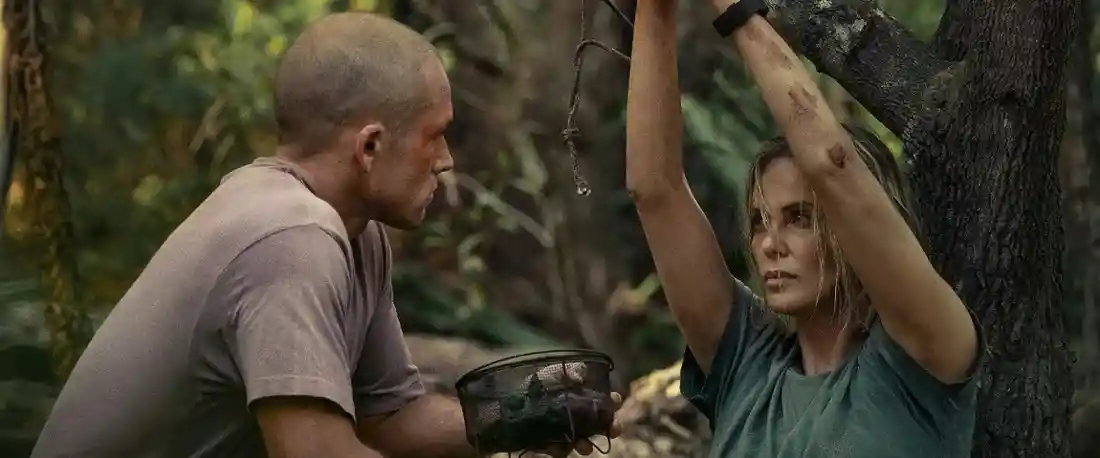
But then Egerton’s mask slips, and honestly, I stopped caring about the logic of how we got there. Because what he does with this character is quietly extraordinary. There’s no theatrical villain monologue, no slow reveal played for Gothic effect. Just a shift. His eyes go somewhere else, and suddenly you’re watching a completely different man than the one who was smiling at her in the parking lot. There’s a moment where he screams, not at her, just out into the trees, alone, and it’s the single most unsettling thing in the film. It doesn’t feel like acting. It feels like something he needed to get out.
What follows is essentially a two-person physical argument conducted across rivers, caves, and dense Australian bush, and Kormákur stages it with a clarity and spatial intelligence that a lot of action directors twice his budget couldn’t manage. You always know where everyone is. You always understand the geography. Every waterfall and narrow passage has a logic that the film honors, which matters more than it sounds, nothing breaks tension faster than action geography that stops making sense.
Theron does what she’s been doing for years now, which is making you forget you’re watching a movie star. Sasha’s survival instincts don’t play as heroic. They play as desperate and practical and exhausting, the way actual survival probably feels, not triumphant, just continuous. She gets hurt and stays hurt. She makes decisions under pressure that are good enough rather than perfect. There’s a particular sequence involving a waterfall that made me wince and then hold my breath and then exhale in a way I wasn’t entirely in control of. That’s not a stunt. That’s a performance inside a stunt, which is rarer than it should be.
Recommended: Mother Mary (2026) Parents Guide
If you come to “Apex” wanting the film to crack itself open and show you something profound about grief or trauma or the human condition, you’ll leave disappointed and it’ll be your own fault for asking the wrong questions. This is a film about a woman trying not to die in the woods, made by people who take that premise seriously enough to execute it with real craft and genuine location beauty. It doesn’t overstay. It doesn’t over-explain. It just moves, relentlessly and well, through one of the more gripping and undersung survival thrillers I’ve seen in a while.
Apex (2026) Parents Guide
Violence & Intensity: This is the main event, and Kormákur doesn’t soften it. The violence in “Apex” is physical, sustained, and deliberately uncomfortable, broken bones that stay broken, wounds that don’t conveniently disappear between scenes, and a pursuit through the Australian wilderness that grows increasingly brutal as it goes on. Theron’s character gets genuinely hurt, and the film makes you feel it rather than cutting away politely. The grisly images the rating flags are earned, there are moments involving injuries and aftermath that are graphic enough to linger. The opening sequence alone involves a tragedy on a cliff face that hits without warning. And the film’s antagonist brings a specific kind of menace that’s more psychological than gory, which in some ways makes it harder to shake. Younger or more sensitive viewers will find this stressful in the way the film fully intends, and that intention doesn’t let up.
Language: Strong language surfaces in moments of fear, pain, and confrontation, the kind that comes out when people are genuinely terrified rather than the kind dropped casually every other sentence. Nothing here feels gratuitous or piled on for effect. That said, parents who run a strict household on this front should know it’s present and occasional throughout.
Sexual Content & Nudity: There is a brief scene of nudity that isn’t sexual in context, it reads more as a moment of isolation and vulnerability than anything titillating. It’s not prolonged, and it’s not graphic. There’s no sexual violence and no romantic content of any significance. This is genuinely the least of the concerns in this film.
Drugs, Alcohol & Smoking: There may be a drink in an early scene, the kind of background detail you don’t really clock, but substance use plays no part in the story and isn’t something you’ll be fielding questions about afterward.
Age Recommendation: Fifteen and up feels right, and even then it depends heavily on the individual kid. The violence is sustained and realistic enough that it’s not a film to brush off as just another action movie. Mature teens who handle tension well and understand the difference between screen violence and real life will likely find it gripping rather than damaging. For everyone younger than that, this one can wait.
