Last Updated on April 20, 2026 by Monica Castillo
I went in expecting something loud and dumb and fun. I got two of those three things, and the one I didn’t get kept me up a little.
Over Your Dead Body is, on its surface, exactly what the trailer sells: a darkly comic bloodbath about a married couple who travel to a remote cabin planning to murder each other for the insurance money, only to have their little arrangement complicated by a trio of escaped criminals who are considerably worse at being human beings than either of them. That’s the pitch. That’s what you’re buying. And Jorma Taccone, yes, one of the guys from Lonely Island, yes, really delivers on it with a kind of full-body commitment that’s almost disarming.
But here’s the thing I didn’t expect to be sitting with afterward: the marriage at the center of this film is genuinely sad.
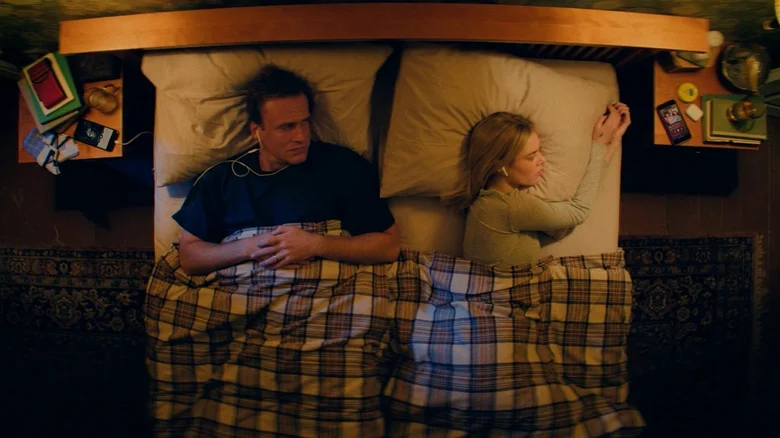
Not in a way the movie asks you to notice. Not in a way that interrupts the carnage for a Meaningful Moment. It just sits there, underneath everything in the way Jason Segel’s Dan talks over his wife mid-sentence without realizing he’s doing it, in the way Samara Weaving’s Lisa has clearly stopped bothering to correct him. These are two people who’ve been disappointing each other for so long it’s become the primary language between them. You don’t get that from a script note. Segel and Weaving are doing that themselves, in the margins of scenes that are ostensibly about knives and property damage.
Recommended: Blue Heron (2026) Parents Guide
Segel in particular surprised me. He’s built a career, a good one on being the most likable man in any room. Here, Taccone strips that away slowly enough that you don’t notice until it’s gone. Dan isn’t a villain. He’s worse: he’s a man who has mistaken pettiness for suffering, who genuinely believes the story he tells about himself. Those same soft eyes that made him endearing for years now read as a kind of passive manipulation. I wasn’t expecting to find that uncomfortable. I did.
Weaving, meanwhile, continues to make choices that baffle and delight me. She could coast in this genre she’s good enough at it that no one would notice. She doesn’t coast. There’s a scene midway through where Lisa has to recalibrate her entire plan in real time while maintaining a completely neutral expression for the benefit of someone who can’t know she’s recalibrating, and Weaving plays it with this barely-there flicker behind the eyes that I caught and immediately rewound in my head. That’s the kind of thing that gets lost in a film with this much noise. It shouldn’t.
The criminals Timothy Olyphant, Juliette Lewis, Keith Jardine arrive like weather. Olyphant has figured out, somewhere in the last decade, that the funniest version of himself is also the most terrifying, and he leans into that here without apology. Lewis is doing something I can only describe as feral joy. The two of them together have an energy that suggests they’ve been making each other worse for years, which the film uses well.
There’s one scene I won’t fully describe that had half the audience at my screening laughing and the other half in a different kind of silence. It involves assault and a pointed, almost parenthetical reference to how the prison system functions. Taccone doesn’t explain it. Doesn’t underline it. Just puts it in front of you and watches what you do with it. I didn’t laugh. Someone two rows back did. I thought about that on the drive home.
The gore is excessive and spectacular and I mean both of those words as compliments. This film earns its R rating in the first act and then keeps spending well past its means. It’s the kind of violence that only works when everyone onscreen seems to be having exactly as much fun as you are, and they are, and you do. A face gets blown off. A man becomes a cutting board. The lakehouse looks gorgeous throughout, which makes all of it somehow funnier.
Recommended: Mother Mary (2026) Parents Guide
What Taccone seems to understand and what makes this more than a solid night out is that we’re currently living inside a satire that has already eaten its own punchline. The cruelty is real. The idiots running it are cartoons. The only honest response might be a film that holds both of those things at once without resolving the tension.
The epilogue does something quietly generous that I don’t want to give away. It earns its sentiment, which is rare in a film that has spent ninety minutes telling you sentiment is a liability.
Dan and Lisa are terrible. They’re wrong for each other in ways that probably predate the marriage. And they find, in the middle of genuine chaos, something that maybe resembles what they originally signed up for.
Over Your Dead Body (2026) Parents Guide
Rated R for strong bloody violence, gore, sexual assault, pervasive language, and sexual content.
Violence & Intensity: I’ll be straight with you: this one’s nasty. Not in a winking, horror-lite way in a faces-getting-blown-off, a-man-being-used-as-a-human-knife-block way. The violence comes early, keeps coming, and escalates past the point most mainstream films would pump the brakes. There’s a dark humor running through a lot of it, which almost makes it worse, because you find yourself laughing at something your body hasn’t finished reacting to yet. Then there’s one stretch, a sustained scene involving physical assault, where the comedy disappears completely. No buffer, no relief valve. It just sits there. That scene alone is reason enough to keep younger viewers away.
Language: Wall to wall. The f-word isn’t dropped occasionally for emphasis, it’s part of the furniture. Characters speak to each other with a baseline contempt that makes even the lighter exchanges feel loaded. There’s no version of this film where the language is a minor concern.
Sexual Content & Nudity: The assault scene I mentioned above has a sexual component, and it’s handled with enough raw discomfort that it won’t feel like the rest of the movie. Beyond that, there’s additional sexual content that’s more straightforward, still explicit enough to factor in, but not in the same category as that sequence. That scene is the one to know about going in.
Drugs, Alcohol & Smoking: Characters drink. It’s not the point of anything, and the film doesn’t romanticize it, but it’s consistent background noise throughout. Nothing that registers as a major concern on its own.
Age Recommendation: Seventeen and up, and even then, it depends on the kid. The R rating here isn’t technical this film went looking for it. Parents who’ve let teenagers sit through edgier horror should know this plays differently. The gore is one thing. The assault sequence and what the film asks you to do with it is another. Worth knowing before you decide.
Over Your Dead Body opens April 24.
