Last Updated on May 5, 2026 by Monica Castillo
Gregg Araki has always made films for people who find most cinema a little too polite. Mysterious Skin. The Doom Generation. Kaboom. A body of work that operates at a frequency slightly outside what mainstream American movies are willing to broadcast queer, confrontational, sexually frank in the way that European cinema takes for granted and American cinema still treats like a live wire. He’s been quiet for a while. I Want Your Sex announces his return in the manner you’d expect: loudly, deliberately, and with minimal interest in your comfort.
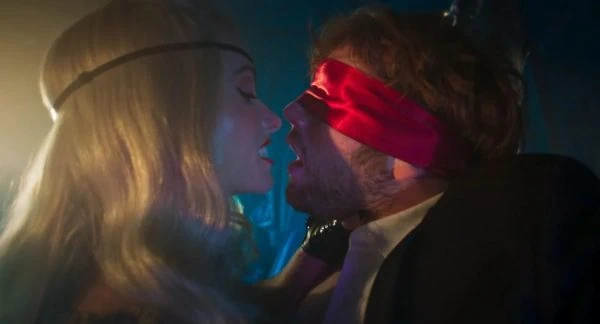
The Story follows Elliot, played by Cooper Hoffman, takes a job at a sexuality-based art gallery run by Erika Tracy, played by Olivia Wilde. Erika is twelve years older, sociopathic in her appetites, and has apparently decided on day one that Elliot is her next project. What follows is a flashback-driven account of their arrangement she dominant, he increasingly not periodically interrupted by a present-day police interrogation conducted by Johnny Knoxville, a casting choice so deranged it becomes its own kind of joke. There’s a mystery at the center, the film takes its time getting there, and by the time it does you’ve been through enough fakeout endings to wonder if resolution was ever really the point.
It probably wasn’t.
Araki uses the interrogation structure the way a clever writer uses a narrator who knows more than they’re telling as a pressure valve. Elliot can acknowledge, directly to Knoxville’s cop, that yes, much of what happened was deplorable, that Erika held institutional power over him, that any reasonable person looking in from outside would call it what it was. He says this and then goes back to the flashbacks. Because he also wanted it. Because consent, in Araki’s films, has never been simple, and the film isn’t interested in pretending it is. Whether this reads as honest or as cover-your-ass screenwriting probably depends on what you bring into the cinema with you.
Recommended: The Lord of the Rings: The Rings of Power Season 2 Parents Guide
Wilde is the revelation here, and I don’t use that word often. Erika is monstrous in ways that are also somehow magnetic another character calls her “the pretentious whore from hell” and the film doesn’t disagree, but it also can’t look away from her, and neither can you. Wilde plays her without apology and without winking distance, which is the only way this character works. Any irony in the performance and the whole construction collapses. There’s no irony. At the Chicago Critics Film Festival this year, Wilde also appeared in The Invite, a single-setting marital comedy where she plays the repressed, starved opposite of everything Erika represents. Watching both films in proximity would be, I imagine, a specific kind of whiplash that tells you more about her range than any awards season role could.
Cooper Hoffman, meanwhile, keeps doing what Cooper Hoffman does: taking roles that require him to be genuinely vulnerable in ways that most young actors avoid, and being extraordinary at it. There’s no shaking the sense that he’s building something, film by film, with no apparent interest in taking the easier route. His father would recognize the instinct.
Charli xcx plays Elliot’s girlfriend Minerva bookish, sexually withholding, constitutionally unsuited to Elliot in ways that become clearer as the film progresses. It’s a performance that goes entirely against her public persona, which is presumably the point, and she handles it with a dry comic precision that the film needs in those scenes to keep them from curdling.
Where I Want Your Sex doesn’t quite land is in its middle sections, where the provocation starts to feel like a mode rather than a method. The film is funniest and sharpest when it’s specific a European character arrives with different values about intimacy; Erika insults those values the moment she leaves; the film notices this about Erika without excusing it. Those moments have actual texture. The more cartoonish touches, the moments where Araki seems to be going for shock because he’s Gregg Araki and that’s what’s expected, land softer than they should.
But the film doesn’t wear out its welcome, which for this kind of material is genuinely difficult. Araki and his leads commit to the register they’ve chosen unapologetically, defiantly and that commitment carries you through the stretches where the writing is thinner. The kinky energy, to use the film’s own frequency, never goes flaccid. That’s both a joke and an honest critical observation, which is probably exactly where Araki wants to leave you.
I Want Your Sex (2026) Parents Guide
Not officially rated by MPA but Estimated rating equivalent: NC-17 / Hard R — adults only
Violence & intensity: Mild: No significant physical violence. Psychological intensity throughout — the film’s central dynamic involves a power imbalance, manipulation, and coercive grooming framed within a consensual BDSM context. A police interrogation framing device implies a serious incident has occurred. Emotional and psychological harm to the lead character is depicted.
Language: Strong: Pervasive strong language and sexually explicit dialogue throughout. In keeping with Gregg Araki’s filmography, language is deliberately provocative and unfiltered. Adult content is discussed frankly and crudely as a feature of the film’s tone, not incidentally.
Sexual content / nudity: Explicit Sexual content is the film’s primary subject matter. Explicit depictions and/or strong references to BDSM practices, dominance and submission dynamics, pegging, threesomes, and sex addiction are central to the narrative. Nudity is expected throughout in keeping with the film’s provenance and intent. This is not incidental adult content, the film is, by design, a sexually explicit work. Strictly for adult audiences only.
Drugs, alcohol & smoking: Moderate: Alcohol and likely drug use consistent with the film’s hedonistic milieu and Araki’s body of work. Substance use is likely depicted as part of the lifestyle portrayed rather than as a cautionary element. Not a focus of the narrative but present in the film’s world.
Themes & context Adults only: Power imbalance, workplace grooming, sex addiction, narcissistic manipulation, and the grey areas of consent within BDSM dynamics are the film’s central themes. The film is deliberately provocative, Gregg Araki’s stated intent is to challenge cultural attitudes toward sexuality. It does not moralize. Parents should be aware this is adult cinema in the fullest sense, not appropriate for any viewer under 18 under any circumstances.
Age recommendation: 18 and older — strictly Explicit sexual content, adult themes, and provocative material make this film appropriate only for adult audiences. No exceptions.
Recommended: The Umbrella Academy Season 4 Parents Guide
