Last Updated on May 5, 2026 by Monica Castillo
I’ll be honest about the fear I carried into this. Season one of The Chestnut Man is one of those rare foreign crime series Danish, released on Netflix in 2021 that actually earns the word perfect. Not “near-perfect.” Not “among the best.” Just: this worked, completely, in a way that most crime television doesn’t. The chestnut figures left at each murder scene. The way the killer’s logic, when it finally revealed itself, felt inevitable in hindsight without ever being obvious. Mikkel Boe Følsgaard and Danica Curcic as Hess and Thulin, two investigators who started as barely tolerating each other and ended somewhere considerably more complicated. I finished it in two nights and then sat with it for about a week.
So yes. The fear going into season two was real.
Hide and Seek earns its existence. That’s the first thing I want to say. It doesn’t just coast on what came before it actually does something with the nearly five years that passed between seasons, using the real-world gap as story material. Hess and Thulin haven’t seen each other. Things happened between them that we weren’t there for, and the show understands that this is interesting rather than inconvenient. You spend the early episodes putting together what changed, which is a more engaging form of exposition than most shows manage.
Recommended: Half Man (2026) Parents Guide
The new case involves a killer who gets inside victims’ heads before anything physical happens, nursery rhymes sent as warnings, the sense of being watched, the creeping realization that someone has access to everything you thought was private. It’s a smart pivot for the show. Season one’s horror was visceral and symbolic, all those little figures made of chestnuts and straw. This season’s horror is the kind that lives in a phone screen at 2am. The killer weaponizes digital footprints, the data trails we leave everywhere without thinking about it, and there’s something genuinely unsettling about how easily the show makes this feel personal. You find yourself thinking about your own accounts, your location history, the photographs you never deleted.
Curcic is the anchor. She was in season one too, obviously, but here she’s doing something harder, playing a woman who’s been changed by time and by what happened with Hess and hasn’t entirely processed either, while also running a murder investigation. Thulin isn’t softer in season two. If anything she’s more armored. Curcic does this without making a performance of it, which is the whole trick. Følsgaard, for his part, plays Hess as a man who’s also been changed and is slightly less good at hiding it.
The subplot I didn’t expect to hit me: Hess and Le, Thulin’s daughter, who was a child in season one and is now a teenager. Their dynamic has a specific texture, she’s sharp enough to see through him, he’s fond enough to let her, and a couple of their scenes carry more weight than scenes twice as long elsewhere in the season.
There’s an event in the middle of the season, I won’t say what it is that redraws the map entirely. The show makes a choice that feels genuinely risky, the kind of move that will split viewers cleanly in half. I sat with mine for a moment and then decided it was the right call. It changes what the remaining episodes are about in a way that makes them feel urgent rather than just procedural. After that, the show moves differently. Faster. With more at stake.
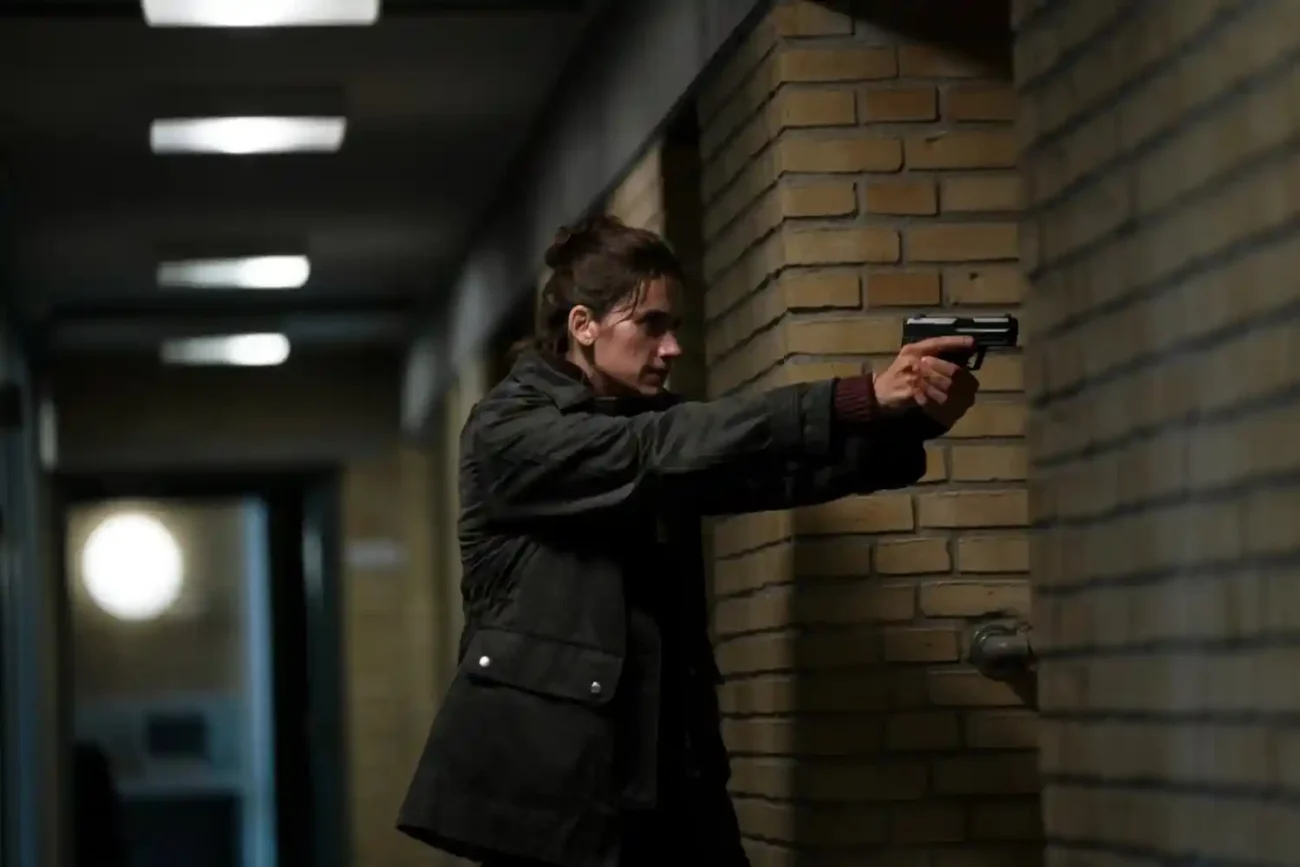
The season is more physically violent than the first. More gun fights, more bodies in motion, more sequences that belong to action television rather than crime drama. This could have felt like a budget increase flexing itself. Mostly it doesn’t, the show’s earned the register by the time it goes there, and the violence is purposeful rather than decorative. The finale sticks its landing. The killer’s reveal makes the particular kind of sense that requires you to think back over what you already watched and realize the evidence was always there.
Søren Sveistrup wrote the source novel, the second book in the series, published in Danish in 2024 with the English translation arriving just recently, and having the material there clearly gave the production something solid to build on. You can feel the difference between an adaptation with a spine and one that’s improvising its mythology.
I went in afraid this would be a disappointment. It isn’t. Whether that’s more of a relief than a pleasure, I’m still figuring out. Both, probably. In the end, both.
The Chestnut Man: Hide and Seek (Season 2) Parental guidance
The Chestnut Man: Hide and Seek is rated TV-MA Danish crime thriller for strong violence, disturbing content, and mature themes.
Violence & intensity: Strong: More physically violent than season one, with gun fights, hand-to-hand confrontations, and life-threatening sequences. Murder scenes are depicted with crime thriller frankness. The killer’s method of psychological stalking, threatening messages, surveillance, nursery rhymes sent as warnings, creates sustained dread throughout. One mid-season event is described as particularly shocking. Not suitable for sensitive viewers or those under 16.
Language: Moderate: Strong language in the original Danish (subtitled or dubbed in English). In keeping with the tone of adult crime drama. No slurs. Language is naturalistic rather than gratuitous.
Sexual content / nudity: Mild–Moderate: Adult romantic tension between principal characters. In keeping with Scandinavian crime drama conventions, some sexual content is likely though not graphically explicit. The emotional complexity of the Hess/Thulin dynamic is central to the season.
Drugs, alcohol & smoking: Mild: Alcohol use consistent with adult European crime drama. No significant drug use reported. Smoking may appear incidentally. Substance use is not a plot element.
Themes & context: Heavy — adult themes: Psychological stalking, surveillance, digital privacy violation, and premeditated murder are central themes. The killer’s use of nursery rhymes as tools of terror gives the season a particular creepiness suited to adult audiences. A teenager (Le) is a supporting character navigating complex adult circumstances. One significant mid-season plot development is described as emotionally intense and potentially distressing. Recommended for mature audiences only.
Age recommendation: 16 and older Strong violence, psychological dread, and a mid-season plot shock make this unsuitable for younger teens. Strictly adult viewing.
Recommended: Hacks Season 5 Parents Guide
