Last Updated on April 23, 2026 by Monica Castillo
Half Man Will Ruin Your Week. Watch It Anyway.
Film & TV CriticApril 23, 2026HBO Max · Premieres Today
Let me be upfront about something: I went into Half Man expecting to admire it from a safe distance. Richard Gadd made Baby Reindeer, which I thought was extraordinary, and I figured this would land somewhere in that same territory, disturbing, yes, but contained. Something you could watch with the lights on and still sleep afterward. I was wrong. I finished the final episode at midnight, sat in the dark for a while, and then went and texted three people who hadn’t seen it yet to warn them.
That is, for the record, very high praise.
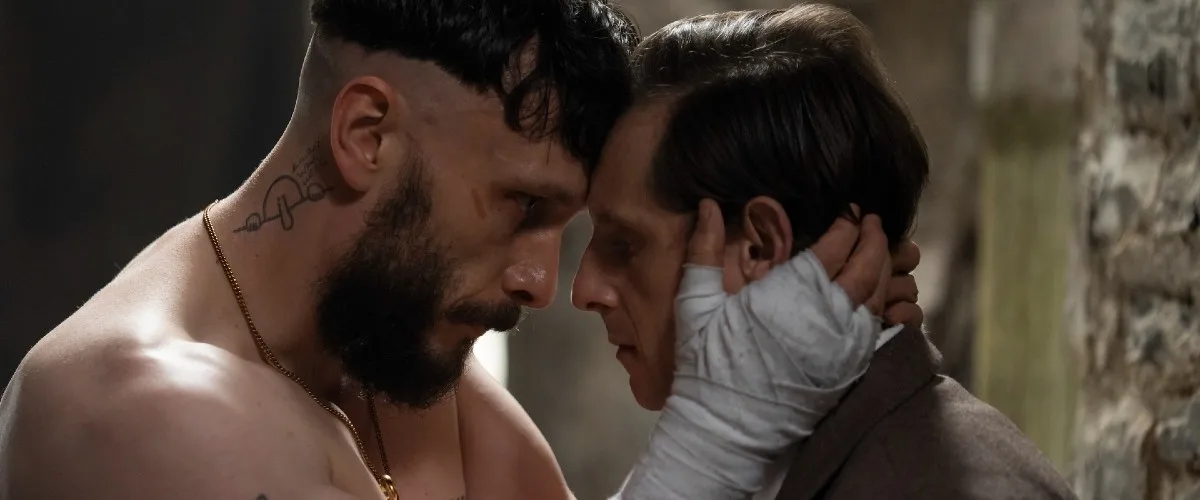
Half Man follows teenage stepbrothers Niall and Ruben brought together when their mothers fall in love in a small town that immediately has opinions about that. Niall (Mitchell Robertson as a teen, Jamie Bell as an adult) is the kind of quiet, ground-down kid who has already learned to make himself invisible. His mother Maura and I will get to Maura has seen to that. Ruben (Stuart Campbell young, Gadd himself as an adult) shows up fresh out of juvenile detention, having bitten off another boy’s nose. He is not subtle. He has never needed to be.
If you’re thinking this sounds like a lot to sit with you’re right. Gadd doesn’t ease you in. He just opens the door and walks you straight into the damage.
“There’s a scene maybe thirty minutes in that I haven’t stopped thinking about. It shouldn’t work. It’s too much, too blurred, too uncomfortable to categorize. It works completely.”
The scene I’m talking about involves Ruben pulling Niall into a sexual encounter that is — and Gadd is precise about this in a way most writers wouldn’t dare, genuinely impossible to read cleanly. There’s desire. There’s coercion. There’s something that looks, briefly, like tenderness, and then isn’t. From that night forward, Niall is untethered from himself entirely. He will spend the rest of his life orbiting Ruben, giving up pieces of his own humanity for the occasional scrap of warmth from the one person who ever made him feel seen. It’s one of the most accurate portrayals of trauma bonding I’ve seen on television. It’s also deeply upsetting in the best possible way, the kind of upsetting that means the writing is doing its job.
Gadd’s thesis, as far as I can work one out, is this: what happens to a frightened child who never gets rescued? Not a rhetorical question. A serious one. Because Ruben was that child first, damaged long before Niall ever met him, wired by neglect and violence to detect weakness in others and use it as a weapon. And Niall, who desperately needed someone to notice him, latched onto Ruben the way a drowning person grabs a piece of wreckage. Even if the wreckage is sharp. Even if it cuts.
The show maps the fallout across years. Every terrible decision either of them makes traces directly back to a childhood where the adults in the room were too consumed by their own chaos to protect anyone. Gadd layers it all, misogyny, internalized homophobia, class, untreated mental illness, every flavor of abuse, not as a checklist of Serious Themes, but as a kind of grim family tree. Pull on one branch and three others shake.
“Comparing it to The Wire feels almost quaint. Gadd makes The Wire look like Bluey.”
Jamie Bell is doing the best work of his career. I don’t say that lightly. As adult Niall, he finds a particular quality of brokenness, not dramatic, not showy, just a kind of glass-eyed sorrow behind everything, that makes you feel every one of Niall’s compromises in your chest. You understand him. You’re frustrated by him. You love him a little. That’s an extraordinarily hard thing to pull off, and Bell does it without a single false note.
Recommended: Hacks Season 5 Parents Guide
Gadd himself, as Ruben, does something almost harder. He finds this slower, heavier physicality as the character ages, a lower register, short grunts replacing full sentences — that makes Ruben feel genuinely unknowable from moment to moment. You can never tell if his silence is warmth or a warning. That ambiguity is the whole performance, and it never slips.
And then there is Marianna McIvor as Maura, Niall’s mother. I audibly screamed at my computer during her third scene. That is not a sentence I have written about a TV performance in years. Every time she appears, she has a fresh betrayal ready, delivered so matter-of-factly it takes a second to register how monstrous it is. She makes you wonder how many real Mauras are out there right now, casually destroying the people who needed those most.
Is it flawless? No. There are a few spots where the pacing dips, a handful of female characters who feel thinner than the men around them, and some monologues that belong more on a stage than a screen. But none of that lands hard enough to matter. The density of the writing carries everything.
The verdict
Half Man is for anyone who ever watched a story about broken men and wanted to understand the breaking, not the big dramatic moment, but the years of quiet accumulation that got there first. It is the best new show of the year so far, and it isn’t close. Everyone else writing for television right now is a writer. Richard Gadd is a bloody artist.
Half Man — What Parents Need to Know Before Pressing Play.
Rated TV-MA · Motion Picture Association · Not suitable for viewers under 17
Violence & Intensity: Half Man is not gratuitously gory, but it is relentlessly brutal in the way that matters more, psychologically. Physical violence is present and it is not softened. A character arrives in the story having bitten off another boy’s nose; that sets the tone early. There are scenes of assault, both physical and sexual, that are shot with a cold, deliberate clarity. No shaky cam, no cutaways designed to protect you. Gadd wants you to sit in the discomfort, and he makes sure you do. There are also scenes of domestic abuse, emotional cruelty, and sustained coercive control that are, honestly, harder to watch than anything with fists in it. The intensity doesn’t spike and release, it accumulates. By the final episode, the weight of it is considerable.
Language: The language is exactly what you’d expect from a raw, unflinching drama set in a working-class small town where people say what they mean and mean it badly. There is strong and frequent profanity throughout. More significantly, there are homophobic slurs — used by characters in the town, by Niall’s mother, and occasionally between the boys themselves in ways that sting precisely because you understand the self-hatred behind them. The slurs aren’t there for shock. They’re there because the show is telling the truth about internalized homophobia, and that truth has a particular vocabulary. It doesn’t make it easier to hear.
Sexual Content & Nudity: This is where the show demands the most from its audience, and parents should know that going in. There is explicit sexual content involving adult characters, including nudity. More challenging is the central scene involving the teenage versions of Niall and Ruben, it is not graphically depicted, but its implications are unmistakable and deliberately unresolved. The show frames it as traumatic, confusing, and coercive, which is the point, but that doesn’t make it comfortable viewing. The intimacy coordination throughout is thoughtful and intentional, consensual scenes feel genuinely safe, and scenes of assault feel deliberately, appropriately wrong. But the subject matter itself is heavy, and some of it involves minors in deeply uncomfortable situations.
Drugs, Alcohol & Smoking: Alcohol is a constant presence, particularly around Ruben’s father, who is an absent and abusive alcoholic. Drinking is depicted as both a coping mechanism and a catalyst for violence not glamorized, not fun. There is some drug use among secondary characters. Smoking appears casually throughout. None of it is presented as aspirational. If anything, the show is quietly damning about what substance abuse does to the people left behind by addicts, especially children.
Age Recommendation: Officially rated TV-MA, and for good reason. This is not borderline, it is a hard no for anyone under 17, and even then, it depends entirely on the teenager.
