Last Updated on March 25, 2026 by Monica Castillo
There’s something faintly mischievous in the way “You’re Dating a Narcissist” positions itself, as if it wants to poke holes in the romantic comedy while quietly slipping into its rhythms anyway. The film, written by Iliza Shlesinger and directed by Ann Marie Allison, circles the idea of love as both a promise and a trap, though it never quite commits to either perspective. What you end up with feels curiously familiar: glossy, escapist, almost vacation-like in its visual pleasures, with a streak of wish fulfillment that wouldn’t feel out of place on the Hallmark Channel.
And then there’s Marisa Tomei, who arrives carrying the kind of lived-in vitality she’s brought to everything from My Cousin Vinny to The Wrestler. She plays Judy, a mother determined, almost desperately so to keep her daughter from rushing headlong into love. Tomei gives the role a nervous electricity, as if Judy’s instincts are always firing a half-second too fast. You can feel the movie leaning on her, hoping that energy will animate the whole enterprise. It doesn’t, not quite. There are flashes of life, certainly, but they flicker against a story that often feels heavier than it should.
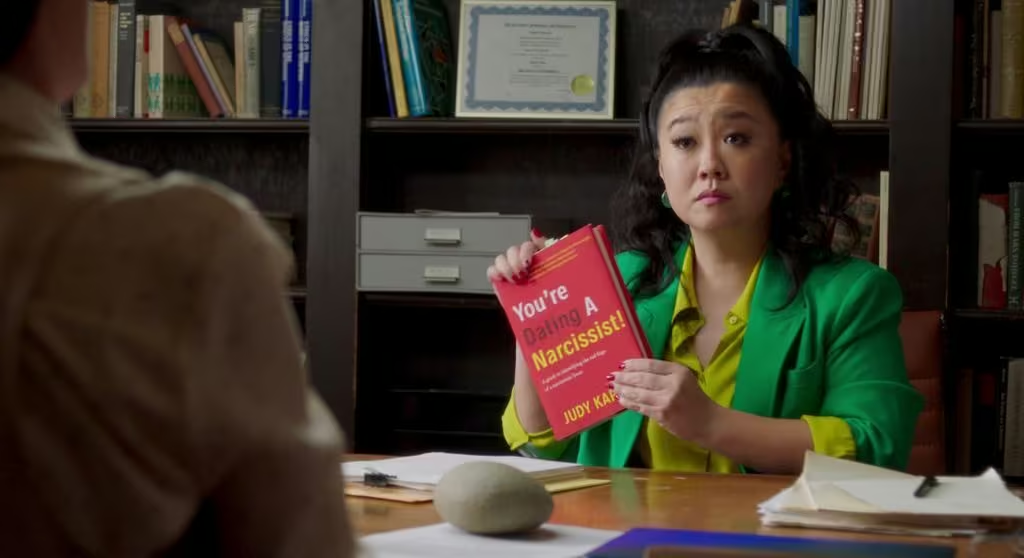
Judy is introduced as a woman who has built a career out of skepticism. She’s a successful author, her book also titled “You’re Dating a Narcissist” serving as a kind of manual for identifying manipulative partners. In the classroom, where she teaches, she’s confident, even commanding, guiding students through the warning signs of emotional danger. Her colleague Diane (played with a grounded warmth by Sherry Cola) becomes both confidante and counterpoint, especially as Diane navigates her own complicated relationship with a married woman. The film hints at deeper emotional terrain here you might expect Diane’s storyline to echo or challenge Judy’s worldview but it rarely digs as far as it could.
Recommended: The Faithful: Women of the Bible Parents Guide
The real disruption comes when Judy learns that her daughter Eva (Ciara Bravo) is engaged to Theo (Marco Pigossi), a doctor she’s known for all of six weeks. It’s the kind of whirlwind romance that, in another film, might be celebrated as fate. Here, it lands like a warning siren. Judy, who has trained herself to see patterns of toxicity everywhere, can’t help but assume the worst.
So she heads to Los Angeles, bringing Diane along, and steps into a world that feels almost too pristine to trust sunlit spaces, a luxurious resort owned by Daniel (José María Yazpik), and Theo’s seemingly perfect family. It’s in this environment that Judy’s suspicions begin to metastasize. Every gesture Theo makes, every detail she doesn’t fully understand, becomes evidence. You can sense the film trying to balance on a knife’s edge here: is Judy a protective mother, or is she unraveling? It’s an intriguing question, and for a while, you lean in, hoping the story will push further into that ambiguity.
Structurally, the film frames all of this through Judy’s own retrospective narration. It opens with her in a state of near panic, recording an apology video for Eva in a hotel room, her thoughts spilling out in fragmented bursts. These video interludes recur throughout, giving the story a confessional tone. It’s a device that should deepen our understanding of Judy her regrets, her blind spots but it mostly reinforces what we already see: a woman caught between conviction and doubt, struggling to recognize when her expertise has turned into obsession.
Once Theo fully enters the picture, the tension is supposed to tighten. Instead, it loosens. The film drifts into lighter, more sitcom-like territory, especially as Judy and Diane begin trailing Theo around Los Angeles, investigating his past and scrutinizing his interactions particularly with an ex-fiancée. There’s a comic impulse here, built around Judy’s increasingly frantic attempts to “diagnose” everyone she encounters as a narcissist. Tomei commits to it, giving Judy a kind of spiraling intensity that’s both amusing and a little unsettling. But the movie doesn’t fully trust that edge. It softens the consequences, opting for mild antics when sharper emotional stakes are within reach.
Recommended: 25 Best Kids Movies on Netflix in 2026
To its credit, the film isn’t as sanitized as its aesthetic might suggest. The dialogue occasionally veers into more adult territory there’s a blunt joke or two that disrupts the otherwise cozy tone—and the script juggles a surprising number of characters and subplots. But that abundance becomes part of the problem. New faces and complications keep entering the frame, as if the film is worried that stillness might expose its thinness. Instead, the narrative grows crowded, its emotional throughline harder to track.
You might notice, too, how often the film slips into the rhythms of a television sitcom. Scenes resolve too neatly, conflicts dissipate too quickly, and moments that should linger particularly those involving trust between parent and child are brushed aside. There’s a more probing, even uncomfortable film hiding underneath this one, a version that would ask harder questions about control, fear, and the limits of parental love. This film gestures toward those ideas but rarely stays with them long enough to let them resonate.
And yet, toward the end, it does make a slightly unexpected turn. It’s not a radical reinvention, but it’s enough to suggest the filmmakers were aiming for something a bit more reflective than the standard romantic formula. You can appreciate the attempt, even if it arrives too late to fully reshape what came before.
In the end, “You’re Dating a Narcissist” feels like it wants to be both a critique and an embrace of romantic fantasy. That tension could have been its strength. Instead, it leaves the film caught in between comfortable in its surfaces, but a little uneasy underneath, like a sweater that looks soft until you actually wear it.
You’re Dating a Narcissist! Parents Guide
You’re Dating a Narcissist! is not officially rated by the Motion Picture Association, though its tone and content place it somewhere between a breezy romantic comedy and something a bit more adult-leaning. It wears a polished, inviting surface, but there are moments where the material edges into territory younger viewers may not fully process—or that parents might at least want to be aware of.
Violence & Intensity: There’s no physical violence to speak of, but the film operates on a different kind of tension, emotional, psychological, and at times uncomfortably persistent. Judy’s fixation on uncovering supposed manipulation creates a steady undercurrent of anxiety. You can feel the pressure build in conversations, in confrontations that never quite explode but linger in that uneasy space between concern and control. For sensitive viewers, especially younger ones, the intensity comes not from action but from the strain of relationships under scrutiny.
Language: The dialogue mostly stays within the bounds of a mainstream comedy, but it isn’t entirely sanitized. There’s occasional profanity, used casually rather than aggressively, and the tone can turn sharp when emotions run high. The film doesn’t rely on harsh or offensive slurs, but its conversational realism means it doesn’t shy away from blunt phrasing either. It’s the kind of language you might expect in adult-oriented streaming fare noticeable, but not overwhelming.
Sexual Content / Nudity: This is where the film nudges past its cozy exterior. There are no explicit scenes or nudity, but the script includes mature sexual references, including a fairly direct joke about anal sex that may catch some viewers off guard given the otherwise light presentation. Romantic relationships are central to the story, and while physical intimacy is implied rather than shown, the dialogue occasionally leans into adult territory in a way that feels more candid than coy.
Drugs, Alcohol & Smoking: Substance use is present but not emphasized. Characters are occasionally seen drinking in social settings nothing excessive, nothing that drives the plot. There’s no notable depiction of drug use, and smoking, if present at all, remains background texture rather than a defining trait. It’s the kind of casual inclusion that reflects adult life without making a statement about it.
Age Recommendations: Despite its glossy, almost comforting presentation, You’re Dating a Narcissist! is better suited for older teens and adults, roughly 14+ at minimum, and more comfortably 16+ depending on sensitivity to mature dialogue.
