Last Updated on March 2, 2026 by Monica Castillo
The first thing I noticed about Young Sherlock wasn’t the mystery, or the accents, or even the familiar silhouette of a coat that someday becomes iconic. It was a young man in a prison cell, so lost in Oliver Twist that he decides on a whim, or maybe on a dare to himself to see if he can live inside the book. He steals. He returns what he stole. He’s shocked to discover that the law, like life, doesn’t care much about clever justifications.
That moment tells you almost everything this show wants to be. Curious. A little smug. Genuinely playful. And occasionally blind to the difference between imagination and consequence.
Guy Ritchie has always liked characters who think faster than the world around them, and here he returns to a figure he already bent to his will on the big screen. After those glossy, muscular Sherlock Holmes films, this television detour produced and partially directed by Ritchie, with Matthew Parkhill steering the season feels smaller at first. Looser. More boyish. It’s also oddly untethered. This isn’t really an adaptation of Andrew Lane’s novels, and it isn’t a clean prequel to Ritchie’s earlier films either. The names are familiar, the shapes are recognizable, but the people inside them feel like they wandered in from another story altogether.
Hero Fiennes Tiffin plays Sherlock at nineteen, and he wisely doesn’t try to mimic any of the performances that came before him. This Sherlock isn’t yet sharpened into a weapon. He’s a problem child with a spectacular brain and no patience for authority, the kind of intelligence that keeps tripping over itself. When his long-suffering brother Mycroft, played with stiff exasperation by Max Irons, ships him off to Oxford not as a student, but as labor it feels less like punishment than containment.
Oxford, of course, doesn’t stay quiet. A professor turns up dead. Papers vanish. Suspicions pile up. Sherlock becomes a suspect because that’s what happens to young men who look guilty even when they’re innocent. The show threads its mystery through these events without ever pausing to explain itself too carefully, which I appreciated. It assumes you can keep up. Sometimes it assumes too much.
Recommended: Lead Children (2026) Parents Guide
The early episodes work best when the stakes remain personal. A stolen document. A body in a study. A sense that something is wrong, but not yet unmanageable. That’s where the show finds its pulse, largely thanks to the relationship between Sherlock and James Moriarty. Yes, that Moriarty. Dónal Finn plays him as charming, self-made, and quietly furious at a system that keeps reminding him how provisional his place is. This version of Moriarty comes from nothing, claws his way into education, and lives under constant threat of losing it all. Against Sherlock’s comfortable background and endlessly forgiving brother, the contrast crackles. Their friendship feels earned, warm, and doomed in a way the show doesn’t underline but clearly understands.
That bond carries the season longer than the mystery does.
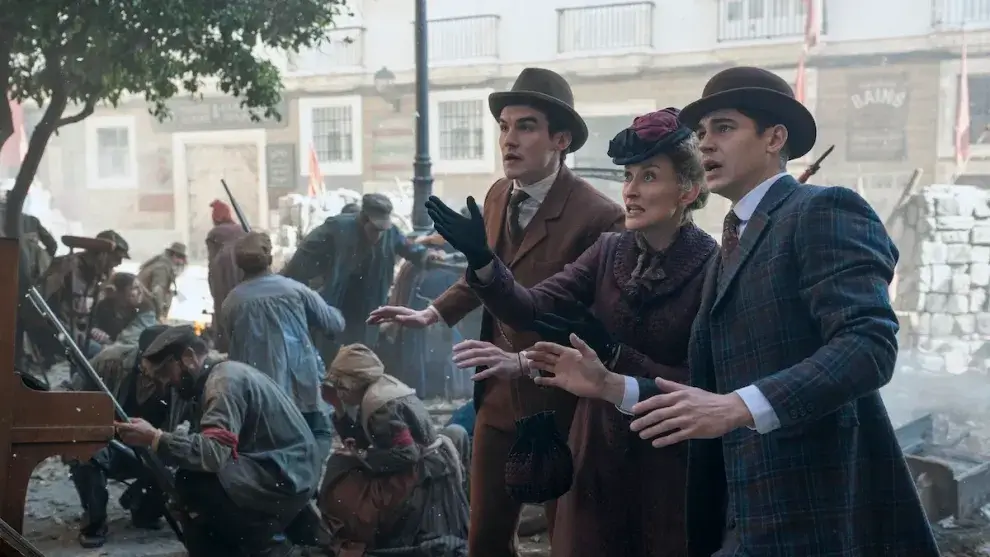
Even when Ritchie steps away after the first two episodes, his fingerprints remain everywhere. The dialogue snaps. The camera refuses to sit still. Action scenes don’t linger, but they move with confidence, cutting and swirling as if the show itself gets bored when things slow down. There’s no attempt to recreate the slow-motion brawls of the films, but the energy is familiar. The show also looks terrific. Costumes feel worn rather than curated, and the production design finds grit in places usually polished. When the story eventually spills into Paris, choked with barricades and unrest, the images finally stretch their legs.
The trouble begins when the show decides that bigger automatically means better. Each episode stacks another revelation on top of the last, as if momentum were something you could manufacture by sheer accumulation. A mystery that starts with a stolen document and a dead academic gradually balloons into international intrigue, secret networks, and breathless urgency, and somewhere along the way the story loses its footing. I kept thinking about how strange it felt to watch a Sherlock this inexperienced stumble into a plot that would strain the credibility of a seasoned detective. The scale overwhelms the character instead of sharpening him, and the series starts sprinting past the very qualities observation, patience, irritation with the obvious—that are supposed to define him. By the end, the noise drowns out the thinking, which is a peculiar misstep for a story about the smartest person in the room.
Recommended: The Fall and Rise of Reggie Dinkins Parents Guide
Some of the show’s ideas flirt with invention. Visualizing Sherlock’s memory as a place he can enter and rearrange works better than it has any right to. Other choices, especially those involving his family, feel desperate for surprise. They echo the worst instincts of late-era Sherlock, mistaking complication for insight and shock for depth. What’s frustrating is that these turns don’t feel inevitable; they feel imported, as if the show suddenly forgot what kind of story it was telling in the first place.
I didn’t dislike Young Sherlock. I enjoyed it, often. I laughed. I admired the craft. I found myself genuinely invested in two young men whose friendship contains the seeds of something poisonous. But I also felt the show slipping away from its own strengths, trading intimacy for spectacle, curiosity for noise.
There’s a quieter version of this series hiding inside the louder one we got. A story about intelligence before discipline, about friendship before rivalry, about how clever boys learn too late that consequences don’t care how smart you are. That’s the version I keep thinking about. The one that doesn’t chase the world, but lets the world come to it, in the dark, while you sit there watching, waiting for a mind to slow down long enough to really see.
Recommended: DTF St. Louis (2026) Parents Guide
