Last Updated on April 10, 2026 by Monica Castillo
I knew what was going to happen in You, Me & Tuscany long before it happened. That didn’t stop me from leaning back in my seat and letting it happen anyway.
There’s a particular kind of romantic comedy that doesn’t bother disguising its machinery. You can see the gears turning, hear the soft click of each familiar beat falling into place. This is one of those films. And yet, sitting there, watching Halle Bailey wander through sunlit Italian streets with the kind of luck that only exists in movies, I found myself giving in to it more often than resisting it.
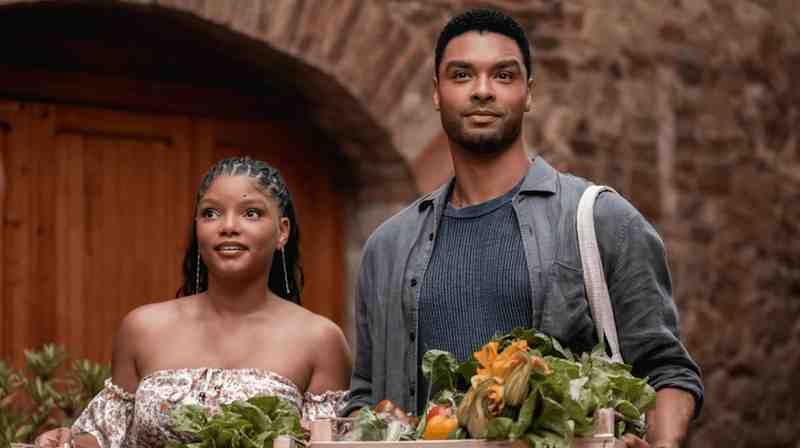
Bailey plays Anna, a professional house sitter who makes one bad decision and then spends the rest of the film trying to outrun it. She breaks into a villa. She finds a ring. She lies. Not a small lie, either, but the kind that requires constant maintenance, the sort that grows teeth if you don’t feed it carefully. Before she knows it, she’s engaged to a man who isn’t there, living among his family, improvising her way through meals, conversations, expectations. I’ve seen this setup before, in one form or another, and so have you. The film doesn’t pretend otherwise.
Highly Recommended: Mermaid (2025) Parents Guide
What surprised me wasn’t the plot, it was how comfortable the movie is letting that absurdity sit out in the open. Anna even calls her situation a “fairy tale nightmare,” which feels about right. She’s living inside a fantasy that could collapse at any moment, and Bailey plays that tension with a light touch. She doesn’t overplay the panic. She lets the joy sneak in alongside it, which makes the whole thing easier to believe, or at least easier to go along with.
Then Regé-Jean Page shows up, and the movie shifts into its inevitable rhythm. Their first meeting over that stolen sandwich, has just enough irritation to spark something. You know immediately where it’s headed. So does the film. It stretches that journey out anyway, letting them circle each other through vineyard walks, long conversations, and a montage that includes wine, laughter, and yes, sprinklers. When the camera slows down to admire Page’s physique, it’s not subtle. It’s not supposed to be.
I kept thinking about older films while I watched this, While You Were Sleeping, Never Been Kissed stories built on the same fragile foundation: a lie that somehow leads to truth. This one doesn’t add much to that tradition, but it doesn’t mishandle it either. It just… follows it. Faithfully.
The supporting cast leans hard into type, and sometimes straight past it. The family Anna falls in with feels less like a group of individuals and more like a collection of personalities you recognize instantly, the stern grandmother, the knowing patriarch, the sister who treats romance like a contact sport. There’s a looseness to their performances that I enjoyed, even when the writing gives them nowhere new to go. A few of them made me laugh out loud, which counts for something.
Visually, the film knows exactly what it’s selling. Italy looks like a dream you’d have after watching too many travel shows, all golden light, rolling hills, and food that seems designed to make you reconsider your life choices. Danny Ruhlmann shoots it with obvious affection, lingering on plates of pasta and glasses of wine as if they were characters in their own right. It’s indulgent. I didn’t mind.
Still, not everything lands. There are moments that feel stitched in after the fact, jokes that arrive from offscreen, cutaways that interrupt more than they enhance. A running gag involving tourists watching from a distance feels like it belongs to a different, broader movie. The tone wobbles occasionally, as if the film can’t quite decide how silly it wants to be.
But Bailey steadies it. There’s a warmth to her performance that carries the film through its weaker stretches. You believe her when she smiles, and you believe her when the weight of the lie starts pressing in. The subplot about her abandoning culinary school could have felt like an afterthought, but it gives her something real to hold onto, a reason for being here that isn’t just romance.
By the time the story reaches its obvious destination, I wasn’t surprised by anything that happened. Not the pairings, not the confessions, not the tidy emotional resolutions. The film plays fair with its audience in that way, it tells you what it’s going to be, and then it becomes exactly that.
And yet, I didn’t leave feeling cheated.
It’s a simple movie. Maybe even a predictable one. But there’s a certain ease to it, a willingness to embrace its own silliness without apology, that makes it go down smoothly. Like a good meal you didn’t have to think too hard about, familiar flavors, well prepared, enjoyed in a place you wouldn’t mind staying a little longer.
I can’t say it surprised me. I can say I didn’t mind being there while it unfolded.
You, Me & Tuscany Parents Guide
Violence is barely a factor. There are no real threats, no physical confrontations worth mentioning. The closest the film comes to “intensity” is situational, the stress of Anna’s lie unraveling, a few moments of emotional discomfort when she’s nearly exposed, and a mildly chaotic festival sequence involving rolling wine barrels. It’s more hectic than dangerous, and even that plays for laughs.
Language pops up more than you might expect for such a breezy film. Nothing extreme, but there’s occasional strong wording scattered throughout, along with casual profanity in conversations. It never dominates the dialogue, though it’s present enough that younger viewers will notice.
Sexual content: There’s flirtation, suggestive humor, and a few scenes that linger on physical attraction, most notably a vineyard sequence where Regé-Jean Page gets the slow-motion, shirtless treatment. Side characters openly discuss their sex lives in a comedic way, and while nothing explicit is shown, the tone occasionally nudges into adult territory. It’s more suggestive than graphic, but it’s there.
Alcohol is a constant presence, which makes sense given the setting. Characters drink wine frequently, at meals, in social settings, during romantic moments. It’s portrayed as part of everyday life rather than something reckless. Smoking is minimal to nonexistent.
As for age, this feels most appropriate for teens and up. Younger kids will likely lose interest, and some of the humor and romantic tension is clearly aimed at an older audience. There’s nothing deeply troubling here, just a steady undercurrent of adult themes wrapped in a light, escapist package.
It’s a film that stays within the lines, just not always the ones you’d expect from something this soft-looking on the surface.
Highly Recommended: The Testaments (2026) Parents Guide
