Last Updated on March 7, 2026 by Monica Castillo
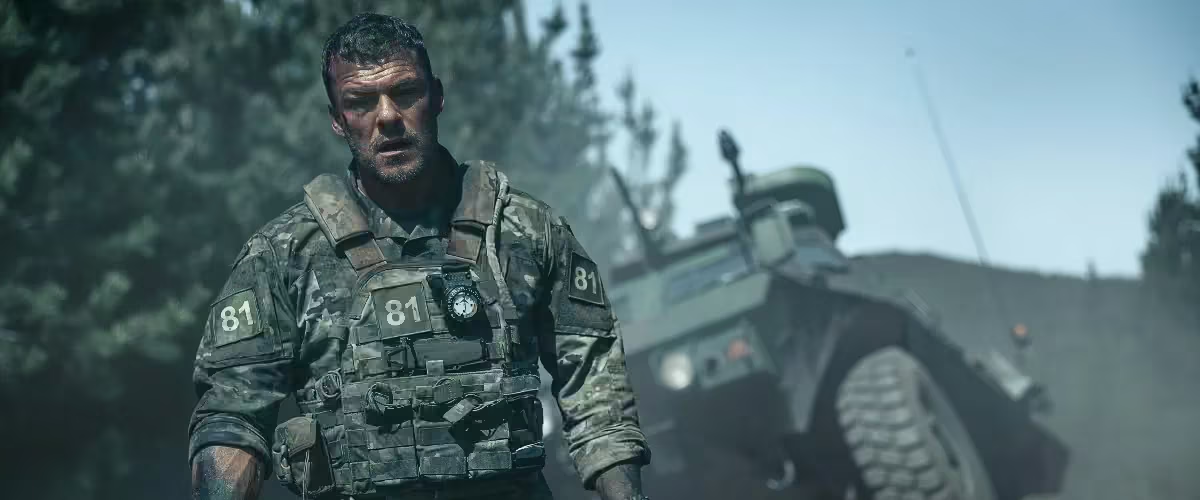
The first thing that stuck with me wasn’t the alien. It was the quiet moment before it shows up a soldier staring at a compass that suddenly begins to spin like it’s lost its mind. The forest is still. Nobody speaks. That tiny metal needle keeps circling as if it knows something the men don’t.
I like scenes like that. Small warnings. The kind that promise a movie might understand tension.
Patrick Hughes hasn’t always been interested in that kind of patience. His filmography tends to move fast, talk loud, and throw punches with a grin. The chaotic buddy energy of The Hitman’s Bodyguard and the cartoonish mayhem of The Man from Toronto come to mind. Even his debut, Red Hill, had the air of a filmmaker who preferred action to reflection. Hughes enjoys momentum.
So War Machine feels like a deliberate pivot. No wisecracking assassins this time. No playful shootouts. Instead we get mud, exhaustion, and soldiers trying to survive something they can’t quite understand.
The story opens in Afghanistan, where Alan Ritchson’s character — known only as “81” — reunites with his younger brother during a dusty roadside lull. The brother, played by Jai Courtney, carries the call sign “Squad Leader,” which tells you something about how this movie handles identity. Real names barely exist here. Everyone’s reduced to a number or a title, like the military paperwork already swallowed them.
Still, that early scene works. The brothers talk about their shared dream of becoming Army Rangers. They show off matching tattoos with the kind of awkward pride siblings sometimes have when they’re trying to say “I care about you” without actually saying it. It’s a small moment, and then gunfire tears straight through it. The attack that follows is quick and messy. When it’s over, the younger brother is dead and 81 is left carrying something heavy he doesn’t know how to put down.
Two years later he’s still carrying it.
Ritchson’s soldier has entered the Ranger Assessment and Selection Program — RASP — chasing the same goal he once shared with his brother. The other candidates know about the Afghanistan incident, though nobody seems quite sure what actually happened out there. Some whisper about bravery. Others wonder if there’s more to the story.
Ritchson plays 81 as a man who runs toward punishment. The training sequences show him pushing past reason, almost daring his body to give out. At one point he nearly drowns during a brutal underwater endurance test. The instructors watch. The other soldiers watch. He refuses to quit.
Recommended: The Six Triple Eight Parents Guide (World War II True story)
Those other candidates form the film’s small circle of personalities. There’s 7, played by Stephen James, who carries himself like someone already practicing how to lead men. Then there’s 15, portrayed by Blake Richardson, whose main qualification appears to be enthusiasm for violence. Authority figures drift in and out through Dennis Quaid and Esai Morales, both projecting the kind of calm command presence that movies love.
The film spends a surprising amount of time on this training. Long runs. Grueling challenges. Mud and sweat everywhere. It’s not revolutionary filmmaking, but Hughes understands physical strain, and those early sections have a grounded feel that works.
Then the movie abruptly remembers it’s a science-fiction thriller.
During the final endurance exercise the dreaded “Death March” the soldiers stumble across something sitting in the middle of the wilderness that absolutely shouldn’t be there: a strange metallic craft half-buried in the earth. Their orders are simple. Treat it like any other obstacle. Neutralize it and move on.
That decision wakes up the film’s title character.
The War Machine itself is less creature than weapon system a towering alien construct that moves with the slow confidence of something that knows nobody here can stop it. It scans the terrain. It fires with clinical precision. And once it starts hunting, it doesn’t stop.
Hughes seems far more comfortable once the chaos begins. The film suddenly finds its rhythm. Soldiers scramble down steep cliffs while under fire. A raging river becomes both escape route and trap. One wounded man has to be carried, slowing everyone down and forcing choices nobody wants to make. The alien keeps advancing.
The design of the machine works in a blunt, practical way. It stomps around like a hostile cousin of something from Transformers, minus the toy-store polish. No personality. No speeches. Just a walking arsenal.
Recommended: Trigger Warning Parents Guide
And that spinning compass comes back, too a clever little warning sign that the machine is nearby. Every time the needle starts its frantic dance, the tension climbs a notch.
Ritchson ends up carrying most of the movie on his shoulders. He doesn’t have a lot of dialogue that feels especially alive, but the performance itself is convincing. Panic flickers across his face when things spiral out of control, and there’s something believable about the way he keeps pushing forward anyway. The movie clearly wants his arc to be about redemption — saving these men after failing someone he loved. The writing doesn’t dig very far into that idea, but Ritchson sells the effort.
For a while, War Machine becomes a solid wilderness survival story with an extraterrestrial twist. Nothing fancy. Just soldiers, terrain, and an enemy that refuses to die.
Then the film reaches the final stretch and starts reaching for something bigger. The tone shifts toward flag-waving heroics that feel strangely out of step with the grim survival story that came before it. The movie also keeps one eye fixed on the possibility of a sequel, which means the ending never quite plants its feet.
That’s a shame, because the most effective parts of War Machine are the simplest ones — men running through dark woods, compasses spinning, something enormous moving somewhere just beyond the trees.
And every time that little needle starts circling again, you remember how much dread a small detail can carry when a movie knows how to use it.
War Machine Parents Guide
War Machine carries an R rating from the Motion Picture Association, and the main reason is violence. The film drops a group of soldiers into a brutal survival situation, and the action doesn’t pull many punches. Gunfire, explosions, and close-range combat show up throughout the story. Several scenes involve graphic injuries, including bodies torn apart by heavy weapons and soldiers badly wounded during attacks. Once the alien machine begins hunting the unit, the violence gets harsher. There are moments with dead bodies and disturbing battlefield images that younger viewers will likely find upsetting. The overall tone is tense and chaotic rather than stylized.
Language is frequent and often harsh, which fits the military setting. Soldiers shout commands, argue, and react under pressure, and the dialogue reflects that environment. The F-word appears many times, along with other strong profanity such as “s—t,” “bastard,” and “damn.” Most of the swearing happens during training sequences or combat situations where characters are panicking or trying to keep control of the group. It’s clearly adult-level language.
Sexual content and nudity aren’t part of the film. The story focuses almost entirely on military training and survival against the alien threat. There are no sex scenes, no nudity, and no romantic subplots that move into explicit territory. Relationships between characters stay in the realm of brotherhood and military camaraderie.
Drugs, alcohol, and smoking play little to no role in the movie. The characters spend most of the story in training exercises or running for their lives in the wilderness, so substance use rarely appears. If alcohol shows up at all, it’s limited to brief background moments and isn’t central to the plot.
Because of the graphic combat, strong language, and intense creature attacks, War Machine is better suited for older teens and adults. Many parents will likely feel the film fits viewers around 16 or 17 and up, depending on how comfortable they are with violent sci-fi action. Younger teens who already watch gritty war films might handle it, but the combination of graphic injuries and constant tension makes it a heavy watch for kids.
