Last Updated on February 25, 2026 by Monica Castillo
The first thing you hear from Wanda Sykes in Undercard isn’t a joke. It’s a sigh. Not a performative one, not a rim-shot pause waiting for laughter, just the sound of someone who has carried too much for too long and doesn’t feel like explaining herself anymore. I realized, sitting there, that this sigh contains more history and emotional information than most of what the film eventually spells out. It suggests a movie about exhaustion, about survival after the cheering stops. It’s a promise the film never quite keeps.
Wanda Sykes has one of the most instantly recognizable voices in American entertainment. It cuts. It rises when irritation tips into anger. It flattens when disbelief takes over. For decades, her comedy has worked because she sounds like someone encountering reality in real time, trying to understand how things got so broken without her consent. That voice has always made audiences feel like collaborators, not spectators.
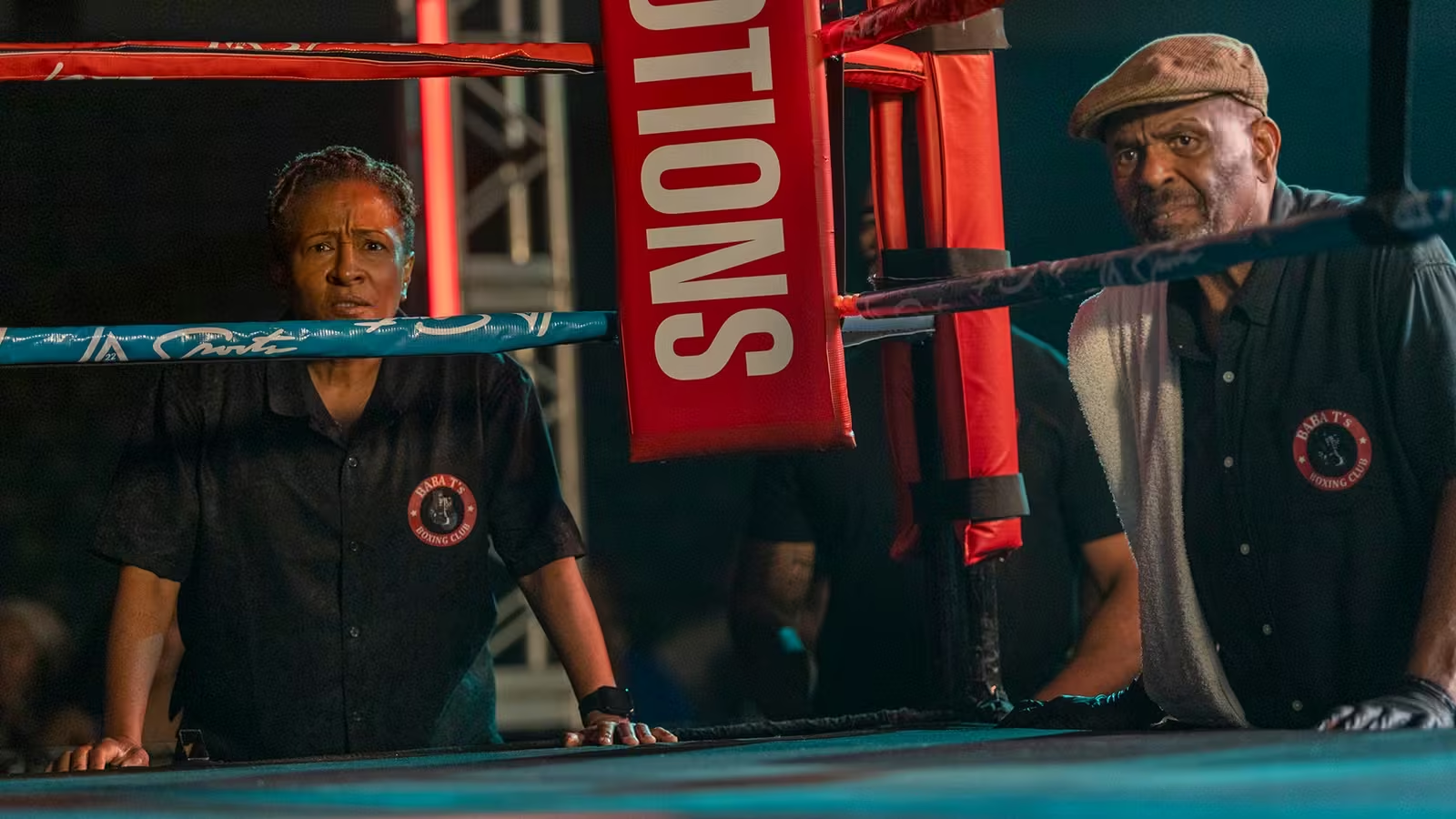
Undercard has been marketed as her first dramatic role, which feels less like a revelation than a misunderstanding of what Sykes has always done. She’s been acting all along; she’s just been telling the truth while doing it. Here, she plays Cheryl “No Mercy” Stewart, a former boxing champion turned trainer, an alcoholic in recovery, a woman clinging to stability with white knuckles and discipline. She coaches fighters at a rundown gym, mentors a promising young boxer named Kordell, and struggles to maintain custody of her niece while her adult son, Keith, drifts in and out of her life carrying equal parts talent and resentment.
Highly Recommended: If Movie Parents Guide
Sykes doesn’t vanish into Cheryl, and that’s fine. Cheryl feels like an extension of the same temperament Sykes has honed for forty years: impatient with nonsense, quick to flare, allergic to self-pity. The jokes are gone, but the rhythm remains. Her lines land hard, clipped, edged with fatigue. You believe she knows how to throw a punch and how to take one. What you don’t always believe is the world the film builds around her.
Tamika Miller’s direction and screenplay feel uncertain about which battles matter most. Boxing movies live and die by clarity, and this one keep blurring its own priorities. Cheryl’s financial desperation drives much of the plot, yet it never adds up. She’s constantly working, training boxers with professional potential, but can’t cover rent. The threat of losing custody of her niece emerges as an emotional pressure point, then recedes until the script needs another complication. Her estrangement from Keith carries real emotional weight at first, but his resistance collapses so quickly that their reconciliation feels scheduled rather than earned.
There’s an early scene I kept thinking about, where Cheryl watches her fighters spar. She doesn’t shout. She barely moves. Her eyes do the work. You can see her measuring angles, remembering how it felt when the ring belonged to her. It’s a quiet moment, and one of the few times the film allows stillness to speak. I wanted more scenes like that. Instead, the movie keeps piling on obligations, each one demanding attention, none given enough space to breathe.
The rivalry between Kordell and Keith, meant to anchor the film, never settles into focus. At first, they appear evenly matched, two fighters shaped by the same woman in different ways. Then, without explanation, the film reframes one as an unstoppable force and the other as a near-impossible long shot. The math keeps changing. I found myself less emotionally invested than intellectually distracted, trying to figure out what I was supposed to believe about their abilities. When the climactic fight finally arrives, complete with announcers insisting on enormous stakes, the tension feels imported rather than built. I wasn’t choosing sides so much as wondering why the movie needed me to.
Highly Recommended: The Bluff 2026 Parents Guide
Sykes remains compelling throughout. She brings weight to underwritten scenes and authority to dialogue that might otherwise drift. But she can’t fix everything. The boxing sequences expose the film’s limited scale, with sparsely filled crowds and staging that can’t hide how small the world feels. The second half leans hard into familiar sports-movie mechanics, not because they feel inevitable, but because the script seems to run out of alternatives.
The title refers to the preliminary fights, the ones meant to warm the audience up before the real event. Miller clearly intends this as metaphor, but it lands closer to self-description. The film knows it’s following a lineage of better, more assured boxing dramas, and it never figures out how to step out from behind them.
I kept returning, as the credits rolled, to that opening sigh. It hinted at a sharper, sadder, more grounded movie one about what happens after the belt is gone, after sobriety becomes maintenance rather than triumph, after your kids stop needing you but haven’t forgiven you either. Wanda Sykes understands that story. You can hear it in her voice. Undercard just doesn’t trust itself enough to tell it.
Undercard 2026 Parents Guide
Violence & Intensity: This is a boxing movie, so physical violence is baked into its DNA. Expect repeated scenes of sparring and full bouts: punches thrown, bodies hit the canvas, blood visible in a few moments, and the wear-and-tear of fighters pushed past comfort. The violence is realistic rather than stylized, presented as labor more than spectacle, but it’s still forceful and frequent. Outside the ring, there are tense confrontations and one arrest scene, though nothing graphic.
Language: Strong language appears throughout, mostly in the clipped, irritated, no-nonsense tone you’d expect from people living under pressure. Profanity is common, though not constant, and used conversationally rather than for shock. No slurs stand out, but the dialogue isn’t softened for younger ears.
Sexual Content / Nudity: There’s no nudity and no explicit sexual activity. A few adult references and charged conversations surface briefly, but the film isn’t interested in sex as spectacle or subplot.
Drugs, Alcohol & Smoking: Wanda Sykes’ character is a recovering alcoholic, and her sobriety fragile, hard-won, and always under threat drives much of the emotional tension. References to past addiction are frequent, and alcohol appears on screen. Drug dealing is part of a supporting character’s storyline, including an arrest, though drug use itself is not explicitly depicted. Smoking is minimal.
Age Recommendations: Best suited for older teens and adults. The themes addiction recovery, financial instability, fractured family relationships carry more emotional weight than shock value, but they require a level of maturity to process.
Highly Recommended: Last Ride (2026) Parents Guide
