Last Updated on March 19, 2026 by Monica Castillo
They Will Kill You is Rated R by Motion Picture Rating (MPA) for strong bloody violence, gore, language and brief sexual content/nudity.
There’s something almost delirious about the way “They Will Kill You” moves like it exists in a space halfway between live-action cinema and the heightened, elastic logic of anime. Bodies aren’t just struck; they’re split apart with a kind of exaggerated force that feels closer to myth than physics. Every movement lands with a snap, punctuated by sound effects that seem to announce themselves a beat early, as if the film wants you to anticipate the blow before it lands. Even the rain refuses to behave normally. It falls in thick, theatrical sheets, turning the air into a hazy curtain less weather than atmosphere, like something out of a neon-drenched fever dream. You can feel director Kirill Sokolov leaning into that unreality, not apologizing for it, but building the film’s entire language around it.
At its core, the premise is deceptively simple: a woman infiltrates a Satanic cult to save her sister. But Sokolov, working alongside co-writer Alex Litvak, doesn’t treat that setup as something to carefully develop. It’s more like a fuse he lights and then sprints away from. What follows is loud, gleeful, and often absurdly violent a film that seems to take real pleasure in how far it can push itself. There’s a mischievous energy running through it, the sense that everyone involved is in on the joke. If you come to it expecting the kind of layered social critique that often underpins “kill-the-rich” narratives, you may find yourself a little adrift. But if you meet it on its own terms, there’s a wild, almost infectious thrill to the chaos.
Recommended: Psycho Killer (2026) Parents Guide
You can practically feel the impatience to get things moving. The early stretches rush forward, brushing past exposition like it’s an obligation rather than an opportunity. Asia Reaves, played by Zazie Beetz, arrives at the Virgil Hotel with a singular goal: find her sister Maria (Myha’la), who she believes is working there. The hotel itself carries an immediate unease—too quiet, too controlled, like it’s holding its breath. Asia is escorted to her room by Lily, the building’s superintendent, played with a disarming calm by Patricia Arquette. It’s the kind of introduction that feels like it should unfold slowly, but the film doesn’t wait. It lunges.
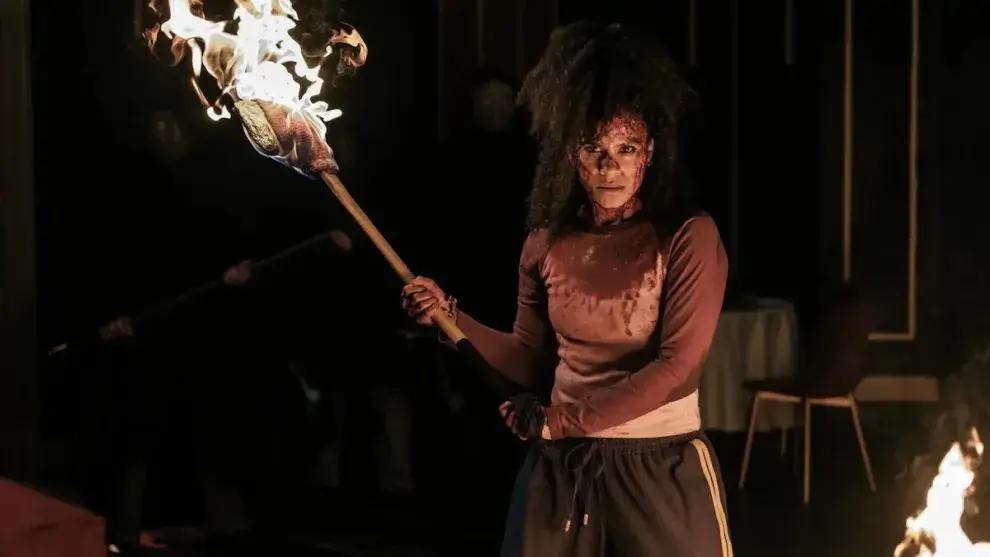
Not long after, three masked intruders Paterson Joseph, Tom Felton, and Heather Graham—break into Asia’s room. Their purpose is ritualistic and cold: capture her, sacrifice her, extend their own lives. But what they don’t anticipate is that Asia is ready. Armed, alert, and unwilling to fold, she turns the invasion into something else entirely. The scene that follows is the film’s centerpiece, the moment where everything it wants to be comes sharply into focus.
It’s chaotic in the best sense messy, inventive, and constantly surprising. Cinematographer Isaac Bauman shoots the action from angles that feel almost mischievous, including a perspective from a knife as it’s passed between bodies in a grim relay, ending in a moment that’s equal parts shocking and darkly funny. Objects in the room don’t stay neutral for long. A mattress becomes a shield, then a weapon. You’re never quite sure what will be used next, or how. That unpredictability gives the sequence a kind of electricity you lean forward, not because you’re following the choreography, but because you’re trying to keep up with it.
Still, there’s a point where the spectacle begins to outpace the emotion behind it. The violence escalates, becoming more exaggerated, more fantastical, but it rarely feels anchored to something deeper. Great action often carries a sense of desperation—you feel each hit because you understand what’s at stake. Here, that connection is looser. Sokolov is more interested in how far he can push the moment than in why it matters. To Beetz’s credit, she grounds what she can. She absorbs punishment convincingly, fights back with force, and gives Asia a physical presence that keeps the film from floating away entirely.
Recommended: How to Make a Killing (2026) Parents Guide
After surviving the attack, Asia discovers the truth about the Virgil: it isn’t just a hotel, it’s an ecosystem. The guests, the staff, everyone is bound to the same cult, their continued existence tied to her death. From there, the film veers into territory best experienced without forewarning, though it’s fair to say that death loses its finality. Those who fall don’t stay down for long, returning altered, empowered by something ominously referred to as the Man Downstairs.
Here’s where the film begins to wobble a bit. Once it establishes that its antagonists can’t truly die, something shifts. The fights are still kinetic, still visually inventive, but they lose a layer of tension. There’s less at risk in any given moment. The film tries to compensate by weaving in flashbacks between Asia and Maria, showing us glimpses of a bond that’s since fractured. But these moments feel rushed, almost like placeholders for emotional weight that never fully arrives. You understand their history intellectually, but you don’t quite feel it.
There are also hints just hints of something more thematically pointed. The fact that the Virgil’s workforce is made up entirely of people of color isn’t accidental, and for a moment, you think the film might dig into that imbalance, that quiet hierarchy of who serves and who benefits. But it never quite commits. These ideas drift in and out, never fully formed, never given the time they need to land. You can’t help but feel that there’s a sharper, more resonant version of this story just beneath the surface, one that might have made the violence feel not just exciting, but necessary.
And yet, even with those gaps, there’s something undeniably refreshing about how much fun the film is having. It exists in a landscape crowded with similar setups—cults, mansions, survival games—but what sets it apart is its willingness to keep playing. It doesn’t settle. It keeps asking, “What’s the most unexpected thing we can do next?” and then actually doing it. That sense of momentum, of constant invention, carries it through its weaker stretches.
Comparisons are inevitable. The stylized bloodshed and revenge-driven structure call to mind Quentin Tarantino’s “Kill Bill,” and even echo Toshiya Fujita’s “Lady Snowblood.” You can see the DNA. But watching Beetz here, those comparisons start to feel less important. She’s not mimicking; she’s carving out something of her own.
There’s a stretch, especially as the film pushes toward its final act, where you can feel her performance locking in. The movements sharpen. The resolve hardens. She’s not just reacting anymore she’s driving the film forward. By the time she’s cutting her way through the last obstacles in a stark, snow-covered setting, something has shifted. You’re no longer thinking about influences or structure. You’re just watching her.
Recommended: The Killer’s Game 2024 Parents Guide
And that’s what lingers. Not the mythology, not the half-formed themes, but the image of Beetz fully inhabiting this role becoming, in real time, the kind of action presence the genre rarely produces anymore. When the credits roll, it’s her you carry with you. Everything else fades a little.
They Will Kill You (2026) Parents Guide
Violence & Intensity: action is frequent, prolonged, and often shockingly graphic, with bodies split, stabbed, burned, and bludgeoned in ways that linger on screen. There’s a stylized, almost surreal quality to it at times, but that heightened tone doesn’t soften the impact. If anything, it makes the brutality feel more unpredictable. One moment you’re watching a clever piece of choreography, the next you’re confronted with something genuinely grotesque. Add in the home invasion setup, the cult’s ritualistic motives, and the sense that no one is ever truly safe, and the intensity rarely lets up. It’s the kind of violence that’s meant to be felt as much as seen.
Language and profanity: The language follows the same emotional pitch as the action—raw, urgent, and often explosive. Strong profanity is used throughout, usually in moments of fear, anger, or desperation rather than casual conversation. It doesn’t feel ornamental; it feels like an extension of the chaos around it. There aren’t notable slurs shaping the dialogue, but the overall tone is aggressive and unfiltered.
Sexual Content / Nudity: There are brief flashes of nudity and some suggestive elements, mostly tied to the cult’s unsettling rituals. They’re not drawn out, and the film doesn’t linger on them, but they arrive in an already tense, uneasy atmosphere, which makes them land a bit harder. It’s less about explicitness and more about how these moments contribute to the film’s overall sense of unease.
Drugs, Alcohol & Smoking: There may be occasional background drinking, but it’s not emphasized or central to any character or plot point. The film’s excesses come from its violence and tone, not from depictions of drugs or alcohol.
Age Recommendations: This is very much aimed at adults, and even then, not all adults. Older teens might be drawn in by the action, but the sheer level of gore and the film’s relentless, almost exhausting intensity make it a tough recommendation. It’s less about whether someone can handle violence in general and more about whether they’re comfortable sitting with this kind of sustained, stylized brutality. If that gives you pause, it’s probably a sign to skip it.
Recommended: Scream 7 (2026) Parents Guide
“They Will Kill You” opens exclusively in theaters on April 24.
