Last Updated on April 3, 2026 by Monica Castillo
The Testaments (2026) — A Review
There’s a particular kind of dread that comes not from what a story shows you, but from how familiar it feels. When The Handmaid’s Tale arrived on Hulu in 2017, it didn’t feel like dystopian fiction so much as a dispatch from a future that was already leaning in the door. The red cloaks showed up at actual protests. The phrases Under His Eye, Blessed be the fruit, migrated from the screen into political placards and social media bios. It was resistance television in the most literal sense, and for a stretch of time, it was essential.
By the time it wrapped in 2025, six seasons deep and increasingly addicted to its own punishment, some of that urgency had curdled. The show had become a kind of endurance test, how much suffering can a viewer absorb before the act of watching starts to feel less like solidarity and more like voyeurism? But those early seasons mattered. That much is worth saying plainly.
The Testaments, now arriving on Hulu as the second Atwood adaptation from the same streamer, steps into a political climate that rhymes unsettlingly with 2017. A year into another Trump administration, the cultural conversation around resistance and survival has shifted, grown more complicated, more exhausted in some corners and more urgent in others. What’s striking, and genuinely impressive is that the show seems to understand this. It doesn’t simply repeat what came before. It finds a different frequency.
Recommended: The Comeback Season 3 (2026) Parents Guide
Josephine Decker directs here with the same atmospheric intelligence she brought to Shirley and the unnerving intimacy of Madeline’s Madeline, that gift she has for getting inside a character’s skin and making the viewer feel slightly claustrophobic in the best possible way. The show moves differently than its predecessor. It’s quieter in some ways, more interior. The violence is still present, but it operates differently now, buried under privilege, dressed in embroidery and soft pastel uniforms, disguised as normalcy.
Where The Handmaid’s Tale was anchored in the raw, grinding terror of a woman who knew exactly what had been taken from her, The Testaments centers on girls who don’t yet know what they’re missing. That’s a meaningfully different kind of horror.
The series is set roughly four years after the events of the previous show a departure from Atwood’s novel, which jumps fifteen years forward, in a Gilead reshaped by the War of Massachusetts and the purges that followed. History, as it tends to do under authoritarian regimes, has been quietly rearranged by those who survived it.
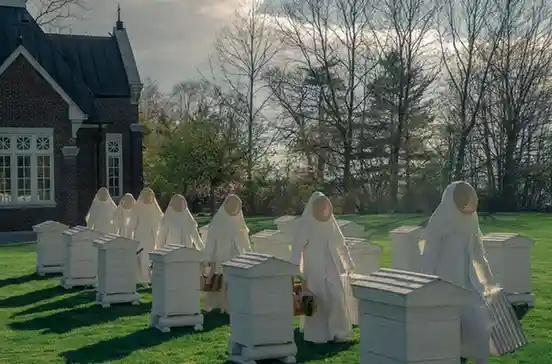
Aunt Lydia, played again by Ann Dowd with that magnificent, unsettling mix of severity and almost maternal warmth, now runs a finishing school for the daughters of Gilead’s most powerful commanders. The show describes her with a line that earns its keep: she has been “worshipped, vilified, and is now worshipped again.” Dowd delivers it like she already knew.
The school is its own kind of horror not the overt, blood-soaked variety, but the slower, more insidious sort. Reading is considered less useful than embroidery. Sex education doesn’t exist in any meaningful sense. The girls wear color-coded uniforms pink for the youngest, plum for the older teenagers, green for those deemed eligible for marriage, and the transition between stages is marked by a public ceremony that any viewer will clock immediately as deeply wrong, even if the girls inside it do not. Obedience is the curriculum. Everything else is decoration.
The story’s center of gravity is Agnes MacKenzie, played by Chase Infiniti with a carefully calibrated mix of compliance and restlessness. She’s a true product of Gilead pious, sheltered, technically content. It’s almost jarring how ordinary she can seem: trailing her friends on school outings, flushing over the young man assigned to protect her, fretting about the cut of a new skirt. You find yourself watching her and thinking, she could have been anyone. That’s exactly the point.
Things begin to shift when Agnes is paired with Daisy, played by Lucy Halliday in what is quietly the season’s most compelling performance. Daisy is a Pearl Girl, Aunt Lydia’s term for foreign converts who’ve come to Gilead seeking to join its way of life arriving from Canada with a history she carries close and secrets she hasn’t quite decided to trust anyone with. The friendship that develops between Agnes and Daisy is where the show finds its real engine. Daisy’s bluntness acts like a slow solvent on Agnes’s certainties, loosening things that were never meant to be questioned.
Recommended: Something Very Bad Is Going to Happen Parents Guide
What Iliza Shlesinger’s writing does well, and it’s worth saying this is not a small achievement for a subject this heavy, is make these girls feel like actual teenagers. The jealousies are real. The crushes are real. The particular cruelty of adolescent social dynamics is rendered with enough honesty that it’s easy to forget, for long stretches, that you’re watching a dystopia. And then one of them will casually repeat a government talking point about “gender traitors” or “fallen women,” and the bottom drops out again. You feel it each time, even when you see it coming.
Mattea Conforti as Becka, Agnes’s closest friend within Gilead’s world, brings a warmth to the ensemble that grounds the more overtly dramatic material. And Rowan Blanchard, playing Shunammite with a gossipy, socially calculating energy that borders on genuine comedy, offers something the show’s predecessor rarely allowed itself: lightness. Not relief, exactly, but the reminder that teenagers will be teenagers even inside a nightmare, and there is something both heartbreaking and affirming in that.
Decker and Shlesinger are working from a novel that Atwood’s readers have held close for years, and The Testaments is not a strict adaptation. it moves pieces around, invents new ones, takes liberties that purists will notice. But the spirit of what Atwood was doing with that book, its argument about complicity and awakening and the specific power of female solidarity, is fully intact. If anything, the translation to television deepens it.
There’s something about watching these friendships play out in real time, across ten episodes that gives them a weight that the novel’s structure told in retrospect, through documents and testimonies, couldn’t quite access.
Where The Handmaid’s Tale was ultimately a story about one woman’s private resistance, Offred surviving, enduring, finding the small cracks in an enormous wall, The Testaments makes the argument that resistance, to be durable, has to be collective. It has to be chosen, not just suffered into. The girls at the center of this series don’t begin as revolutionaries. They begin as girls, which turns out to be enough. That’s the show’s most quietly radical claim, and Decker films it like she believes it.
The Testaments Parents Guide
Rated TV-MA (MPA)
Violence & Intensity: The violence in The Testaments is mostly the kind that doesn’t bleed on screen but settles into your chest anyway. The show has moved away from the graphic torture and physical brutality that wore down viewers of The Handmaid’s Tale in its later seasons. What replaces it is something arguably harder to shake, systemic cruelty dressed up as ceremony, as routine, as normalcy. A public ritual marking a girl’s first period as a communal confession and praise event is disturbing precisely because the girls inside it don’t recognize it as violation. There are moments of more direct menace and threat, and the psychological weight of the world these characters inhabit is heavy and sustained throughout all ten episodes. This is not comfortable viewing, even when nothing overtly terrible is happening on screen.
Language: The profanity is relatively restrained by TV-MA standards, but the ideological language of Gilead carries its own ugliness. Terms like “gender traitors” and “fallen women” are deployed casually by teenagers who have been raised to mean them, and that casual cruelty lands harder than any conventional slur. The show’s tone is serious throughout, there’s no ironic distance offered between the viewer and the world’s moral horror. Younger viewers may absorb those phrases without fully processing what’s being normalized, which is, in a sense, exactly what the show is warning you about.
Sexual Content & Nudity: There is no explicit sexual content, but the subject matter is inescapably sexual in its implications. The entire architecture of Aunt Lydia’s school exists to prepare teenage girls for marriage to powerful older men, and the show doesn’t flinch from making that reality clear. The ceremony surrounding a girl’s first period treated as a public, communal event, carries an invasiveness that many viewers will find deeply uncomfortable. Crushes and early romantic feelings are present and handled with a light touch, but the broader context in which female sexuality is controlled, monitored, and deployed as a political instrument gives even those softer moments an uneasy undertow.
Drugs, Alcohol & Smoking: Neither drugs nor alcohol feature meaningfully in the storyline. Gilead is, by design, a world of rigid control and enforced sobriety, at least for the women within it. What little appears is incidental to the world-building rather than anything that drives character behavior. This is not a category of concern for most parents watching alongside older teens.
Ag Recommendation: The TV-MA rating is warranted, but the nature of the content here is more psychological and political than visceral. For a mature, thoughtful teenager, particularly one already familiar with The Handmaid’s Tale, or one who has encountered Atwood’s work in school — The Testaments could be a genuinely valuable and conversation-starting watch. The themes of complicity, bodily autonomy, and the slow erosion of freedom through comfort and ignorance are worth sitting with at almost any age, provided the viewer has the emotional footing to handle them. Fifteen or sixteen and up feels right, with the caveat that the show’s world is one that many young women, depending on their own circumstances, may not experience as purely fictional..
All ten episodes were screened for review. The Testaments premieres April 8 on Hulu.
