Last Updated on April 1, 2026 by Monica Castillo
The Super Mario Galaxy Movie (2026) is Rated PG by Motion Picture Rating (MPA) for action, mild violence and rude humor
There’s a moment somewhere in the middle of “The Super Mario Galaxy Movie” where the camera lingers just barely, for half a breath on one of Rosalina’s cosmic observatories drifting through a star-flecked void, and it’s genuinely beautiful.
I found myself leaning forward slightly, the way you do when a movie briefly becomes what it could have been.
Then the scene cuts, and we’re off again, careening toward the next thing, the next gag, and the next recognizable Nintendo sprite to point at and squeal over. The observatory floats away. The movie doesn’t look back.
That tension between what these films are capable of and what they’re content to be, is the real subject of any honest review of this franchise.
I keep thinking about 1993’s “Super Mario Bros.,” that deranged curio with its cyberpunk sewers and Dennis Hopper in platform boots, chewing scenery with the commitment of a man who has absolutely nothing to lose. It was a catastrophe. It was also, in its lunatic way, alive. Nobody greenlit that thing by asking what the audience expected.
The current era operates on the opposite philosophy: ever since “Sonic the Hedgehog” course-corrected its infamous nightmare-fuel design after fan revolt and was rewarded with a box office fortune, the unspoken contract of the video game movie has been fidelity above all else. Give the people what they already love, rendered faithfully, with the sharp edges sanded off. The 2023 “Super Mario Bros. Movie” executed this formula with cheerful efficiency and became the highest-grossing video game adaptation ever made. Of course there’s a sequel.
Recommended: 25 Best Kids Movies on Netflix in 2026
“The Super Mario Galaxy Movie” is and I want to be precise here not a bad film the way a film with genuine ambitions can be bad. It’s more the kind of film that makes you feel slightly sleepy in a pleasant, non-threatening way, like being handed a warm towel you didn’t ask for.
Loosely, very loosely adapted from the beloved 2007 game, it sends Mario (Chris Pratt, still adrift somewhere inside that accent) and Luigi (Charlie Day, given even less to do than before) into space after Bowser Jr. voiced by Benny Safdie, a casting choice that raises more questions than it answers hatches a scheme to free his father from prison by kidnapping the ethereal Princess Rosalina (Brie Larson) and building a space armada.
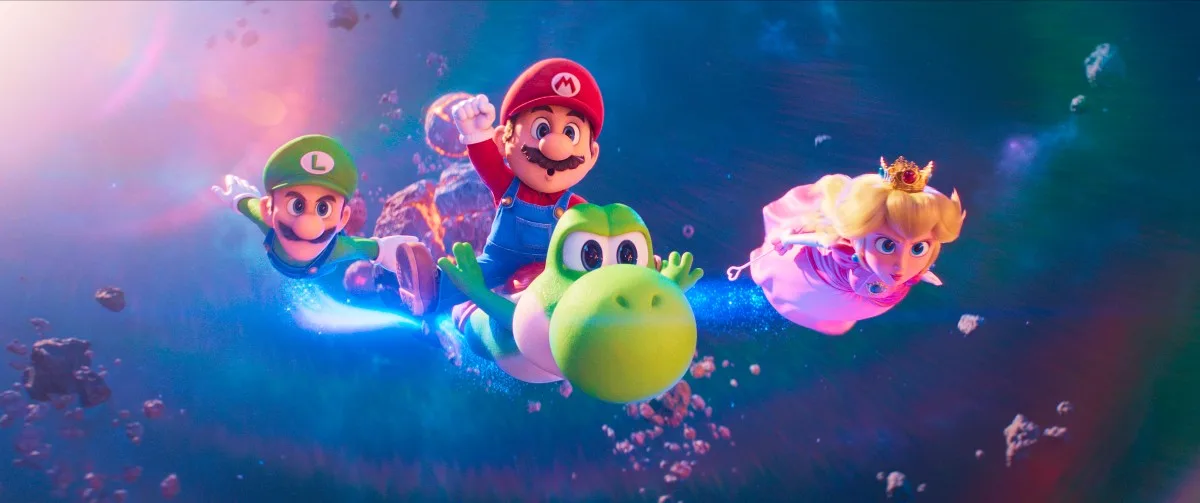
Princess Peach (Anya Taylor-Joy) rockets off to handle things herself. Yoshi shows up. Nobody explains why, and the film would prefer you didn’t ask. Bowser (Jack Black), now miniaturized and apparently on a therapy-speak healing journey to manage his anger, gets left behind with the bros. to mind the kingdom. This lasts about eleven minutes before everyone ends up in space together anyway.
Screenwriter Matthew Fogel rushes us through this setup like a man late for another meeting, stringing together a series of set pieces that function less as a story than as a delivery mechanism for Easter eggs. There’s an extended Rosalina action sequence she dispatches a giant robot with the fluid grace of a shōnen protagonist, and it’s the most kinetically interesting thing in the picture before the film promptly benches her for most of its runtime. Toad (Keegan-Michael Key) is rightfully, if briefly, resentful of Yoshi’s effortless induction into the inner circle, and I kept waiting for the movie to actually do something with that. Instead it gets folded into a one-liner and forgotten. Loose threads are the native landscape of this franchise; you learn not to pull them.
What we get instead of character is recognition. Bowser Jr.’s surveillance monitors are styled like vintage side-scrollers, complete with the bleeping 8-bit music. A shrink ray fashioned, not-so-subtly, after a NES Zapper turns Mario and Luigi into gap-toothed toddler versions of themselves, which is admittedly pretty funny for about thirty seconds.
Recommended: Something Very Bad Is Going to Happen Parents Guide
The Lumas flutter around with their squeaky voices, being aggressively adorable. This is the real grammar of the Illumination Mario movies: not storytelling, but the steady accumulation of things you recognize, things you loved once, things that trigger a small warm buzz in the chest that can, if you’re not careful, be mistaken for emotion. It doesn’t matter whether any of these elements serve the film. It only matters that you clock them, and smile, and feel briefly, pleasantly seen.
Black suffers most from the film’s mechanical generosity. Bowser miniaturized is Bowser defanged, and the voice modulation strips the volcanic, ridiculous charisma he showed in the first film down to a squeak. No “Peaches” reprise. He has maybe four good lines.
Brian Tyler’s score, though I’ll give it this is a genuine improvement. The first film leaned on needle-drops with the nervous energy of someone trying to fill silence at a dinner party; this one trusts Tyler’s orchestral work more, which gives the action sequences a weight they’d otherwise lack. And then there’s Fox McCloud. Glen Powell voices the “StarFox” hero as a swaggering space rogue, an obvious Han Solo riff that works precisely because Powell sounds like he’s having an actual good time in the booth.
He’s in the film longer than I anticipated, and every time Tyler weaves in that propulsive, brass-heavy “StarFox” theme and I will not pretend otherwise something in me lit up. I was ten years old again, burning through battery packs on a Sunday. I’d be lying if I said I didn’t want more. Frankly, I’d be lying if I said I didn’t want them to just go ahead and make the “StarFox” movie instead.
The film ends abruptly enough that I actually checked the runtime afterward to confirm I hadn’t missed something. I had not. It just stops. Which, when you think about it, is the honest move. “The Super Mario Galaxy Movie” has never really pretended to be building toward anything. It’s not the kind of movie that stays with you; it’s the kind that moves through you, brisk and bright and frictionless, leaving behind the faint residue of a pleasant afternoon and nothing much else.
It will almost certainly make a billion dollars. The kids will love it. The beleaguered parents in the audience will doze lightly in their stadium seats and feel, for ninety-odd minutes, briefly reprieved. That observatory will drift through the void, gorgeous and unnoticed, and the film will keep running, cutting away before the image has any chance to mean something.
The Super Mario Galaxy Movie (2026) Parents Guide
Violence & Intensity: Nothing here will traumatize anyone old enough to hold a game controller. The action is the rubbery, consequence-free variety, characters get zapped, shrunk, launched into space, and flattened with the breezy impermanence of a Saturday morning cartoon. Rosalina’s robot-fighting sequence is probably the most intense stretch of the film, and even that reads closer to anime-inflected spectacle than genuine threat. Bowser remains the franchises designated heavy, but miniaturized and stripped of menace, he’s more silly than scary.
Language: The “rude humor” in the rating refers mostly to the kind of toilet-adjacent slapstick and mild insult comedy that Illumination has built an empire on, nothing that will make you sink into your seat as a parent.
Sexual Content / Nudity: None.
Drugs, Alcohol & Smoking: The closest thing to an altered state is a shrink ray that turns the brothers into toddler versions of themselves, which is played entirely for laughs and lasts about thirty seconds.
Age Recommendations: Comfortably appropriate for children five and up.
The kids who grew up with the first film will track the story fine. The parents sitting beside them, however, are advised to bring coffee. You’ll be comfortable. You won’t be riveted.
Recommended: Good movies for 9 12-year-olds on Netflix
