Last Updated on April 3, 2026 by Monica Castillo
The Stranger (2025) Review
François Ozon opens his adaptation of The Stranger with the old Gaumont Studio logo, the real one, the 1940s version , and for a moment you wonder if he’s setting up a joke. Ozon is a playful filmmaker. He did a full Fassbinder tribute with Peter von Kant in 2022, campy and adoring and completely committed to its own theatrical excess. He’s the kind of director who enjoys the seams of a genre almost as much as the genre itself. So when that period logo appears, you brace for some form of knowing irony, a smirk hidden somewhere in the frame.
The story is one most people carry around vaguely, even if they’ve never read Camus. A French man Meursault lives in colonial Algiers. One afternoon on a beach, for reasons he cannot meaningfully explain, he shoots and kills an Arab man. He had the inclination, and he had the gun, and those two things were enough. When he’s convicted and sentenced to death, he doesn’t rail against the verdict or collapse into remorse. The best he can offer is that he’d “upset the balance of the day.” And then he goes.
I’m not treating those details as spoilers. If you come to this film having read the novel, you’ll be watching for how Ozon handles what you already know. If you haven’t read it, the story will still reach you not through plot, but through something more uncomfortable than plot. Either way, you don’t leave this film unchanged. That much I’ll promise.
Highly Recommended: You’re Dating a Narcissist Parents Guide
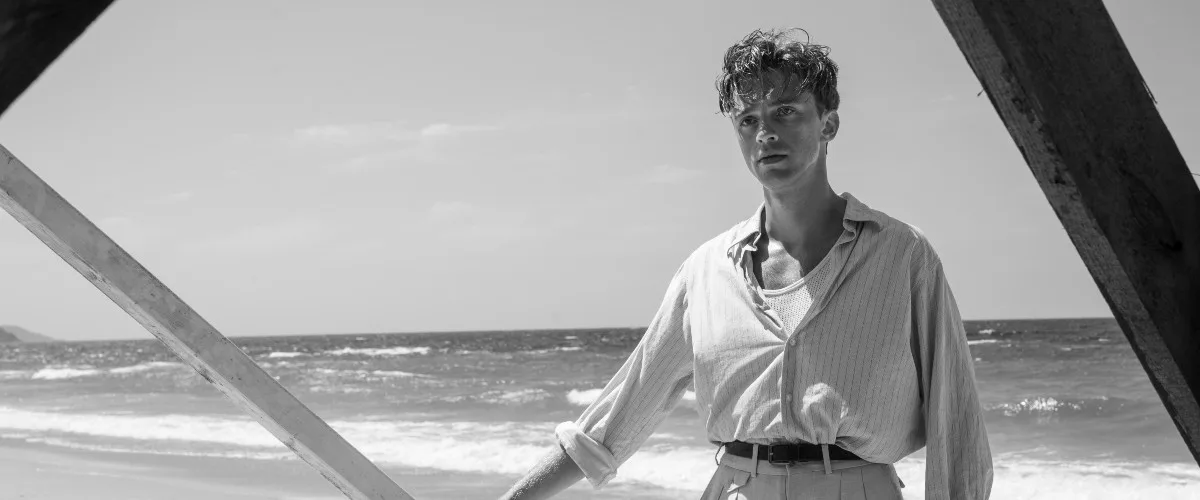
Benjamin Voisin plays Meursault, and casting him was itself a kind of argument. The man is genuinely beautiful, the old-fashioned kind of beautiful that belonged to French cinema in the postwar decades. There’s something in his face that the camera keeps wanting to solve, some quality that reads as depth until you realize, slowly, that it might be absence. Rebecca Marder plays Marie, his girlfriend, and she’s warm and real and completely baffled by him in a way that’s hard to watch. They make love. They swim. They sit in the Algiers sun. She clearly loves him. He doesn’t say he doesn’t love her back, he just doesn’t say he does, and when she asks him directly, he answers with the honesty of someone who doesn’t understand why the question matters. It’s not sadism. Somehow that makes it worse.
Ozon frames their early life together with what amounts to a fake colonial tourism reel, Algeria announced as “le premier sourire du Algérie,” Algeria’s first smile, and the artificiality of it is deliberate. They watch a Marcel Pagnol film together, starring Fernandel, that beloved face of French comedy, and it feels like the last normal thing that will happen. There’s a neighbor, charming in a sly, slightly greasy way, who may be exploiting his Algerian girlfriend, and it’s her brother who ends up on that beach. Another neighbor, played by Denis Lavant with a restraint that surprises you if you’ve seen what Lavant is capable of, quietly admires Meursault because the young man was decent to his dog. That detail stays with you. There’s nothing wrong with Meursault on paper. He’s pleasant. He functions. He’s not visibly broken. And then he stares into the sun as a pocket knife catches the light, and something in the film closes shut.
Ozon doesn’t lean heavily on the novel’s first-person narration, he uses it sparingly, strategically — but when he does pull from Camus’ prose, he takes it verbatim. No paraphrasing, no updating. He clearly decided those sentences were already finished, and he was right. The film closes on a famous rock song that maps loosely onto the arc of the story, and it doesn’t feel like a clever reference. It feels like evidence, that Camus got there first, and that what he wrote burrowed so far into culture that it surfaced in a completely different form decades later without anyone planning it.
Here’s the thing about Ozon that this film brings back into focus: he has been making horror movies for nearly thirty years. Not supernatural horror, but the other kind, the kind that has nowhere to hide behind a monster. See the Sea, from 1997, was a small, suffocating film about two women and a slow-building wrongness that you couldn’t name until it was too late. That instinct never left him. It was just quieter in some films than others. In The Stranger, it’s back at full volume.
Highly Recommended: Fantasy Life (2026) Parents Guide
This is a horror film. I don’t say that to be provocative. I say it because sitting with Meursault, really sitting with him, following his logic all the way to the end, produces something that functions exactly like dread. Not because he’s evil in any operatic sense, but because his worldview is coherent. It holds together. And somewhere in the back of your mind, watching him, you find yourself checking your own reactions, making sure they’re still there. The abyss in this film isn’t on screen. It’s in the space between you and the screen, and it grows the longer you look.
The Stranger (2025) Parents Guide
Not Rated (MPA)
Violence & Intensity: The violence in this film is not frequent, but it is the kind that lodges in you. The central act, a man shooting another man on a beach in broad daylight, is rendered with a cold, almost clinical stillness that makes it more disturbing, not less. There’s no frenzy, no panic. Just a trigger pulled, and then pulled again, and the awful quiet that follows. The film’s final movement, circling a death sentence and an execution by beheading, doesn’t dwell in gore but carries a genuine psychological weight.
Language: The film is in French with subtitles, which naturally changes the texture of how language registers. There is no heavy profanity in the conventional sense, but the colonial terminology used to refer to Arab characters, period-accurate and deliberately unreconstructed, carries its own ugliness. Ozon doesn’t soften it. He isn’t supposed to. Younger viewers may not immediately catch the weight of those words, but older teenagers will, and it’s worth a conversation.
Sexual Content & Nudity: There is nudity here, natural, unguarded, and consistent with the sun-soaked Algiers setting Ozon builds in the film’s early stretch. Meursault and Marie swim, sunbathe, and share a physical relationship that the film depicts with frankness rather than titillation. It isn’t graphic, but it isn’t hidden either. Think of it less as a scene and more as part of the atmosphere Ozon is constructing, warmth, bodies, ordinary pleasure, before everything else.
Drugs, Alcohol & Smoking: Alcohol is present in the social fabric of the film, drinks shared between neighbors, the easy rhythms of colonial leisure, but it isn’t a focus and no one is depicted as drunk or impaired. Smoking appears, as it does in most period-set French cinema, as something close to punctuation. Neither is glamorized particularly, and neither drives the story.
Age Recommendation: This is a film for older teenagers and adults not because of any single scene, but because of what the whole thing asks of you. The philosophical core of The Stranger requires a viewer who is willing to sit with a deeply uncomfortable idea: that a man can kill someone and feel, honestly, nothing. Processing that requires some emotional and intellectual maturity.
