Last Updated on April 3, 2026 by Monica Castillo
Let me be upfront about something. I’ve been circling this film for years around Easter, every single year telling myself this is the one I finally write about. The sequel is coming. It’s now or never. So here we are.
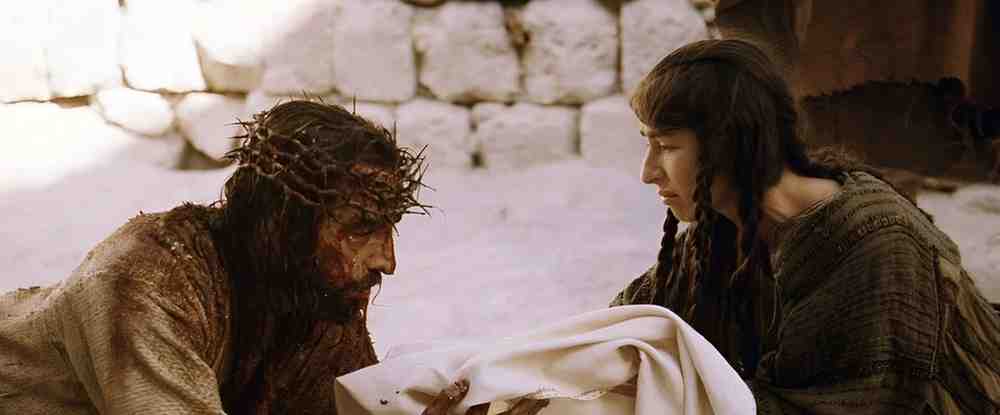
Mel Gibson’s The Passion of the Christ came out in 2004 and covered the last twelve hours of Jesus of Nazareth’s life from the Garden of Gethsemane, where he prays alone the night before his arrest, through the crucifixion. That’s the whole film. No origin story, no disciples getting their moment, no sermon on the mount. You are dropped into the middle of the story already in motion, and Gibson has absolutely no interest in catching you up. If you don’t already know who these people are and what’s at stake, the film will not stop to explain it to you. That’s either a bold artistic decision or a significant flaw, depending on how you look at it. Probably both.
Jim Caviezel plays Jesus, and the first thing worth saying is that not one syllable of English comes out of his mouth for the entire runtime. The film is performed entirely in Aramaic, Hebrew, and Latin subtitled, but only because someone apparently talked Gibson out of releasing it with no subtitles, which was his actual original plan. The man wanted to screen a film about the most recognizable story in Western civilization and just trust audiences to figure it out from context. I’m simultaneously baffled by that and kind of impressed by the audacity of it.
Caviezel is good. Really good, actually. He has this quality that’s hard to name a stillness, a weight that makes you feel like you’re watching someone carry something enormous before anyone has laid a hand on him. The gold contact lenses were a choice, but they worked. There’s a moment early on where even the actor playing Barabbas a blink-and-miss-it bit part seems to register something in Caviezel’s presence that wasn’t scripted. Little things like that are what separate a performance from an experience.
Now. The violence. We have to talk about the violence.
This film gets called Christian torture porn sometimes, and I don’t think that’s fair, but I understand where it comes from. The scourging scene Roman soldiers using a whip lined with bone and metal, designed specifically to tear flesh is not easy to watch. I’m not going to pretend it is. But here’s the thing I keep coming back to: every other film depiction of the crucifixion I’d seen before this one left me with a nagging question. Why did he die so fast? Crucifixion was engineered to be slow, agonizing, sometimes lasting days. Jesus was on the cross for roughly six hours. That never added up until I watched this film and saw the full picture of what his body looked like before they even put him on the cross. Oh, I thought. That’s why. Gibson wasn’t being gratuitous for its own sake he was being, in a strange way, more honest than anyone had been before him.
There’s artistic license throughout, and some of it lands better than others. The devil drifting through scenes like a silent observer is genuinely unsettling if this is the most significant moment in human history, you believe he showed up. The Roman torturers behaving like feral animals initially felt over the top to me, but Gibson is deliberately painting a portrait of human depravity, the worst of what people are capable of, doing this to someone who came specifically to save them. Once that framing clicked, the choice made sense. What doesn’t entirely work is the demon children tormenting Judas until he hangs himself a bit theatrical, a bit much. And cramming the story of the woman caught in adultery into Mary Magdalene’s backstory via a single rushed flashback doesn’t really serve either story. Some things needed more room than this film was willing to give them.
The scene that wrecked me and I mean genuinely wrecked me has nothing to do with the violence. It’s Mary. When Jesus stumbles and falls under the weight of the cross, and she runs to him through the crowd. That’s the moment. Because for two hours you’ve been watching a theological event, a cosmic transaction, the redemption of humanity and suddenly it’s just a mother watching her son die and being completely unable to stop it. The film earns that moment honestly, and it hits harder than anything else in it.
John Debney’s score deserves more credit than it usually gets. I bought the CD the week the film came out. Still have it. It’s the kind of score that tells you exactly what you’re supposed to feel before the image even registers haunting, swelling, specific in a way that most film music isn’t anymore.
My one genuine pacing complaint: the walk to Golgotha drags. You’re carrying two hours of accumulated grief by that point, and there are stretches of that sequence where Gibson just… keeps going. A tighter edit would have hurt nothing. I say that as someone who respects what he was going for.
One small thing that has stayed with me since 2004, and I mean this it genuinely changed how I watch movies. When Jesus dies on the cross and says “Father, into your hands I commend my spirit,” the camera catches his pupils dilate. That’s it. That’s all it is. But it was the first time watching someone die in a film where I actually felt like I’d seen a person die. I’ve looked for it in every film death since. Most don’t do it. We Were Soldiers apparently did it first also starring Mel Gibson, which explains a lot. But it’s a tiny, meticulous detail in a film full of enormous gestures, and somehow it’s the thing I remember most.
The resurrection gets about thirty seconds at the very end, and it needed to be there. Without it, the film is just suffering with no horizon. That brief final image Jesus, risen, walking forward isn’t triumphant exactly. It’s quiet. But it changes the entire emotional math of everything that came before it. The point was never the death. Gibson knew that. He just made you earn the understanding of it.
Is The Passion of the Christ a perfect film? No. Does it assume too much of its audience? Absolutely if you don’t know this story walking in, you’ll be lost. Does it live comfortably inside a specifically Catholic sensibility that not every viewer will share? Yes, and that’s worth knowing going in. But as an act of filmmaking the commitment of it, the craft of it, the sheer refusal to look away it’s one of the most serious and genuinely affecting religious films ever made. For a faith movie, it’s a real movie. And in 2004, that still felt like something.
With the sequel on the horizon, now really is the time to sit with this one again. Just don’t do it on an empty stomach.
