Last Updated on March 11, 2026 by Monica Castillo
The first surprise in The Optimist is how small Stephen Lang allows himself to be.
This is the same actor who once seemed capable of snapping steel cables with his hands. In Avatar he carried himself like a man who could bench-press a Jeep. In Don’t Breathe he turned stillness into something frightening. Yet here he enters the frame as Herbert Heller tall, slightly stiff, another elderly man you might pass in a grocery store without thinking twice. And that’s the trick. Lang makes you believe it.
He doesn’t drastically reshape his body for the role. What he changes is the way he inhabits it. Herbert walks with the determined pace of someone who still believes he’s 25 until his balance falters for half a second and reality taps him on the shoulder. Sometimes he stops mid-stride and scans the room as if the floor tilted without warning. There’s a touch of vertigo in the movement. Age creeping in through the joints.
The accent helps too Eastern European filtered through decades of American life, softened but never erased. The voice of someone who left home young and carried its rhythm with him whether he wanted to or not.
Herbert is dying. Cancer. The sort that makes people start sorting through the boxes in their past.
So he decides to talk.
The real Herbert Heller ran a clothing store in San Rafael, California, and spent years speaking to students about surviving Nazi-occupied Czechoslovakia. Before his death in 2021, he asked filmmaker Finn Taylor to turn his life into a movie. Watching Lang perform the role now carries a faint sense of obligation, as if the film is trying to keep a promise.
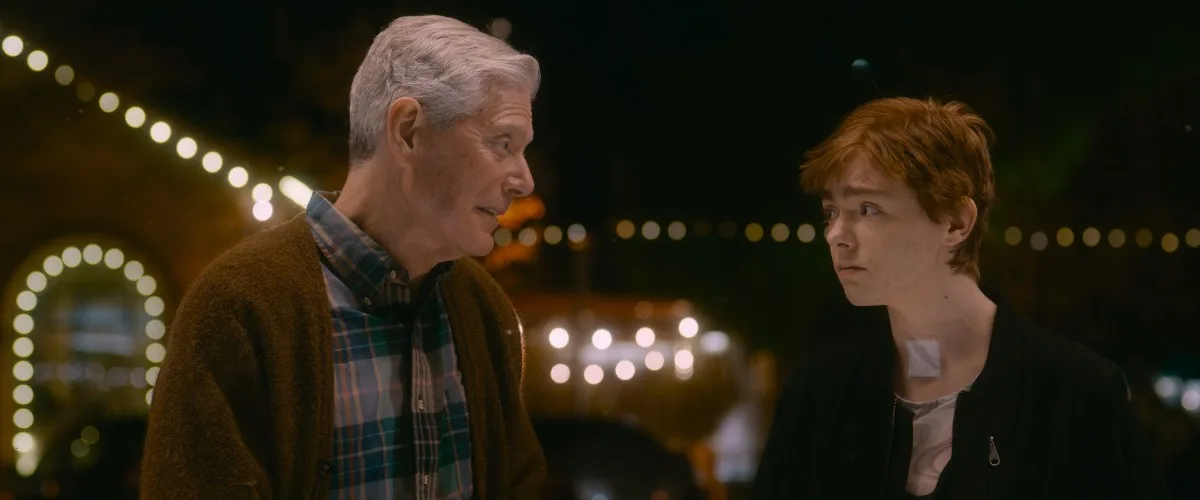
Across from him sits Abby, played by Elsie Kate Fisher, and she’s the other pillar holding this movie upright.
Abby is in rehab after a disaster she doesn’t want to discuss. Her counselor, Ruth (Robin Weigert, steady and perceptive), runs a small side project recording interviews with Holocaust survivors. Abby becomes her assistant. She holds the camera, asks questions, and occasionally fills the uncomfortable silences.
Soon she’s paired with Herbert.
At first the conversations feel stiff, the way conversations do when two strangers know they’re supposed to say something important but haven’t yet found the door into it. Over time that changes. Herbert warms to her. Abby listens in a way that invites confession.
Fisher understands this character immediately. Abby carries herself like someone who learned early that the safest place in a room is the corner. Shoulders angled inward. Eyes that drift away when attention lingers too long. Yet there’s a stubborn steadiness underneath it all, something Abby herself doesn’t quite recognize.
You’ve met people like her. Quiet kids who became easy targets because they were bright enough to threaten insecure classmates but not ruthless enough to fight back.
Fisher, only twenty-three, has been working long enough to make this look effortless. She started as the voice of Agnes in Despicable Me, then slipped into more demanding work in Eighth Grade, Barry, and Castle Rock. Here she plays shame without melodrama. Abby doesn’t beg for sympathy. She barely allows herself to speak.
Recommended: Scarpetta (2026) Parents Guide
Eventually she tells Herbert why she’s in rehab. After discovering ugly secrets about her father, Abby made a reckless decision that spiraled into tragedy. Someone she loved a restless, generous young woman named Sabrina ended up dead.
The weight of that fact never leaves the room. When The Optimist simply lets Lang and Fisher sit across from each other and talk, the movie works. You lean in. Their voices become the rhythm of the film. Unfortunately, the movie itself seems oddly impatient with those moments.
Taylor structures the story as a collage: Herbert in the mid-2000s telling his story, Abby reliving the mistake that destroyed her life, and long stretches following Herbert as a young man fleeing Nazi persecution and trying to rebuild afterward. The timeline jumps constantly. Just when a scene starts breathing, the film cuts sideways into another era. The effect isn’t so much intricate as restless.
You start imagining alternate versions of the film while watching it. One version could have been almost theatrical two people in a room trading memories until the air thickened with them. Another could have followed young Herbert across wartime Europe, surviving through luck, nerve, and the occasional act of kindness. A third might have stayed entirely with Abby, tracing the slow process of living with a terrible mistake.
Instead the movie keeps slicing between all three.
The interruptions arrive at the worst possible times. Herbert begins telling Abby a story, Lang leans forward, Fisher listens with that fierce concentration she has, and just as the scene tightens the film cuts to a flashback illustrating the memory we were already imagining. At other moments we sink into the past only to be snapped back to the interview room exactly when we’d prefer to stay where we are.
It creates a strange sensation: a film that keeps stepping on its own best moments. Yet dismissing The Optimist outright feels wrong. The craft is solid. Every actor commits fully. You can feel the filmmakers trying, sometimes a little too hard, to honor the material. And occasionally the movie lands somewhere special.
There’s a passage where the young Herbert slips back into Prague after escaping his tormentors. The city feels hollowed out, its familiar streets carrying an uneasy quiet. Neighbors glance at him with the guarded look of people who survived by looking the other way. The sequence unfolds almost wordlessly just small actions, fragments of narration, and images of a place that no longer feels like home.
Recommended: Project Hail Mary (2026) Parents Guide
Over it plays Jeff Tweedy’s “Love Is the King,” a song recorded eighty years after the events we’re watching. That choice sounds absurd when you describe it. On screen, somehow, it works. The music drifts across the images like a memory from the future.
For a few minutes the film stops explaining itself. It just lets the images exist.
I found myself wishing the whole movie trusted moments like that more. Trusted Lang. Trusted Fisher. Trusted the audience to sit with a story rather than chase it through three different timelines.
The Optimist is uneven and awkwardly built. Scenes collide. The editing keeps tugging the film away from the very conversations that give it life.
But there’s something stubbornly human about it too. A real man’s memories, an actor carrying them with quiet dignity, and a handful of scenes that remind you why movies despite all their missteps can still slip under your skin when you least expect it.
The Optimist: The Bravest Act Is Truth Parents Guide
The first thing parents should know about The Optimist: The Bravest Act Is Truth is that it isn’t built around spectacle. No explosive action sequences. No chase scenes meant to jolt younger viewers. The intensity comes from memory specifically the memories of a man who survived Nazi persecution and has decided, late in life, to speak honestly about it. That honesty shapes the entire experience.
Violence appears mostly in recollection and historical context rather than graphic display. When the film follows Herbert as a young Jewish boy in Nazi-occupied Czechoslovakia, the atmosphere carries real danger. Soldiers, interrogations, threats, the constant fear of betrayal by neighbors those elements hang over the scenes like a storm cloud. A few moments suggest brutality in concentration camps and wartime persecution, but the camera usually pulls back before anything explicit happens. Still, the emotional weight is strong. Children may not see bloodshed, but they’ll feel the menace of a world turning against ordinary people.
Language stays relatively restrained. Conversations carry the gravity you’d expect from discussions about war, guilt, and personal tragedy. There’s occasional profanity in tense or emotional moments, but it isn’t constant or aggressive. Because the story touches on the Holocaust, references to antisemitism and slurs tied to that history may surface in dialogue or historical context. They’re not used for shock value; they’re reminders of the hatred that shaped Herbert’s past.
Sexual content is minimal. The film acknowledges romantic relationships especially within Abby’s backstory involving a woman she loved but it treats those relationships with quiet respect rather than explicit imagery. Physical intimacy stays mostly offscreen. What matters is the emotional fallout from Abby’s decisions and the loss she carries, not the details of the relationship itself.
Substance use appears primarily through Abby’s storyline. She’s in rehab when the film begins, recovering from drug abuse connected to the tragic mistake that changed her life. The film references addiction, recovery meetings, and the consequences of substance use rather than depicting frequent on-screen drug consumption. Alcohol and smoking may appear briefly in adult settings, but they’re not a central focus.
Age recommendations depend less on explicit content and more on emotional readiness. Older teens roughly 14 and up are likely capable of processing the themes: Holocaust history, survivor’s guilt, addiction, and the burden of truth. Younger viewers may struggle with the heavy conversations and the quiet, reflective pacing. This isn’t a film that explains everything gently. It expects patience, empathy, and a willingness to sit with difficult stories.
