Last Updated on February 24, 2026 by Monica Castillo
About an hour into The Gray House, I had the strange, slightly panicked realization that the show wasn’t asking for my attention so much as my address. This wasn’t a series I could half-watch while folding laundry or checking my phone. It wanted me seated. Settled. Willing to learn the geography of parlors and prisons, to recognize uniforms by cut and mud pattern, to keep track of who could trust whom on which street in Richmond on which day. The show doesn’t ease you in. It throws the door open and expects you to step inside, boots off, plans canceled.
All eight chapters arrive at once on Amazon Prime Video on February 26, and together they sprawl across 522 minutes an audacious length that places the series in the long shadow of giants like Band of Brothers and The Pacific, and stretches well past John Adams or The Queen’s Gambit. This kind of scale used to belong to television events, the sort families planned meals around—Roots, War and Remembrance, Centennial and The Gray House clearly wants to stand in that lineage, for better and sometimes worse.
Because yes, it’s too big. Too busy. It carries extra characters like overpacked luggage, drags a few subplots behind it that never quite arrive anywhere interesting, and leans more than once on the weary old idea that moral clarity enters history through the conscience of a privileged white woman. The accents wobble. The dialogue occasionally announces itself. You’ll roll your eyes. Probably more than once.
And yet. It works. Not cleanly. Not always gracefully. But it works.
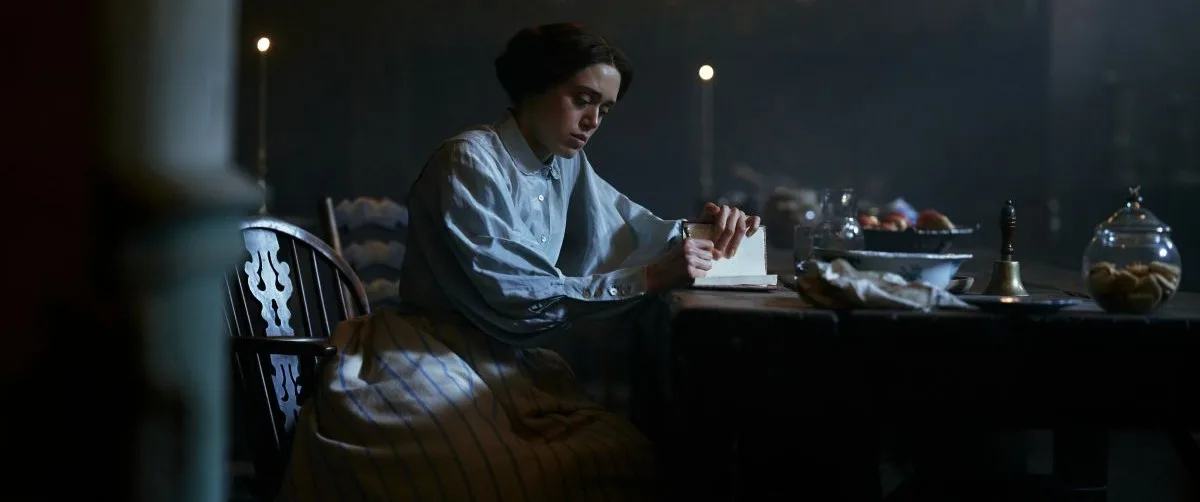
The series looks extraordinary, filmed with a tactile richness that gives weight to brick, fabric, and smoke. Romania stands in for Virginia, and if you squint you can feel Richmond’s streets tightening as the war presses in. The craftsmanship is never in doubt production design, costumes, editing, and camera work all conspire to make the past feel crowded and unstable, the way it must have felt to live inside it. With Kevin Costner and Morgan Freeman as executive producers, a writing staff that includes John Sayles, and all eight episodes directed by Roland Joffé of The Killing Fields and The Mission, the pedigree shows. Sometimes it shows a little too loudly.
Recommended: The Night Agent Season 3 Parents Guide
Freeman opens the series with a brief voice-over “This story is inspired by true events”—then wisely retreats until the end. His voice has become so culturally overfamiliar it risks tipping solemnity into parody, and the restraint feels earned. The story begins in Richmond on July 1, 1860, and centers on four women whose lives intertwine with a Union spy network operating in plain sight of Confederate power. Mary-Louise Parker gives Eliza Van Lew a brittle intelligence and social ease that reads as both armor and weapon. Her scenes feel lived-in, never posed. As her daughter Elizabeth, Daisy Head charges headlong into opinion and danger, sometimes with more conviction than judgment. Amethyst Davis, as Mary Jane Richards, supplies the series with its steadiest moral gravity, while Hannah James pushes past the limitations of the “courtesan with secrets” role through sheer force of presence.
Around them swirl politicians and generals Jefferson Davis, Judah Benjamin—and later the parade of historical faces that threatens, at times, to turn the series into a wax museum with dialogue. There’s even Ben Vereen, decades after playing Chicken George, now embodying Isham Worthy with a quiet authority that carries the memory of that earlier work whether the show intends it or not.
I kept thinking, during the battle scenes and the whispered exchanges, about how close the series comes to collapsing under its own ambition. There’s a soap-operatic excess to some of the writing. A few lines clang. A few detours stall the momentum. But the show never loses sight of what it’s reaching for: an account of resistance carried out not on open fields but in kitchens, churches, and drawing rooms, by people history footnotes and then forgets.
By the time Freeman returns to tell us who survived and who didn’t, The Gray House has worn me down and won me over. I didn’t admire every choice. I questioned more than a few. But I stayed. I moved in. And when it ended, I felt that particular, old-fashioned sadness that comes from leaving a place that demanded something from you and gave something back, unevenly, imperfectly, but honestly.
The Gray House 2026 Parents Guide
Violence; it lives inside it. Battle scenes arrive in bursts of noise and confusion, with blood on uniforms and bodies left where they fall. The show doesn’t linger on gore, but it never cushions the blow either. Violence tied to slavery is harder to shake public humiliations, threats, physical punishment, and the constant sense that harm can come without warning. The brutality isn’t sensationalized, but it is persistent, and it’s meant to be felt.
The language reflects the era, which means parents should expect more than the usual scattering of “damn” and “hell.” Racial slurs are spoken by characters who believe in them, and the show doesn’t soften that ugliness for comfort. The intent is clear these words expose character and cruelty but they land with force, and younger viewers may not have the context or emotional distance to process them.
Sexual content is present but restrained. One central character works as a courtesan, and the series treats her profession frankly without turning scenes into spectacle. There are moments of intimacy, implied nudity, and sexual tension used as currency or manipulation. Nothing is graphic, but the subject matter is unmistakably adult.
Alcohol and smoking are woven into daily life rather than highlighted as vices. Characters drink constantly whiskey passed in back rooms, celebratory toasts, long nights fueled by bottles that never seem to empty. Smoking is nearly everywhere: cigars, pipes, rooms clouded with it. The show doesn’t comment on these habits; it simply presents them as part of how people coped, avoided, and occasionally unraveled.
Age-wise, this isn’t meant for casual family viewing. Older teens with a strong grounding in history and an ability to sit with discomfort might manage it, but even then, supervision helps. The series demands patience and emotional maturity.
Recommended: The Last Thing He Told Me Season 2 Parents Guide
