Last Updated on February 25, 2026 by Monica Castillo
There’s a moment early on when Reggie Dinkins, flashing the kind of smile that suggests he’s never really accepted the verdict on his own life, shrugs off his career-ending scandal with the line, “I only gambled on myself.” It lands quickly, almost casually, and then it sticks. Not because it’s especially clever, but because it captures the peculiar moral weather system this show lives in a world where self-belief, self-delusion, and self-marketing blur together until no one’s quite sure where one ends and the other begins.
That uneasy, funny blur defines The Fall and Rise of Reggie Dinkins, which at first glance looks like a very specific attempt to bottle lightning twice. You put Tracy Morgan opposite Daniel Radcliffe under the guidance of Robert Carlock, and the comparison to 30 Rock feels less like a reach than a warning label. Former star with bottomless confidence. Neurotic creative type desperately clinging to relevance. Chaos, jokes, volume. You’ve seen this shape before.
But the surprise and it really is one is how quickly the show stops chasing that shape and starts bending it into something gentler, stranger, and more interested in how people hold each other up than how they tear each other down. Carlock and co-creator Sam Means clearly know every predictable pressure point this premise could lean on, and they consistently choose to lean somewhere else.
Recommended: The Gray House 2026 Parents Guide
Reggie Dinkins was once a superstar NFL running back until a gambling scandal cratered his career and his public image. Years later, with his legend reduced to punchlines and panel-show hot takes, he decides it’s time to reclaim the narrative. His solution is to hire Arthur Tobin, an Oscar-winning documentarian who torched his own credibility after melting down while trying to direct a Marvel movie. Arthur arrives brittle, superior, and clearly terrified that his best work is already behind him. Radcliffe plays him as a man who confuses seriousness with depth, and the performance keeps finding new shades of embarrassment without begging for sympathy.
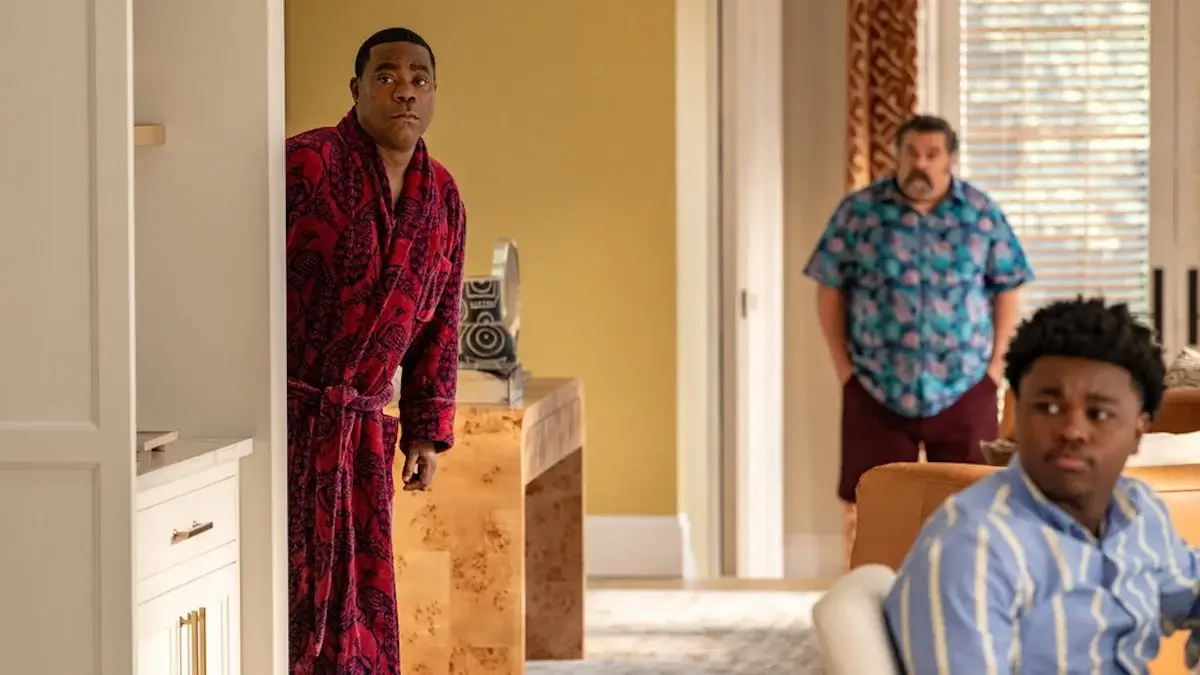
The people around Reggie could have been built as walking sources of conflict, but the show refuses that easy fuel. Monica, his ex-wife and longtime agent, doesn’t secretly pine for him or seethe with resentment. Erika Alexander plays her as someone who knows exactly who Reggie is and has decided, eyes open, how much of that she’s willing to manage. Brina, Reggie’s much younger fiancée, isn’t treated as a joke or a threat; Precious Way gives her warmth and intelligence without sanding off her optimism. Carmelo, Reggie’s teenage son, isn’t pushed toward a destiny he doesn’t want, and the show never pretends that parental disappointment would be funnier than acceptance. Even Rusty, Reggie’s former teammate who lives in the basement and behaves like a human non sequitur, exists less as a target than as a fact of life. Bobby Moynihan plays him like someone everyone has already agreed not to question.
That refusal to mine humor from cruelty shapes how the show moves. The laughs don’t come from characters shredding one another. They arrive sideways a ridiculous flashback, a one-liner that slips past you and then doubles back, a situation collapsing under the weight of pure bad luck. One of the season’s sharpest jokes sends Monica on a blind date that goes spectacularly wrong through no fault of her own. The joke isn’t that she’s flawed. The joke is that the universe can be.
Recommended: Dark Winds Season 4 Parents Guide
Morgan, inevitably, carries echoes of Tracy Jordan, but the writers don’t try to pretend otherwise. Instead, they reframe that energy. Reggie isn’t a walking disaster dropped into scenes to detonate them. He’s the emotional center, a man whose confidence keeps tangling with his own blind spots. Morgan plays him big, but not empty. You understand why people stay. You understand why they roll their eyes. Often at the same time.
What really frees the show up is the way it pushes conflict outward instead of letting it rot inside the house. Because these people aren’t locked in constant combat with one another, the pressure comes from rivals, hangers-on, media parasites, and various fame-adjacent opportunists who smell leverage. That shift does something quietly radical: it lets the family close ranks. Scenes often end not with a zinger at someone’s expense, but with a small, earned alignment a look, a shared irritation, an unspoken agreement to deal with the nonsense together. The guest characters, many of them calibrated to be sharper and more predatory, only make that bond clearer. Watching Reggie and his orbit navigate a world that rewards ruthlessness, you start to see the show’s softest instinct as its sharpest edge.
There’s an ongoing joke about how Reggie’s scandal looks almost quaint in a sports culture now saturated with legalized gambling and nonstop outrage, and the show trusts you to feel the queasiness of that without underlining it. It doesn’t lecture. It observes. It lets the absurdity speak for itself.
By the end of the ten episodes, the most striking thing isn’t that the story feels finished, but that it doesn’t. This feels like a show just beginning to understand what its ensemble can do, how many different combinations still haven’t been tried. In another era, this would’ve been allowed to stretch out, to grow over a longer run. Instead, it stops mid-thought.
Reggie wants his name restored. The show, more quietly, suggests something else matters more: who’s willing to stand beside you when the noise dies down. It’s a modest idea. And it’s one that stays with you after the jokes fade.
The Fall and Rise of Reggie Dinkins Parents Guide
Violence and intensity are minimal and mostly verbal. There’s no graphic physical violence, no blood, and no sustained threat. The most aggressive moments come in the form of raised voices, public embarrassment, or the social fallout of past scandals. Sports-related imagery appears in flashbacks, but injuries are not lingered on or sensationalized. Emotional tension exists — reputations on the line, careers wobbling but it’s played for humor rather than suspense.
Language is present but controlled. Expect occasional profanity, including mild to moderate swear words, used casually rather than aggressively. There are no slurs, and insults tend to be situational rather than cruel. The tone favors absurdity over nastiness, and when characters say something sharp, the joke is usually on them. Younger viewers won’t be inundated with foul language, but it’s not a show that pretends adults don’t swear.
Sexual content is light and mostly implied. References to relationships, dating, and off-screen intimacy appear, often as part of character dynamics rather than explicit jokes. There is no nudity, and sexual humor stays firmly in the realm of suggestion or awkward conversation. The show treats romance as part of adult life, not as a source of shock.
Recommended: Lead Children (2026) Parents Guide
Drugs, alcohol, and smoking appear occasionally, largely in social or industry settings. Characters drink at events or in casual conversation. Gambling is a recurring theme due to Reggie’s past scandal, discussed openly and sometimes satirically, but not depicted in detail. Drug use is referenced more than shown, and there’s no glamorization of addiction.
Age-wise, this is best suited for teens and up, with a stronger recommendation for older teens and adults. Viewers around 14–15 can likely handle the content, but many of the jokesabout media culture, sports hypocrisy, and professional burnout will land harder for adults. This isn’t inappropriate for younger audiences so much as uninterested in catering to them.
