Last Updated on March 22, 2026 by Monica Castillo
Ever sat through a church play and thought, “You know what? This is a good story. It just needed a bigger budget and a lot less cardboard”? That’s basically the experience of watching Fox’s The Faithful: Women of the Bible a series of three made-for-TV movies retelling Old Testament stories through the eyes of the women who actually lived them. And look, the intention is genuinely noble. These women deserve the spotlight. They’ve waited thousands of years for it. So it’s almost painful to report that when the spotlight finally flicks on… it kind of flickers.
So, What’s the Story?
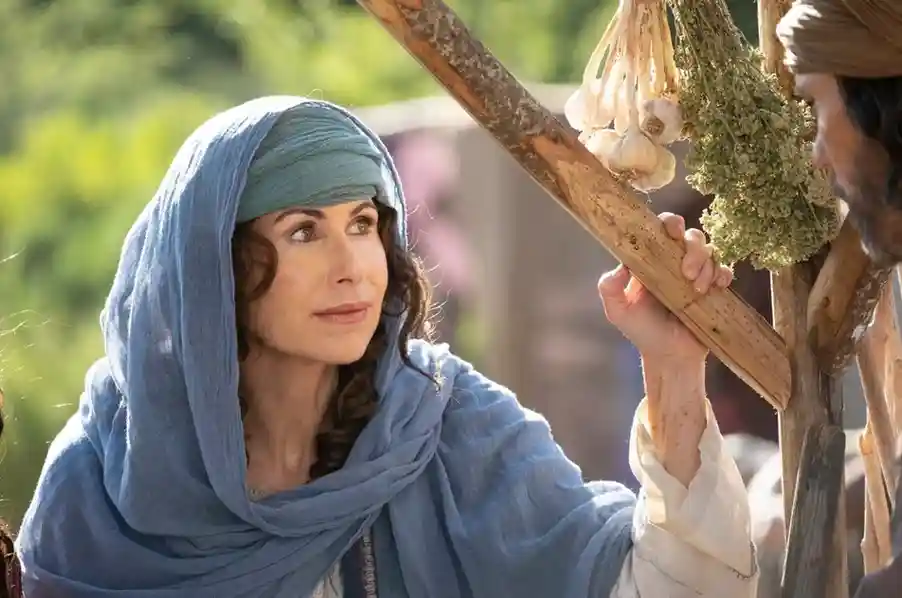
The first film , the only one critics got to see ahead of air is called “The Woman Who Bowed to No One,” and it centers on one of the most emotionally brutal love triangles in all of human literature: Sarah (played by Minnie Driver), her husband Abraham (Jeffrey Donovan, largely relegated to the sidelines here), and Hagar (Natacha Karam), the woman Sarah asks her husband to sleep with because she herself cannot conceive.
Let that sink in for a second. Sarah, a woman who loves her husband deeply, who aches for a child she can’t have, makes the impossible decision to offer another woman to him and then raises that child as her own. And Hagar, a woman who has already escaped the horrors of Pharaoh’s Egypt, who finds something like safety and kindness with Sarah and Abraham what does she feel when she has to give the baby away while still living under the same roof?
These are not small questions. These are the kinds of questions that keep theologians, therapists, and honestly just regular people up at night. They echo our very modern conversations around surrogacy, bodily autonomy, and what love actually looks like when it gets really, really complicated. There is so much to work with here.
Which makes it all the more frustrating that The Faithful doesn’t fully dig in.
Here’s the thing: adapting sacred scripture is a genuinely tricky creative tightrope. You’re dealing with stories your audience may already know by heart, events that are meant to be simultaneously historical, miraculous, and deeply personal. Get it right, and you’ve made something transcendent. Get it wrong, and you’ve made a very expensive nativity play.
The Faithful lands somewhere between the two but unfortunately, a lot closer to the nativity play end of the spectrum. The aesthetic is stiff. The world feels thin. And without proper world-building to anchor us, the show’s miraculous moments land with a soft, unconvincing thud rather than the awe they’re supposed to inspire.
Think about what Netflix did with Cien Años de Soledad, or what HBO pulled off with Like Water for Chocolate. Those productions were lush you could practically smell the food, feel the heat, taste the dust in the air. So when magic happened in those worlds, it felt earned. It felt real. Because the ordinary world around it was so vividly constructed, the extraordinary had somewhere to land.
The Faithful doesn’t build that foundation. It just sort of assumes you’ll meet it halfway. And that’s a big ask.
Recommended: Dark Winds Season 4 Parents Guide
Let’s be fair: Minnie Driver is working hard. There’s genuine emotional intelligence in her performance, and she clearly understands the weight of what Sarah is carrying. Natacha Karam brings warmth and quiet dignity to Hagar. These are not bad actresses sleepwalking through their roles. They’re giving it real effort. The performances deserve a better vehicle.
But the production? Oof. Hagar’s wigs are and I say this with as much gentleness as I can muster distractingly bad. The costumes look like they were raided from a Vacation Bible School storage closet circa 1997. And the Voice of God effect? It’s a voiceover. Just a voiceover. For God. In a show about the Bible. That’s the best they had.
This is where you have to shake your head, because The Bible is quite literally one of the most powerful intellectual properties in human history. It has survived millennia. It has shaped civilizations. And somehow, it couldn’t get a wig budget.
The storytelling choices are equally baffling at times. The episode opens with a young Sarah defiantly refusing to marry a man her parents have chosen for her a scene that’s meant to establish her as fierce and independent. And sure, it does that. But it also makes her feel like every other plucky female protagonist of the last three decades. We’ve seen this opening. A hundred times. In a dozen genres. If you’re going to tell us Sarah is extraordinary, you actually have to show us why she’s extraordinary not just have other characters react to her like she is while we sit there wondering what we’re missing.
Highly Recommended: The Exorcism Parents Guide
And then there’s the birth scene issue, which honestly feels like the most glaring missed opportunity in the whole film. We see Hagar give birth the pain, the effort, the physicality of it. Fine. But Sarah’s birth? The woman who conceives way past any age where conception should be possible, in an ancient world with zero medical support? The show just skips it. Narratively, that is baffling. Hagar’s birth is biologically normal. Sarah’s birth is a miracle. That’s the scene you lean into! That’s the scene that could’ve been genuinely moving, even transcendent. Instead, The Faithful looks away at exactly the moment it should be looking closest.
If you have been waiting genuinely, faithfully waiting for Bible stories told from a woman’s perspective on mainstream television, The Faithful will probably satisfy that hunger, at least partially. It’s there. It’s earnest. It means well.
But if you’re coming in as a viewer who simply loves great storytelling, rich character drama, or visually stunning television? You might spend most of the runtime feeling like you’re watching something that could have been remarkable and somehow settled for being merely decent.
There’s a real idea buried in The Faithful a genuinely important one about finally giving complicated, extraordinary biblical women the full-throated, human, messy, gorgeous treatment they’ve deserved for centuries. Sarah and Hagar are not footnotes. They are the story. And this show seems to half-know that, which almost makes it worse.
The Faithful: Women of the Bible Parents Guide
Rated TV-PG | Fox
Violence & Intensity: Nothing here that’s going to traumatize anyone, but don’t let the Sunday-school aesthetic fool you completely. There are moments of peril and emotional tension references to slavery, captivity, and the general brutality of ancient life are woven through the story. Hagar’s time under Pharaoh’s rule is touched upon, and the power dynamics between masters and servants carry a quiet menace that younger kids might find unsettling even without graphic imagery. Childbirth is shown with some physical discomfort and pain. It’s not bloody or graphic, but it’s not sanitized into a warm glow either at least for Hagar’s scene.
Language: Completely clean. This is a Fox Biblical drama airing in primetime on a Sunday night — nobody’s dropping anything edgier than a dramatic pause. No profanity, no slurs, nothing that’s going to make you lunge for the remote. The tone throughout is reverent, sometimes stiff, and about as far from foul-mouthed as television gets.
Sexual Content & Nudity: This is actually where parents of younger children might want to have a conversation ready, not because of anything explicit there’s nothing remotely graphic on screen, but because of the subject matter itself. The entire emotional core of the story revolves around a wife asking her husband to sleep with another woman so she can have a child. That’s the plot. It’s handled with restraint and no physical depiction, but the concept of Sarah essentially arranging a sexual relationship between Abraham and Hagar is front and center. For teenagers, it’s a genuinely rich conversation starter. For younger kids, it might just be confusing without some parental context.
Drugs, Alcohol & Smoking: Absolutely nothing to flag here. Not a goblet of wine, not a whiff of anything. This one’s a clean slate from start to finish on that front.
Age Recommendation: Honestly, the TV-PG rating feels about right. For kids under 10, the themes are likely to fly over their heads or raise questions that need a thoughtful adult in the room to answer. For teenagers particularly those with any religious background or curiosity about faith, history, or women’s stories this is actually worthwhile viewing, even with its production flaws. The themes of jealousy, desperation, sacrifice, and complicated love are handled seriously enough to spark real discussion. Think of it less as a movie night and more as a conversation starter with your family.
Rating: 2.5 out of 5 Watch it if the Bible is your thing. But if Fox ever greenlights a Season 2, someone please please get these women a real budget. They’ve waited long enough.
