Last Updated on April 5, 2026 by Monica Castillo
The Drama is Rated R by the MPA for sexual content, some violent/bloody images, language throughout, and brief drug use.
There’s a peculiar cruelty in how long it takes to tell real love apart from infatuation. You can’t reason your way to the answer. Only time and hardship do that work slowly, and not always mercifully. Romantic comedies have long made a game of this uncertainty, testing fickle hearts through mismatched couples, farcical misunderstandings, and the kind of manufactured chaos that somehow clarifies what was always true. The Drama, however, has darker and stranger ambitions. Directed by Josephine Decker from a screenplay by Iliza Shlesinger, it arrives dressed as a darkly absurdist riff on the genre, and for a while, you believe it might actually know something the others don’t.
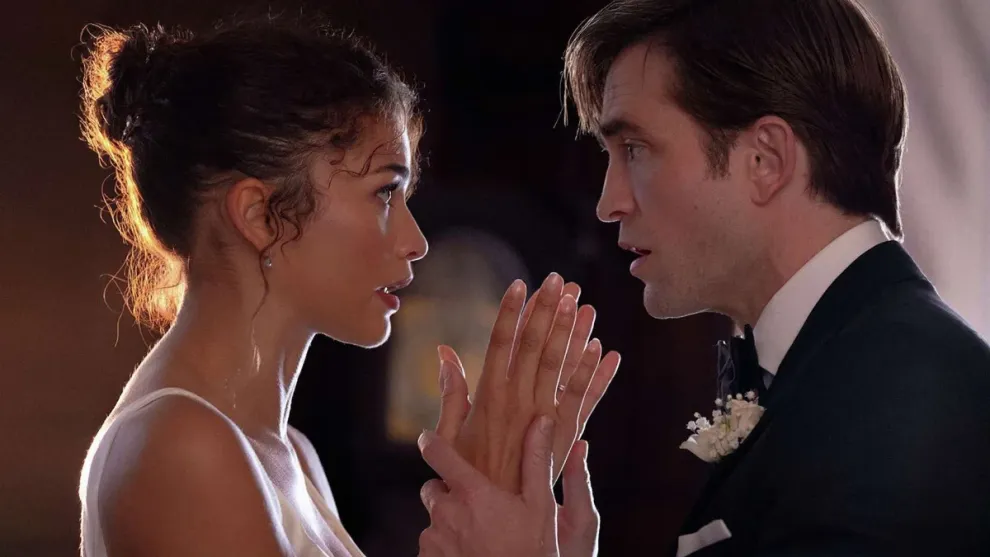
Emma (Zendaya) and Charlie (Robert Pattinson) are engaged. They are, by all appearances, in love, or something sufficiently close to it. Then one wine-soaked evening, Emma reveals a harrowing secret from her past, something she carried since adolescence, something so irreversible it sets the entire film spinning on a new axis. The fallout from that confession is meant to be the engine of everything that follows: questions about moral hypocrisy, about how we love people once we’ve seen the worst of them, about race and gender and the violence we believe different bodies capable of. These are urgent, genuinely charged questions. The tragedy and it is a tragedy of craft, not intention is that The Drama raises them with considerable noise and then, one by one, lets them quietly rot.
It’s worth saying upfront: this is a significant stumble for Decker, whose previous work suggested a filmmaker of rare intuitive power. In Madeline’s Madeline, she mapped the interior life of a young woman unraveling with an almost unbearable sensory intimacy. In Shirley, she used the gothic unease of Shirley Jackson’s world as a lens for examining creative obsession, feminine ambition, and the claustrophobia of expectation. Both films operated in a register of controlled strangeness, unsettling precisely because they trusted their characters so completely. The Drama does not trust its characters.
Highly Recommended: Imperfect Women (2026) Parents Guide
Shlesinger, best known for her stand-up and her semi-autobiographical 2021 Netflix film Good on Paper, writes with a sharp eye for social comedy, the performative warmth of dinner parties, the competitive undercurrents of friendships that have quietly curdled. You can feel those instincts in certain scenes. But the screenplay ultimately doesn’t give Decker enough to excavate. And Decker, for her part, seems caught between her own aesthetic impulses and a story that demands a different kind of discipline.
The film opens with a meet-cute you’ll either find endearing or, if you’re paying attention, quietly alarming. Charlie (a reliably magnetic Pattinson) is drafting his wedding speech with his best friend Mike (Mamoudou Athie), reminiscing about the moment he first laid eyes on Emma. She was in a coffee shop, reading. He watched her from across the room, stalked her, really — and when she stepped away from her table, he snapped a photo of her book: a fictional novel called The Damage by the fictional Harper Ellison, which Decker has teased as a future project, a bit of self-mythology baked into the film’s DNA. Charlie ran a quick search, bought just enough context to fake familiarity, and approached her. He didn’t initially realize he was speaking into her deaf ear. Emma, charmed despite all reason, gave him a second chance at his fumbling line.
It’s meant to be cute. It mostly is. But you might find yourself wondering, even then, what exactly Emma sees in this man beyond the fact that he tried. What does Charlie love about Emma beyond the thrill of having found her? What do they argue about? What do they want? The film can sense the hollowness, it even seems aware of it. Several characters describe themselves and others as being about “the vibes,” and there’s something almost confessional in how often that phrase appears. During coffee, Emma tells Mike’s wife Rachel (Alana Haim) that until she was 28, she had never been in love. It’s a small disclosure, but it lands with weight. Is this love, or is Emma simply close enough to love that the difference doesn’t feel urgent yet?
The film’s most structurally interesting scene attempts to answer that question by dismantling it. One night, over wine, Rachel dares Mike, Charlie, and Emma to confess the worst thing they’ve ever done. Mike admits to using his spouse as a human shield against a dog. Rachel once locked a boy in a closet. Charlie may have cyberbullied a kid in his teens. And then Emma speaks. Without detailing what she reveals, the film’s one genuine act of restraint, I’ll say only this: when she was a teenager, she took her father’s rifle with every intention of doing something devastating with it. The room changes. Rachel curdles. Charlie goes pale and distant. Everything that follows unfolds in the shadow of that moment.
There’s a version of this story in which Emma’s background unlocks a genuinely radical examination of Southern racism, of how Black women are exoticized and pathologized in the white imagination, of what it means to be seen as a “madwoman” and why that label lands differently depending on who wears it. Decker has proven herself capable of exactly that kind of radical empathy Shirley demonstrated it with bruising clarity. But here, those questions are raised and then quietly set aside, as though the film became nervous about the very territory it had staked out. The Louisiana backstory feels borrowed rather than inhabited. Emma reads, as one character more or less puts it, as retroactively Black color-blind casting that the narrative hasn’t fully thought through, or a character whose racial identity exists as context without being permitted to become meaning.
This is where Shlesinger’s screenplay most conspicuously struggles. The comic instincts that made her previous work feel lived-in don’t translate easily into the kind of cultural specificity this material demands. And Decker, whose previous films located their power in an almost sensory fidelity to interiority, seems here to have defaulted to formal experimentation as a substitute for depth.
The formal gestures are, at first, genuinely interesting. L-cuts chop conversations short before they resolve, the audio of one scene bleeding into the imagery of another, performing the film’s argument about miscommunication rather than simply stating it. The sound design layers separate dialogues, oscillating between Emma’s muffled deafness and Charlie’s hearing clarity, suggesting the fundamental asymmetry of how two people can occupy the same room and perceive almost entirely different realities. In quieter moments, this is quite beautiful. But it’s hard not to notice, as the film progresses, that these techniques are doing increasingly heavy lifting for a script that gives them less and less to work with. The smarter the editing gets, the more you’re aware it’s compensating.
Perhaps the film’s single most damaging failure is what it does with Charlie. Or rather, what it doesn’t do. Pattinson is an actor who has made a career of inhabiting damaged, emotionally arrested men from his early work in The Lighthouse to his more recent turns in Mickey 17 and he can conjure genuine menace and wounded pride from even minimal material. He does what he can here. But Charlie, as written, is a destination without a journey. His discomfort with Emma’s revelation is vivid; what it reveals about him is almost nothing. He doesn’t look inward. He doesn’t surface some equivalent darkness of his own. His soul-searching is performed rather than felt, a series of troubled expressions without any real excavation beneath them.
Mike and Rachel fare no better. Mamoudou Athie has the quiet authority of an actor who deserves a much richer role, and Alana Haim, so memorably alive in Licorice Pizza, is reduced here to a vehicle for social cruelty dressed up as righteousness. These are devices, not people. Their dialogue isn’t bad so much as purposeless they speak in order to provoke reactions rather than to reveal themselves. That’s not characterization; it’s puppetry with a morality-play agenda.
The film wants to position Rachel and, to a lesser extent, Charlie as self-righteous hypocrites people whose judgment of Emma says more about them than about her. It’s a fair point, and a potentially sharp one. But the film hasn’t earned the right to prosecute anyone’s apathy or moral vanity when it has barely troubled itself to understand its own characters. You can’t satirize superficiality from within it.
Highly Recommended: Outlander Season 8 Parents Guide
