Last Updated on March 6, 2026 by Monica Castillo
The bride is Rated R by Motion Picture Rating (MPA) for strong/bloody violent content, sexual content/nudity and language.
The film opens with Mary Shelley herself played by Jessie Buckley with the sort of wild, unbothered confidence that makes you sit up straight pacing through what looks like literary purgatory and swearing like someone who’s been stuck there for a century. She’s trying to figure out what comes after Frankenstein. How do you follow the monster you created? Where do you go once the story everyone remembers is already written?
Most directors would treat that premise with a certain polite reverence. Maggie Gyllenhaal kicks the door open instead.
Her Bride! is loud, strange, a little unruly. Sometimes brilliant. Sometimes messy in ways that make you suspect an executive somewhere took scissors to the film. But even when it stumbles, it moves with the kind of nerve you wish more studio films had.
Gyllenhaal doesn’t remake Bride of Frankenstein. She hijacks the idea and drives it straight into 1936 Chicago.
Shelley, still narrating from her strange afterlife office, chooses a woman at random to become her new Bride. That woman is Ida, also played by Buckley a mobster’s girlfriend who lives the kind of life that looks glamorous until the camera lingers half a second too long. Men use her. Men bruise her. Eventually one pushes her down a staircase and the story abruptly changes categories.
Death, it turns out, isn’t the end of Ida’s usefulness.
Across town, Frankenstein’s Monster Christian Bale under heavy makeup but unmistakably Christian Bale searches for companionship. Not just company. Something warmer. Something physical. Something human, or at least close enough to pass in dim light.
He finds an ally in Dr. Euphronius, played by Annette Bening with the amused impatience of someone who knows this whole enterprise is ridiculous but can’t resist poking it with a stick. When the resurrected Bride finally opens her eyes, she doesn’t remember Ida’s life at all. The slate’s clean. Which means the monster gets to fill it.
Recommended: Dolly Parents Guide
He tells her they were lovers. That her name is Pretty Penny. That they shared a beautiful life before tragedy struck.
And for a while, she believes him.
The dynamic between Buckley and Bale carries the movie through its most chaotic stretches. They have the chemistry of two people who shouldn’t trust each other but can’t stop orbiting the same gravitational pull. It isn’t hard to think of Joker and Harley Quinn watching them though the film that tried that trick recently wishes it had this much spark.
Buckley dominates the screen. That’s not criticism. It’s physics.
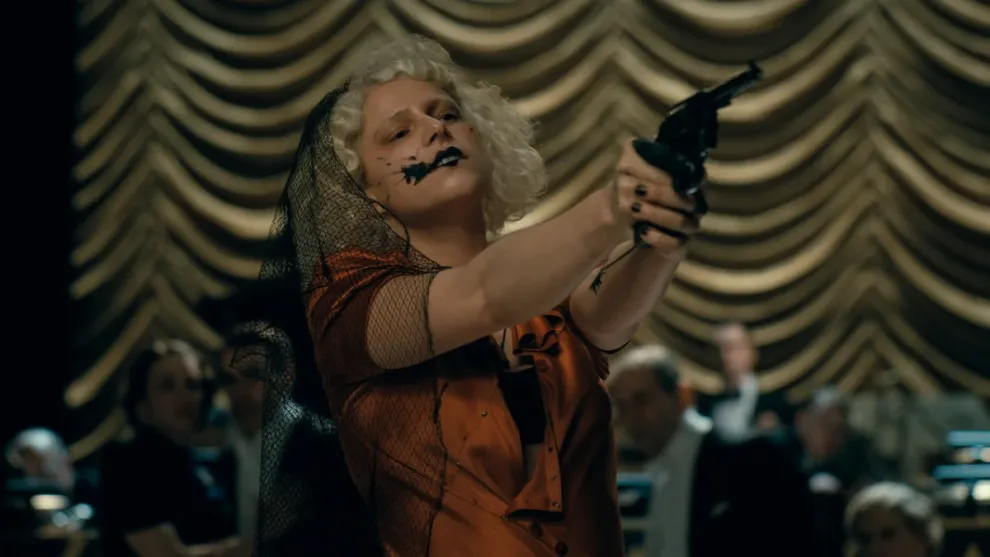
Her Bride looks like a silent-film phantom: white face, dark smudge at the corner of her mouth, tongue blackened like she swallowed ink. Women across the country begin copying the look as the pair drift across the Midwest leaving corpses behind them. Gyllenhaal frames it like the birth of a new kind of folk hero a woman who stops asking permission.
The road-trip structure feels pulled straight from Bonnie and Clyde or Badlands. Lovers on the run. Violence trailing behind them like tire tracks. But the movie isn’t really about crime.
It’s about anger. Old anger. The kind that sits quietly until someone finally listens.
There’s a dinner party scene midway through the film that I haven’t been able to shake. Ida wanders into a mobster’s house and suddenly hears something the others can’t. Voices. Women’s voices. Every woman killed by the men at that table, whispering from somewhere just offscreen.
Buckley lets the moment build until it detonates.
“The dead aren’t at rest,” she screams.
For a second the movie stops being fantasy and starts feeling like a warning.
Bale plays his monster with an almost embarrassing hunger. He wants love. He wants sex. He wants to be admired in the way movie stars are admired. When he discovers a musical film idol named Ronnie Reed played by Jake Gyllenhaal with a charming Dick Powell grin — he becomes fascinated with the idea of Hollywood masculinity. Reed survived polio. Walks with a shortened leg. Still gets the girl.
The monster watches those films and imagines himself inside them.
Not the monster. The leading man.
That thread could’ve supported half a movie by itself. Unfortunately the film only has time to glance at it before moving on. Ronnie Reed enters the story in a burst of energy and disappears almost as quickly, which feels less like intention and more like a missing reel somewhere on the cutting-room floor.
Other characters drift in and out with the same slightly unfinished feeling. Peter Sarsgaard and Penélope Cruz play detectives chasing the mob angle Cruz as Myrna Mallow, a Latina officer trying to earn respect in a department that treats her like decoration. There’s an interesting film hiding in her story too, but The Bride! keeps returning to the gravitational pull of Buckley and Bale.
Hard to blame it.
By the time the film reaches its chaotic finale at a drive-in theater — monsters, mobsters, movie screens flickering in the night the whole thing feels like it might spin off its axis. The plot frays. Side characters vanish. Threads dangle.
And yet I didn’t mind.
Some films fail because they don’t try enough. This one tries almost too much. Ideas crash into each other. Themes pile up like wrecked cars on the roadside. Gyllenhaal clearly had a bigger, stranger movie in her head than the one that reached theaters.
Still, what remains is alive in a way safer films rarely are.
Jessie Buckley walks through it all like a storm cloud that learned to speak. Angry. Curious. Occasionally funny. And by the end you realize the monster story Mary Shelley started two centuries ago was never really about the creature at all.
It was about the people who built it. And what happens when it finally decides to write its own ending.
The Motion Picture Association gave The Bride! an R rating, and the reasons aren’t subtle. Maggie Gyllenhaal’s film has the temperament of something that doesn’t care about polite company.
Violence erupts often, sometimes abruptly, and it isn’t staged with much restraint. Shootouts, beatings, and a handful of grisly deaths punctuate the story as the Bride and Frankenstein leave their mark across 1930s America. Blood appears frequently, and a few scenes linger just long enough to make the brutality sting rather than pass as spectacle. None of it feels cartoonish. The film wants you to feel the damage.
Recommended: 1920: Horrors of the Heart Parents Guide
Language follows the same philosophy: nobody bothers to clean up their mouths. Characters swear freely throughout the film, including repeated uses of strong profanity. The dialogue leans hard into coarse, adult language that fits the film’s rough world of gangsters, outlaws, and angry ghosts. The opening scenes alone make it clear this isn’t a polite retelling of a classic monster story.
Sex and nudity also factor into the R rating, though the film handles them with a mix of bluntness and dark humor. There are several scenes involving sexual situations between characters, along with partial nudity. The movie doesn’t shy away from the physical curiosity surrounding Frankenstein’s search for intimacy either an element that becomes both comic and unsettling at times. It’s frank about bodies and desire, which makes sense for a story built around a creature who simply wants to be wanted.
Alcohol and smoking appear regularly as part of the film’s period setting. Characters drink in bars, at parties, and during quiet conversations. Cigarettes are everywhere, the way they tend to be in movies set in the 1930s, and gangsters handle liquor like it’s another piece of furniture in the room. None of it becomes the focus of the story, but it’s constant background texture.
Taken together, the film clearly lands in adult territory. The themes, language, and imagery aim squarely at mature viewers who can handle violence, sexuality, and the film’s darker emotional undercurrents.
Recommended for Teenagers under 17 would likely find parts of it intense or disturbing, and younger viewers would almost certainly miss what the film is trying to wrestle with beneath the blood and bravado. This is the kind of movie meant for grown-ups who can sit with messy characters and uneasy ideas.
Recommended: Scream 7 (2026) Parents Guide
