Last Updated on February 27, 2026 by Monica Castillo
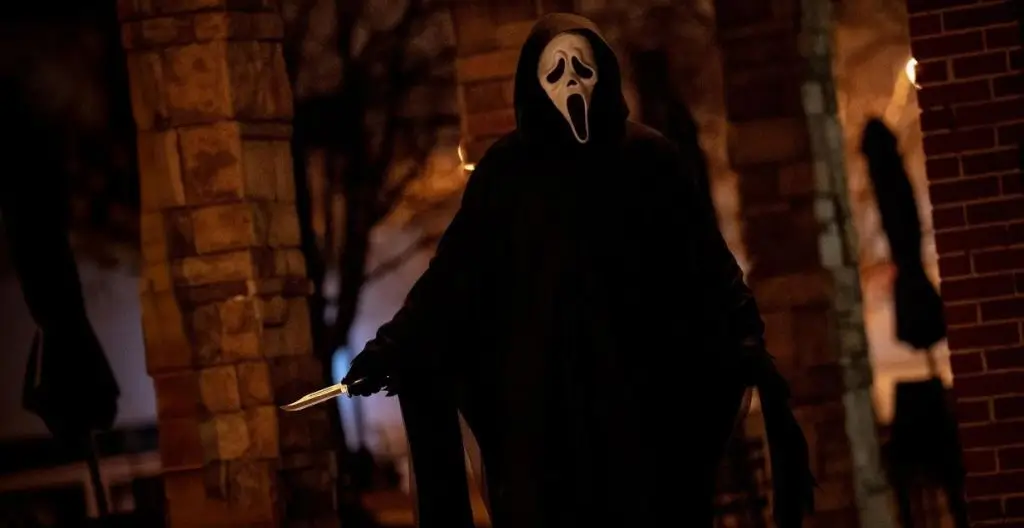
Scream 7 is rated R by the Motion Picture Association for strong bloody violence, gore, and language, and that rating isn’t doing any heavy lifting. The movie earns it the old-fashioned way: with knives, screams, and a fixation on how far a body can be pushed before the camera cuts away. Or doesn’t.
About halfway through Scream 7, I caught myself doing something I almost never do anymore. I stopped thinking about who the killer might be and started thinking about contracts, press releases, and the quiet sound of a franchise changing course in a panic. That’s not the movie’s fault entirely, but it is the movie’s truth. You can feel the seams. You can feel the erasures. You can feel the hand of a studio tugging the wheel hard and late, hoping the audience won’t notice the skid marks.
Scream 7 arrives with baggage it never metabolizes. The dismissal of Melissa Barrera, the sudden exits of Jenna Ortega and director Christopher Landon, the sense that something mid-thought was yanked away and replaced with a nostalgia-flavored substitute. This wasn’t a creative reset so much as a scramble. What we get is a film that wants desperately to feel inevitable, even as it constantly betrays how avoidable all of this was.
So back we go. Back to Sidney Prescott. Back to safety-through-familiarity. Back to the comforting illusion that if you repeat the shapes loudly enough, the feeling will follow.
Kevin Williamson, the original architect of the franchise, returns to the keyboard, and the guiding philosophy seems borrowed from Ice Cube’s weary speech in 22 Jump Street: do the same thing again and hope everyone claps. But repetition without conviction isn’t homage. It’s drift. And this script drifts constantly, inventing rules when it needs them, ignoring them when it doesn’t, and flattening characters into placeholders who exist solely to be chased, stabbed, or remembered fondly from better movies.
Highly Recommended: The Gray House 2026 Parents Guide
Sidney now lives in Pine Grove, a quiet town with a suspicious surplus of empty streets, alongside her husband Mark (Joel McHale) and their children. Ghostface, as ever, returns right on schedule, this time armed with videos claiming to originate from Stu Macher. Yes, that Stu. Dead since the Clinton administration. The movie flirts with the idea of resurrection, legacy, myth-making—then drops it like a hot pan once the logistics get annoying.
There’s an early scene set at Stu’s old house, now an Airbnb for true-crime tourists, and it captures the franchise’s current predicament perfectly. The kills here are grisly, inventive, occasionally inspired. A midair disembowelment lands with real, queasy force. You feel the technicians at work. But all that blood splashes against a wall of emptiness. The violence is louder than the ideas behind it.
What Scream 7 never resolves is which era it wants to honor and which it wants to pretend never happened. The Barrera–Ortega films hang over everything like an uncomfortable conversation no one wants to have. Williamson’s script acknowledges them just enough to feel defensive, then shuffles their remaining characters to the margins. The Meeks twins, once the emotional spine of the reboot, spend much of the film literally waiting for screen time as part of Gale Weathers’ news crew. That’s not subtext. That’s blocking.
The tone curdles further when the movie turns strangely contemptuous toward its own immediate past. Characters sneer at the previous films. Sidney is praised for skipping the last one. The implication is clear: those movies didn’t matter. Neither did the people who cared about them. It’s a risky move to insult the audience you’re asking to show up out of loyalty.
Following Sidney again should feel grounding. Instead, it feels circular. After watching her survive, adapt, and slowly reclaim agency across multiple films, this chapter insists she’s still fundamentally broken. Her teenage daughter Tatum named, of course, after Rose McGowan’s original character exists primarily to re-experience Sidney’s trauma at the exact same age. Therapy, growth, hard-earned resilience? The movie shrugs them away. Trauma here isn’t something you process. It’s something you reset for the sequel.
Highly Recommended: The Bluff 2026 Parents Guide
The parallel that kept nagging at me was Laurie Strode in David Gordon Green’s Halloween trilogy, especially Halloween Ends. Another final girl, another attempt to examine what survival does to a person when it stretches across decades. Neve Campbell sells the struggle because she always does. Her performance has weight even when the writing doesn’t. When the camera stays with her, the movie almost works. Almost.
Then it cuts away.
Courteney Cox returns as Gale Weathers in what feels less like a role than an obligation. She appears, disappears, and reappears at the climax as if checking items off a list. Mason Gooding and Jasmin Savoy Brown fare no better. The script engineers their presence through coincidences so elaborate they call attention to themselves, like a magician explaining the trick while performing it.
The most dispiriting thing is how little the film understands teenagers, a problem that would’ve horrified the guy who once wrote Scream and Dawson’s Creek. Isabel May’s Tatum isn’t a character so much as a collection of reactions. She runs through empty streets screaming instead of dialing 911. Her phone vanishes and reappears depending on the needs of the scene. The movie keeps insisting she isn’t her mother, then never gives her the ingenuity or defiance to prove it. Sidney fought back. Tatum barricades doors and waits.
The mystery, such as it is, barely registers. The killer reveal plays like a stretched-out episode of Scooby-Doo, the kind where you spend the unmasking trying to remember if you’ve seen this person before. Horror works best when its rules feel understood, even when they’re being bent. Here, the rules feel forgotten.
What Scream 7 does want to talk about awkwardly, angrily is fandom. Online outrage. Entitlement. The villain parrots complaints that once flooded comment sections when Campbell skipped Scream 6. How dare she. How dare the story move without us. The irony is thick enough to trip over. The film scolds the very audience it hopes will forgive it.
By the end, exhaustion sets in. Not shock. Not sadness. Just the dull fatigue of watching a series that no longer trusts its own instincts. This isn’t the worst crime a horror sequel can commit, but it might be the most fatal. The mask is still there. The knife still gleams. But the pulse the thing that once made these movies feel alive to the moment, they were made has slowed to a twitch.
Some franchises end with a bang. Others just keep walking, long after the lights should’ve gone out, mistaking movement for life.
Scream 7 Parents Guide
The violence is constant and explicit. This isn’t suspense built on shadows; it’s impact built on spectacle. Characters are stabbed, slashed, disemboweled, and killed in ways meant to provoke gasps rather than dread. There’s a noticeable uptick in gore compared to earlier entries, with close-ups of wounds, blood spray, and prolonged attacks that linger longer than necessary. The opening sequence alone establishes that the film wants to shock first and reflect later. Teen characters are placed in repeated life-or-death situations, and the intensity rarely lets up once Ghostface enters the frame.
The language is aggressive and frequent. Expect a steady stream of strong profanity, including repeated uses of the F-word and other coarse expressions. The dialogue leans caustic, often hostile, with insults tossed casually in moments of stress or sarcasm. While there aren’t many outright slurs, the tone is sharp-edged and mean-spirited, especially in scenes where characters argue or lash out under pressure.
Sexual content is minimal but present. There are references to sex, relationships, and intimacy, mostly verbal rather than visual. A brief romantic setup in the opening act suggests sexual activity, but nudity is not a focus, and the camera doesn’t linger on bodies for erotic effect. The franchise remains far more interested in violence than sexuality.
Drugs and alcohol. Adults drink socially, and there are background moments involving alcohol at gatherings, but substance use isn’t glamorized or central to the plot. Smoking and drug use are not major elements, and younger characters are not shown engaging heavily in either.
As for age recommendations, this is not a movie for kids or younger teens, even horror-savvy ones. The combination of graphic violence, relentless threat, and cynical tone makes it most appropriate for older teens late high school at the absolute youngest and adults who already understand what a Scream movie delivers. Even then, parents should know this installment is harsher and less playful than some of its predecessors.
Highly Recommended: Undercard 2026 Parents Guide
