Last Updated on February 27, 2026 by Monica Castillo
You have to give credit to developer Nerial for coming up with a gameplay formula as simple and easy to understand as that of Reigns. This short-form adventure strategy game is essentially about making choice-after-choice in the hope of surviving as long as you possibly can and it’s a formula that has been adapted from the original idea into branded collaborations like with Game of Thrones and also into other historical settings like the Three Kingdoms of China. Accessible on PC but also mobile, where in my eyes this series actually shines brightest, Nerial has managed to land another big fish and combined the basic brilliance of Reigns with the exceptional fantasy universe of The Witcher.
If you played the Game of Thrones edition and thought that was Reigns at its finest, you’ll be similarly impressed with the structuring of Reigns: The Witcher. The premise hasn’t changed at all. You stare at cards with short challenges to overcome and you must select one outcome or the other depending on how it fits where you want to lead the story. The caveat is that you have to survive as long as possible, but this is far from easy as the four key attributes change with every choice you make.
For example, a human lord might ask for help in dealing with a Scoia’tael agent, wherein your choices are to ignore their pleas and upset the human faction or accept their request and upset the non-human faction. There’s rarely a choice that works well for all involved and even when you do come across unanimously positive options, it’s never usually to the benefit of Geralt, as the aim isn’t about pleasing everyone but keeping these attributes firmly centred. At the end of the day, a Witcher is no ally to humans, non-humans, or magic-users first and foremost, as rather a Witcher moves through the land drenched in impartiality. If you find yourself too kind to magic-wielders (at the end of the day, it’s hard to say no to Yennefer and Triss), Geralt will ultimately find himself dying a hedonistic death, which one could argue is better than being lynched by an angry human mob but that at the end of the day has the same outcome in Geralt’s adventures coming to an abrupt end.
As you can see, like past Reigns titles, this The Witcher edition is also about politics and balancing the expectations of all the three key parties. The main difference here when compared to prior instalments in the series is that the fourth and final attribute is Witcher-specific. Each decision you make that benefits or harms Witcher-kind will rise and lower this attribute, where seeing it hit rock bottom is a massive problem but seeing it cap out won’t actually result in immediate death and instead will lead to an incoming fight, typically with a monster. This is an extremely basic encounter where you move Geralt’s icon left and right across a grid to avoid incoming damage tiles all while attempting to land on attack tiles so you can strike back. Think on the lines of Guitar Hero, if it was scaled back to its very, very most rudimentary. It’s a pleasant break from the card-swiping gameplay, but hardly a feature that will have you singing with glee.
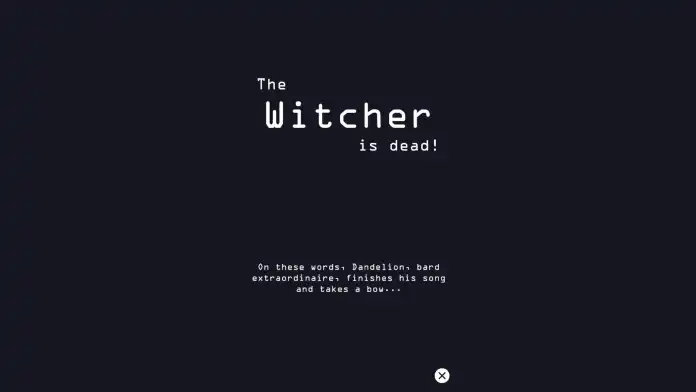
But anyway, what’s actually the narrative thread that ties this game together, you ask? It’s The Witcher and as you may expect, any story worth a damn in this universe is performed by the legendary (and totally humble) bard Dandelion. You don’t actually play as Geralt of Rivia in this game, as the plot is basically that Dandelion tells stories where Geralt is the main character, and these stories are what you experience, hence why events that otherwise have never happened happen and why the traditionally wise and wary Witcher dies a host of grisly deaths in this game. This idea is also how the different card modifiers are applied, as you will have to contort your approach to each story depending on the three cards laid out prior, with this being Tarot-like elements that depict a certain narrative premise.
Highly Recommended; The Mortuary Assistant (2026) Parents Guide
It could be Geralt the Eternal, Geralt the Comedian, Geralt the Lover, the list goes on, and the idea is that each card has a way to ‘complete’ it by exploring narrative elements that are only present when this card is used for a ‘run’. And why would you complete a card? As you complete cards, you will earn experience to level up Dandelion and unlock new cards, and each completed card provides the bard with new inspirations for stories he tells to those that book him for jobs.
This brings me to the final layer worthy of note in Reigns: The Witcher. Dandelion’s performances happen every so often and this is where you find yourself taking to different castles and towns to weave a tale based on what the organiser is searching for. One individual may want a tale about how nasty Witchers are, leading Dandelion to whip out stories based on Geralt’s gullible nature, love of monsters, and hatred of humans, each being threads based on your completed cards. This is a mini narrative game where it’s about selecting the right card based on the text-based dialogue laid out, which is ultimately similar to the main Reigns format but at the same time highly unique. Like the combat, it works fine but you also won’t be crying in the town square about how revolutionary this feature is.
Nerial has done a wonderful job at bringing The Witcher into Reigns, with an effective use of the wider narrative, monsters, characters, political allegiances, and such, plus the music, sound effects, and visual direction all feel as though they could belong in one of CD Projekt Red’s games. The best comparison I can think of about the way this game looks is if The Witcher had a Fort Condor-like mode from Final Fantasy VII. That’s the vibe that this Reigns title gives off.
But all in all, Reigns: The Witcher is just more Reigns. If you still find this gameplay formula fun and entertaining, there’s a lot to love, but if you think it could use a more significant overhaul, this instalment won’t exactly impress you much more that the other highly similar chapters did. It’s incredibly easy to pick up, doesn’t demand much time at all to blast through a run, and it works like a charm on mobile devices. You could say that this is the ultimate commuting video game and if you’re looking for something to fill such a void, you won’t go too far wrong here. That being said, if you’re desperate for anything more from The Witcher to tie you over until The Witcher 4 in a few years, you probably won’t find all too many hours of entertainment here before deciding to move on.
Reigns: The Witcher Guide
Reigns: The Witcher lives and dies by balance. Every card you swipe pushes one or more meters, and the game rarely tells you which one will matter most until it’s already too late. The goal isn’t to make the “right” decision. It’s to avoid making the same kind of decision too often. Favor humans too consistently and you’ll pay for it. Indulge magic users because Yennefer or Triss bats an eyelash and Geralt’s life collapses just as quickly. Neutrality isn’t safety here. It’s a tightrope.
Most choices are political, even when they don’t look like it. Requests for help, moral dilemmas, offhand conversations nearly all of them tie back to humans, non-humans, or magic. You’re not meant to solve problems. You’re meant to survive the fallout. When a choice feels generous, it’s usually a trap. When it feels cruel, it often buys time. The smartest runs come from alternating instincts rather than following one guiding philosophy.
The Witcher-specific meter works differently and demands special attention. Let it sink too low and Geralt’s story ends abruptly. Let it climb too high and the game throws you into combat instead of killing you outright. These fights are simple rhythm challenges, more reflex than strategy, and they exist as pressure valves rather than set pieces. You won’t win by mastering them. You’ll win by not triggering them too often.
The modifier cards Geralt the Lover, Geralt the Comedian, Geralt the Eternal—are where long-term progress lives. Each one reshapes how certain situations play out and introduces narrative threads you won’t see otherwise. Completing their hidden objectives isn’t about efficiency. It’s about experimentation. Lean into the personality they suggest, even when it feels counterproductive, and you’ll unlock new possibilities for future runs.
Dandelion’s performances function as both reward and test. When you’re asked to tailor a story for an audience, read carefully. These segments mirror the core game but reward thematic consistency instead of balance. Matching the tone the listener wants matters more than telling the “best” version of events. Success here feeds directly into progression, unlocking new cards and expanding the narrative sandbox.
If there’s one practical piece of advice worth holding onto, it’s this: short runs are normal. Frequent deaths aren’t failure. They’re the point. The game teaches through repetition, not mastery. Play in bursts. Let curiosity guide you more than caution. The story isn’t what happens to Geralt. It’s how many different ways he can fail before you understand why.
This isn’t a game about winning. It’s about surviving long enough to hear a better story the next time around.
