Last Updated on February 20, 2026 by Monica Castillo
Psycho Killer Rated R by the Motion Picture Association for strong bloody violence, strong sexual content, graphic nudity, drug use, and pervasive language.
The trouble is that “Psycho Killer” doesn’t seem particularly interested in style at all. Or, for that matter, in ideas. It unfolds as a bare-bones cat-and-mouse chase, populated with half-formed notions about Satanism and capped off by an ending so misguided it’s hard not to cringe a little in your seat. The screenplay comes from Andrew Kevin Walker, whose name still carries weight thanks to the corrosive brilliance of Se7en. But this film feels less like a descendant of that classic than a bad dream version of it closer in spirit to the infamous, studio-friendly alternate ending that would have replaced “what’s in the box?” with a dull shootout inside a church. It’s worth pausing to be grateful that version never made it to the screen.
The film centers on Jane Archer, played by Georgina Campbell, a highway patrol officer whose life collapses when her husband also a cop is murdered during what should have been a routine traffic stop. The killer, it must be said, was pulled over without probable cause, and the officer wasn’t exactly radiating restraint. Still, the movie wastes no time turning Jane’s grief into fixation. She becomes consumed with tracking the so-called Satanic Slasher apparently all the good serial-killer nicknames have already been claimed crisscrossing America’s highways and decoding his cryptic messages scrawled in blood, determined to halt his roaring spree. You can feel the film straining to mythologize this pursuit, to give it weight it hasn’t earned.
Highly Recommended: I Can Only Imagine 2 (2026) Parents Guide
There’s an old line, often attributed to Oscar Wilde, about misfortune and carelessness, and it’s hard not to think of it here. Losing a spouse is tragedy enough; losing any trace of a personality along with him feels like narrative negligence. Whether it’s meant to be an expression of grief or simply a failure of characterization, Jane Archer barely registers as a human being. She has no idiosyncrasies, no contradictions, no inner life you can latch onto. She isn’t so much a character as a placeholder a blank index card labeled “PROTAGONIST,” with the details to be filled in later. Campbell, to her credit, behaves as if there’s something there, committing fully to emotions the script never quite articulates. Watching a capable actor labor to give shape to emptiness is quietly painful, and her effort is the closest the film comes to dignity.
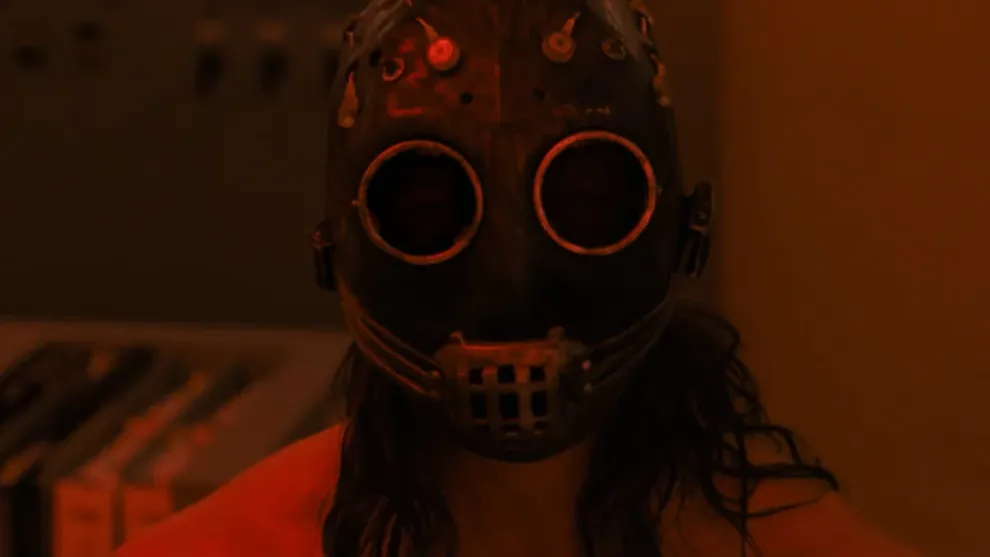
The Satanic Slasher himself is portrayed by James Preston Rogers, who looms through the film as a massive, unkempt presence, all stringy hair and cavernous voice. You might think he wandered in from an audition for Heathcliff and never left. His face is kept mostly hidden, so the performance boils down to physicality and mood less a person than a moving mass. The sound design amplifies this, giving his footsteps an absurd, thunderous quality, as if he’s forever stomping across creaky floorboards in oversized boots, regardless of whether he’s on asphalt, dirt, or concrete. It’s ridiculous, though the mask, at least, has a certain grim flair.
Midway through, the film detours into a subplot involving a community of Satanists orbiting the killer, and for a fleeting moment, you can sense the movie flirting with something interesting. Here, the Slasher appears to be a genuine believer, surrounded by people who treat Satanism as little more than an excuse for excess and spectacle. You might start to wonder if the film is about to say something anything about faith, performative belief, or the dangers of ideological extremism. That hope doesn’t last long. The sequence exists largely to kill time, padding out a second act that otherwise has nowhere to go.
The movie marks the directing debut of Gavin Polone, whose producing résumé includes Curb Your Enthusiasm and genre staples like 8mm, Stir of Echoes, and Zombieland. Those films understood how to energize familiar material with confidence and rhythm. Here, that spark is missing. With more panache behind the camera, “Psycho Killer” might have survived its own simplicity, even its occasional silliness. Instead, it sits there, strangely lifeless. The inertia sets in early, and it never lifts not even during the opening credits, which parade a series of pagan symbols that look less like ominous iconography than a forgotten desktop screensaver.
Highly Recommended: Lead Children (2026) Parents Guide
Perhaps the film’s most unforgivable sin beyond its wince-inducing finale is its casual misuse of a great song. The Talking Heads’ 1977 single Psycho Killer is a sly, unsettling pop artifact, a serial-killer fantasy imagined, as David Byrne once described, as a collision between Alice Cooper and Randy Newman. That’s wit. That’s tone. It’s painful to see it dragged into service of a film so lacking in both. Honestly, if the filmmakers were searching for a Talking Heads title that captured the mood of this wandering, ominous road trip, they already had one waiting for them. Road to Nowhere would have been painfully apt.
Psycho Killer (2026) Parents Guide
Violence & Intensity: Murders are frequent and linger on bloodshed, with stabbing, bludgeoning, and ritualistic killings framed in a grim, exploitative way. The “Satanic” elements lean heavily into shock imagery bloody symbols, mutilated bodies, and crime scenes designed to unsettle rather than illuminate. The tone is harsh and relentless, though rarely suspenseful; instead, it settles into a numbing cycle of brutality.
Language: Strong language is used throughout, including frequent uses of the F-word and other crude expressions. The dialogue has an aggressive, abrasive edge, often spoken in anger or contempt. While slurs aren’t a defining feature, the verbal tone is consistently hostile and coarse, reinforcing the film’s mean-spirited atmosphere rather than adding realism or depth.
Sexual Content / Nudity: film includes graphic nudity, sexualized violence, and ritualistic sexual imagery tied to its Satanism subplot. These scenes exist largely for provocation, not character development, and may be deeply uncomfortable for viewers. There’s little emotional framing sexuality is treated as another tool for shock.
Drugs, Alcohol & Smoking: Substances are shown casually and sometimes indulgently, without meaningful consequences or critique. Alcohol and smoking also appear intermittently, reinforcing the film’s grimy, morally vacant setting.
Age Recommendations: This film is not appropriate for children or younger teens in any context. Even older teenagers may find its content excessive and unpleasant rather than thrilling.
