Last Updated on March 3, 2026 by Monica Castillo
In a television landscape built for distraction limited series, half-watched seasons, stories abandoned mid-thought it’s something of a minor miracle that Outlander has lasted eight seasons and is preparing to end in 2026 without feeling like it overstayed its welcome. That kind of endurance isn’t just about ratings or loyalty; it’s about trust. The show earned the faith of its audience by committing, over and over again, to emotional follow-through. It never stopped believing in the power of long memory.
Adapted from the novels of Diana Gabaldon, the series has always been a balancing act one that shouldn’t work as well as it does. Sweeping romance shares space with brutal wars, political upheaval, time travel logic puzzles, and flashes of humor that arrive just in time to keep the weight from becoming unbearable. Twelve years on, the story is finally preparing to let go of Claire and Jamie Fraser and the extended family that formed around them. There’s something quietly devastating about that realization. These characters haven’t just lived through history; they’ve lived alongside us.
The final stretch arrives without the safety net of Gabaldon’s concluding novel, leaving the show’s writers to imagine an ending without a definitive blueprint. For longtime fans, that uncertainty stirs familiar anxieties. Anyone still waiting on George R. R. Martin to finish A Song of Ice and Fire knows how uneasy it feels to love a story without knowing how or if it will end. The lingering question, then, is whether Outlander can craft a conclusion that feels emotionally whole, or whether it will leave behind a vacuum destined to be filled with endless attempts to rewrite what didn’t land.
Highly Recommended: The Umbrella Academy Season 4 Parents Guide
Based on the first three episodes provided to critics, the answer seems to be that the show isn’t chasing reinvention. Instead, it’s leaning into familiarity. New antagonists emerge, instantly abrasive in the way Outlander villains tend to be. Battles loom where survival feels uncertain but inevitable. Loss arrives, as it always does, with the quiet cruelty of timing. Time itself bends and doubles back. And at the center of everything remains a love story that, against all odds, still feels alive.
Spoilers ahead.
The previous season ended on one of the show’s more destabilizing twists a revelation about the fate of Claire and Jamie’s presumed stillborn daughter that felt deliberately disorienting. The premiere wisely avoids prolonging the confusion. Answers come swiftly. But just as quickly, the storyline recedes, closing before it has time to fully breathe. It’s the one narrative choice that feels slightly misjudged, less because it exists than because of how briefly it lingers. Whether it proves to be a narrative cul-de-sac or the quiet start of something larger is a question the rest of the season will need to answer.
From there, the story moves on, as history always does. We arrive in Savannah in 1779, freshly reclaimed by the British, where Claire, Jamie, and young Frances are making their way back toward Fraser’s Ridge. Along the journey, the show allows itself the luxury of reunion. Old faces reappear not as cheap nostalgia, but as reminders of the lives these characters have intersected with and changed. In lesser hands, such moments can feel obligatory. Here, they feel deserved. You can sense the shared past humming beneath the dialogue.
Once back at Fraser’s Ridge still defiantly outside British control the Frasers reconnect with Ian, portrayed by John Bell, who has rebuilt their home piece by piece. Familiar figures like Amy and Lizzie resurface, grounding the present in memory. Then comes the long-anticipated revelation: Brianna has brought Roger and their children back through time.
With them comes something more dangerous than weapons knowledge. A modern book titled Soul of a Rebel, written by Frank Randall, makes its way into Jamie’s hands. What begins as curiosity hardens into dread as he sees his own name printed again and again, culminating in a calm, historical certainty: Jamie Fraser is meant to die at the Battle of Kings Mountain. You can feel the shift in him. Fate, once something he challenged head-on, now waits for him patiently, already written. It’s a quietly terrifying idea that the future might already be done with you.
That fear isn’t Jamie’s only burden. The Ridge has changed in his absence. New settlers arrive with new allegiances, and not all of them sit easily. Captain Charles Cunningham, played by Kieran Bew, presents himself as courteous and cooperative, though his past as a British soldier never fully fades. Benjamin Cleveland, embodied by Turlough Convery, is more openly hostile, urging Jamie to join a militia against the Tories. And beneath it all simmers Jamie’s unresolved jealousy over Claire’s encounter with Lord John Grey a reminder that even time-traveling soulmates carry human wounds.
Recommended: House of the Dragon Season 2 Parents Guide
Lord John, portrayed with quiet restraint by David Berry, remains an essential presence, though he keeps his distance from the Frasers. His focus shifts toward William, who is unraveling after Jane’s death. When John delivers devastating news about one of William’s cousins, it sends the young man on a personal reckoning less a quest for answers than an attempt to outrun grief.
The final season doesn’t signal a radical departure, and that feels intentional. Outlander has survived by trusting its emotional grammar. There are births that feel miraculous precisely because of how much has been lost. Deaths arrive with the familiar ache of inevitability. Romance and sex remain part of the fabric not as spectacle, but as reassurance. The heat of early-season passion may have cooled, but something steadier has taken its place.
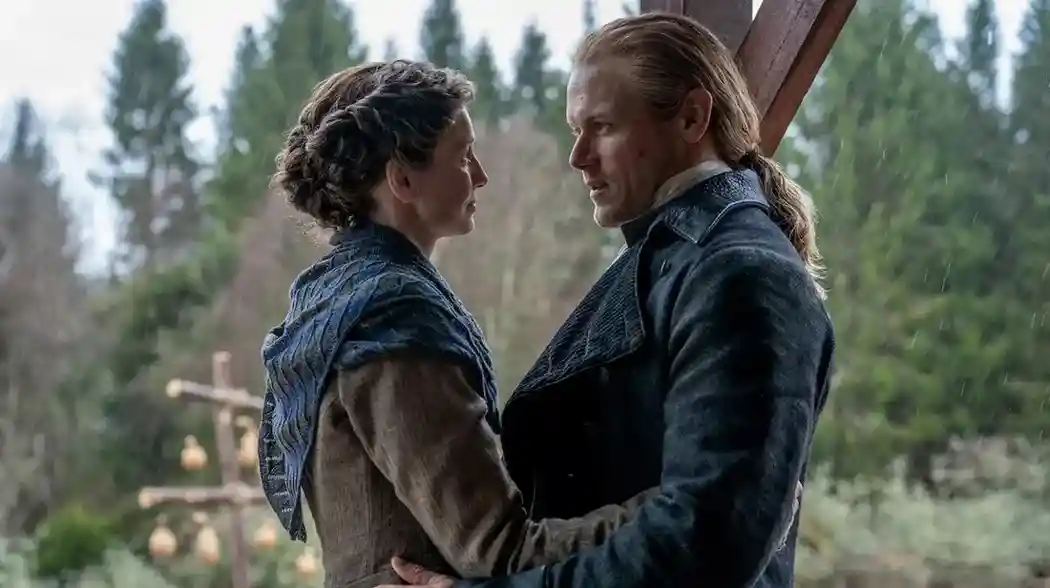
What endures most powerfully is the marriage at the center of it all. After decades of shared trauma, separation, and reunion, Claire and Jamie’s relationship carries a depth that feels earned rather than performed. Caitríona Balfe and Sam Heughan have refined this partnership into something quietly astonishing. Whether they’re teasing each other, clashing, or resting together in wordless intimacy, the connection feels lived-in. When the final credits roll, it won’t just feel like the end of a show. It will feel like saying goodbye to people we’ve known for a very long time.
Outlander Parents Guide
Violence & Intensity: Violence in Outlander is frequent and often visceral. Battles are bloody, with sword fights, gunfire, and wartime brutality shown in close detail. Beyond combat, the series includes torture, executions, sexual violence, and prolonged scenes of physical and psychological suffering.
Language (Profanity, Slurs, Tone): Strong language appears regularly, including profanity and insults appropriate to historical settings. Slurs tied to race, nationality, and gender are used in context, often to underscore power dynamics or cruelty rather than for shock value.
Sexual Content / Nudity: Sexual content is explicit and central to the series. Consensual sex scenes between adult characters are frequent, often lengthy, and sometimes graphically depicted, including nudity. The show also portrays sexual assault and coercion, sometimes in disturbing detail, treating these moments seriously but unavoidably intensely. While intimacy is often framed as emotional connection, it is never discreet or implied.
Drugs, Alcohol & Smoking: Alcohol use is common and culturally normalized within the story, particularly drinking spirits and wine. Characters are shown intoxicated on occasion. Smoking appears intermittently. There are also references to medical drug use appropriate to the time periods, though recreational drug use is not a primary focus.
Age Recommendations: Outlander is best suited for adults 18 and older. Its mature themes, explicit sexuality, graphic violence, and emotionally heavy subject matter make it inappropriate for children or younger teens.
Recommended: My Demon Parents Guide
