Last Updated on March 11, 2026 by Monica Castillo
Adventure has always been the lifeblood of One Piece, but what becomes immediately clear in its second season is how confidently the show now occupies its own strange, exuberant identity. It returns not with a reinvention, but with a deepening, a sense that the creators understand precisely why audiences fell for this world in the first place and have chosen to lean even harder into those qualities.
For viewers like me, whose familiarity with One Piece comes more from cultural osmosis than direct experience, the live-action adaptation served as the gateway. I’d heard about the scale of the franchise, of course the decades-long run, the endless episodes of the One Piece, the fiercely loyal fanbase but Netflix’s version was the first time I actually stepped into the world.
And that first season had a peculiar charm. It was openly goofy, sometimes bordering on ridiculous, yet anchored by an emotional sincerity that made its eccentricities feel endearing rather than embarrassing. The fights were energetic, the cast clicked instantly, and the characters carried dreams big enough to fill the ocean they sailed across. Even from the outside looking in, you could feel the adaptation had captured something essential about the original story’s spirit.
Season two builds directly on that foundation, and watching it feels a little like rejoining friends you’ve been away from for too long.
I still haven’t gone back to read the manga or dive into the anime. My entire experience with this universe remains filtered through the live-action show. That admittedly creates a kind of narrative tunnel vision—no comparisons, no debates about adaptation choices, just the story as it unfolds here. But after finishing all eight episodes of this new season, that perspective almost feels like a gift. The show stands comfortably on its own, and by the time the finale rolls around, the anticipation for season three starts to feel less like curiosity and more like impatience.
Before getting into the adventures themselves, it’s worth noting one of the season’s most unexpectedly refreshing qualities: its pacing. Modern streaming shows have developed an odd habit of shrinking their episodes down to 30 or 40 minutes, often leaving stories feeling hurried or strangely thin. One Piece pushes in the opposite direction. Nearly every episode hovers around the hour mark, and several exceed it.
The result is something that feels almost old-fashioned in the best way. Each installment unfolds like a compact adventure film roomy enough for character moments, action sequences, and the occasional emotional pause. It’s funny how something that used to be standard television storytelling now feels like a luxury. Watching these episodes, you’re reminded how much stronger a narrative can feel when it’s allowed to breathe.
The cast, meanwhile, remains the series’ most reliable asset. Every performer commits wholeheartedly to the show’s delightfully bizarre tone. Nobody seems embarrassed by the material, and that lack of self-consciousness becomes contagious. The characters move through the story with the kind of earnest conviction that makes the strangest moments believable.
Whether they’re throwing punches, sharing a laugh, or navigating a quiet emotional beat, the chemistry among the main ensemble feels genuine. It’s the sort of casting where you gradually stop seeing actors playing parts and start seeing a crew that genuinely belongs together.
If the season has a structural drawback, it stems from the expansion of the story itself. The first season benefited from the elegance of introduction. Each central character received an episode exploring their past and their dreams, and by the finale those threads neatly converged.
Season two doesn’t have that luxury. The world gets bigger. The roster grows. Inevitably, the individual character arcs feel slightly less contained than they did before.
But even with that shift in focus, the characters still manage to find moments that resonate.
The new arrivals are particularly memorable. Miss Wednesday enters the story with a backstory that quickly earns the audience’s sympathy, while Tony Tony Chopper, the series’ talking reindeer doctor becomes a standout almost immediately. Chopper could easily have come across as a novelty character in live action, but the show treats his history with surprising tenderness. His story on Drum Island carries an emotional weight that sneaks up on you, helped along by two lively and thoughtfully drawn supporting characters who shape his past.
What makes those scenes work is their sincerity. The show never mocks the absurdity of a talking reindeer. It simply asks you to care about him and before long, you do.
Meanwhile, the Straw Hat crew introduced in season one benefits from something subtler but equally satisfying: familiarity. With the introductions out of the way, the series can finally let these characters exist together without constantly defining them.
You start noticing the small things. The teasing remarks. The casual arguments that quickly dissolve into laughter. The quiet loyalty that surfaces when things get dangerous. These interactions give the group a warmth that wasn’t always possible in the first season, when the narrative was still busy assembling the team. Now they feel like something closer to a family.
Some storylines still stand out individually. Roronoa Zoro continues wrestling with the aftermath of his defeat by Mihawk, his determination to become the world’s greatest swordsman sharpening with every challenge. And Monkey D. Luffy remains guided by an almost disarming optimism, particularly when the story brushes against the legend of Gol D. Roger, the pirate whose legacy looms over the entire series.
If the three-year wait between seasons brought any clear benefit, it’s the sheer scale of the production. The world feels noticeably bigger this time around.
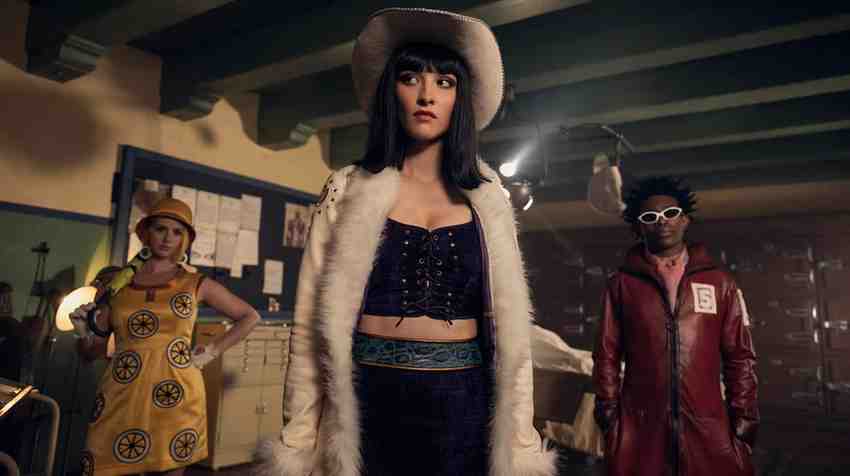
Locations like Loguetown, Whiskey Peak, and Drum Island are built with sprawling practical sets that lend the action a physical presence. You can feel the space when characters run across rooftops or clash in crowded streets. The action sequences in Loguetown already match the energy of the first season, but Whiskey Peak raises the bar considerably.
One standout moment sees Zoro facing down a staggering number of Baroque Works agents—essentially a one-man war against a hundred enemies. It’s the largest action set piece the series has attempted so far, and it unfolds with an exhilarating sense of momentum from beginning to end.
Elsewhere, the show leans more heavily into visual effects to bring the Grand Line’s surreal geography to life. Reverse Mountain twists nature in impossible directions, Little Garden introduces dinosaurs roaming primeval landscapes, and other islands reveal environments that feel pulled straight from a fever dream of adventure fiction.
Not every digital moment is flawless—there are a few shots where the illusion wobbles—but the ambition is undeniable. More often than not, the series succeeds in conveying just how strange and expansive this ocean-spanning world really is.
Which leads to the most fascinating thing about One Piece: on paper, so much of it should feel ridiculous.
There’s a reindeer who talks. Explosive nose powers. Hairdos large enough to hide weapons. Elements that sound perfectly at home in manga or animation suddenly exist in live action. By all logic, this should collapse into camp.
Instead, the show charges forward with complete sincerity. It treats every strange detail as part of a living world rather than a punchline. The silliness registers for a split second just long enough for you to recognize it before the story sweeps you up in its sense of wonder.
Season two also broadens its exploration of Devil Fruit abilities. These supernatural powers remain as bizarre as ever, but the series begins exploring their darker edges. In the later episodes especially, some of these transformations veer into unexpected body-horror territory, giving the powers a slightly unsettling dimension that works remarkably well.
The antagonists add further texture to the season. The various Baroque Works agents bring a colorful lineup of threats, each providing the Straw Hats with a different kind of battle to overcome. Among them, Miss All Sunday emerges as an especially intriguing presence cool, composed, and clearly destined for something larger. Her connection to Mr. 0 hints at storylines that are only beginning to unfold.
Other figures, like Monkey D. Dragon, drift into view briefly but leave the unmistakable sense that much bigger revelations lie ahead.
By the time the season concludes, the impression is unmistakable: the story is expanding faster than ever.
If the first season proved that One Piece could work in live action, the second confirms that it can thrive there. The show embraces its eccentricities, deepens its characters, and builds a world that feels vast enough to support countless adventures still to come.
There’s a rare kind of joy in watching a series this confident in its weirdness this willing to be heartfelt, adventurous, and just a little ridiculous all at once.
And if season three arrives with the same spirit, it’s hard not to imagine this voyage continuing for quite some time. After two seasons, the horizon still looks wonderfully wide.
