Last Updated on February 18, 2026 by Monica Castillo
There’s a certain kind of story that keeps resurfacing in cinema and television, one I’m perpetually drawn to, where institutional rot is exposed not by grand heroes but by stubborn, decent people who simply refuse to look away. Call it the contamination drama: narratives rooted in real-world negligence, were poison chemical, moral, bureaucratic seeps into everyday life. Think of Erin Brockovich, or Dark Waters, or the chilling procedural dread of Chernobyl. These stories tend to move deliberately, even stubbornly, because the truth they’re circling is slow, resistant, and often inconvenient.
Lead Children, a six-episode Polish miniseries arriving this week on Netflix, fits squarely into that lineage. Like last year’s Toxic Town, it reflects the streamer’s ongoing appetite for imported true-life accounts of environmental and moral failure. It doesn’t reinvent the form, and it rarely quickens its pulse. Still, as a steady, clear-eyed look at a grim episode in Polish history that remains largely unknown outside the country, it earns your attention.
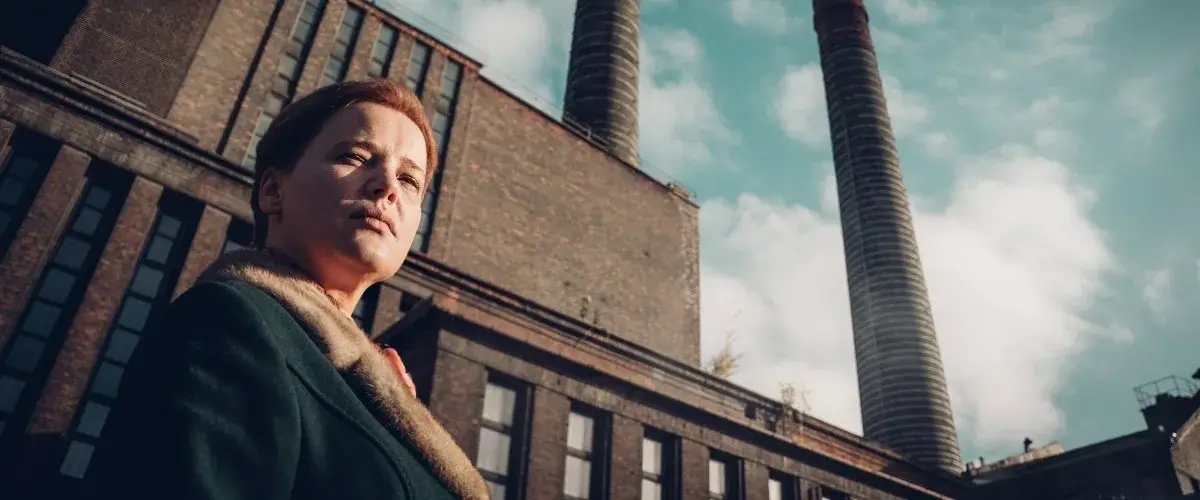
Directed by Maciej Pieprzyca, Lead Children takes us to Communist-era Poland in the 1970s, specifically the district of Szopienice in Katowice. It’s a small, working-class neighborhood defined almost entirely by the hulking smelting plant that dominates its skyline and, eventually, its fate. The factory is ever-present, its chimneys vomiting thick black smoke that curls ominously over mud-caked streets. Children splash through puddles, drink tap water, and swim in nearby pools while invisible toxins drift through the air like an unspoken curse. You can feel the threat long before anyone names it. Soon, children begin falling ill. What looks like anemia spreads. Infants are born dead. The community absorbs these tragedies with a kind of exhausted resignation until Jolanta Wadowska-Król enters the picture.
Jola, as she’s known, is played by Joanna Kulig, whose presence immediately sharpens the series. A young, driven medic with a husband employed at the local hospital, she starts asking the questions everyone else seems too tired or too afraid to raise. Why are so many children sick? Why here? Her investigation quickly leads her to the metalworks looming over the town, an answer that feels both obvious and taboo. Kulig, familiar from her collaborations with Paweł Pawlikowski, gives Jola a restlessness that reads as moral impatience. She can’t stand the idea of living comfortably inside a lie.
Highly Recommended: Moana 2 Parents Guide
The series smartly plants this trait early. In a seemingly minor scene, Jola argues with a shady food truck vendor over a shortchanged order. Her husband later scolds her for making trouble. Wouldn’t it be easier, he suggests, to let it go? Her response lands like a thesis statement for the entire miniseries: why accept being cheated just to preserve a fragile sense of calm? His answer sometimes peace of mind costs you lingers uneasily, because the show knows how often that logic wins.
That tension ripples outward as Jola’s inquiries begin to threaten the local power structure. The politburo takes notice, including Governor Zdzisław Grudzień, played with small-minded menace by Zbigniew Zamachowski. He’s less concerned with poisoned children than with the potential damage to his authority. Even Jola’s neighbors bristle, torn between fear for their families and dependence on the very factory that’s making them sick. The tragedy here isn’t just contamination; it’s complicity born of necessity. As Jola presses on, the strain bleeds into her marriage, her career, and her sense of safety. The show makes no secret of how dangerous this will become it opens in medias res, with Jola dragged to a junkyard and threatened at gunpoint by a secret police officer. What follows isn’t suspense about whether she’ll be punished, but a grim accounting of how many forces can align against one woman telling the truth.
Pieprzyca stages all of this with a restrained, almost plainspoken confidence. The visual language leans heavily into gray skies, muddy streets, and functional interiors that echo the aesthetic sobriety of Chernobyl. The camera doesn’t embellish; it observes. Kulig, by contrast, brings flashes of warmth and eccentricity dancing alone in her living room, singing in her car that remind you what’s at stake beyond policy and statistics. She feels alive in a world slowly numbing itself. Opposite her is Hubert Niedziela, the SB officer assigned to monitor and obstruct her efforts, played by Michał Żurawski with an unsettling mix of charm and menace. His handsome exterior masks a man trying, unsuccessfully, to reconcile duty with decency, and his scenes with Jola crackle with distrust.
Spending six hours in this environment can be draining. The sorrow accumulates. The moral cowardice wears on you. This is not a series that rewards binge-watching so much as patient, measured viewing. And yet, that heaviness feels earned. It mirrors the suffocating reality of a town poisoning itself to preserve jobs, reputations, and the illusion of normalcy. Watching it, you might find yourself thinking uncomfortably about how familiar this pattern remains how often governments and communities still choose denial over disruption.
Highly Recommended: How to Make a Killing (2026) Parents Guide
Lead Children doesn’t pretend to be revolutionary. Its power lies in persistence rather than surprise. By anchoring its story in one woman’s refusal to stay quiet, it honors the real Jolanta Wadowska-Król, remembered in Poland as “the Polish Erin Brockovich,” and reminds us why these stories keep getting told. Because the systems that enable harm rarely disappear. And because, even now, it matters to see what it costs and what it requires to stand up anyway.
Lead Children (2026) Parents Guide
Rating: TV-MA (as listed by the Motion Picture Association)
This is an adult-aimed historical drama dealing with real-world harm, systemic cruelty, and emotional distress. It is not designed for casual or younger viewing.
Violence & Intensity: There is little overt physical violence, but the series carries a constant atmosphere of threat and unease. Children suffer serious illness, infants are stillborn, and the long-term effects of poisoning are discussed in unsettling detail. One key moment involves the protagonist being abducted and threatened at gunpoint by a secret police officer brief, but deeply distressing. The emotional intensity comes less from action than from helplessness, intimidation, and the slow realization that authorities are willing to let people suffer to protect themselves. It weighs on you.
Language: There are no persistent slurs, but the tone can be harsh, dismissive, and emotionally cutting, especially when officials belittle or silence concerned parents. The verbal cruelty feels grounded and realistic rather than sensationalized.
Sexual Content / Nudity: There is no explicit sexual content. Mild intimacy between married adults appears briefly and without graphic detail. Pregnancy and childbirth are central themes, including traumatic outcomes, which may be emotionally difficult even without sexualized imagery.
Drugs, Alcohol & Smoking: There is no depiction of illicit drug use, but environmental poisoning functions as the series’ central “substance abuse” metaphor inescapable, involuntary, and devastating.
Age Recommendations: Recommended for ages 16–17 and up, depending on maturity. While the series lacks explicit sex or sustained violence, its themes child death, government corruption, medical trauma, and psychological intimidation are heavy and emotionally taxing.
Entire series watched for review. All episodes stream February 11 on Netflix
