Last Updated on February 18, 2026 by Monica Castillo
How to Make a Killing is rated R by the Motion Picture Association (MPA) for strong language and some violence, including bloody images. While the film is stylish and often darkly ironic, its subject matter is grounded in crime, moral decay, and emotional cruelty, making it firmly intended for mature audiences.
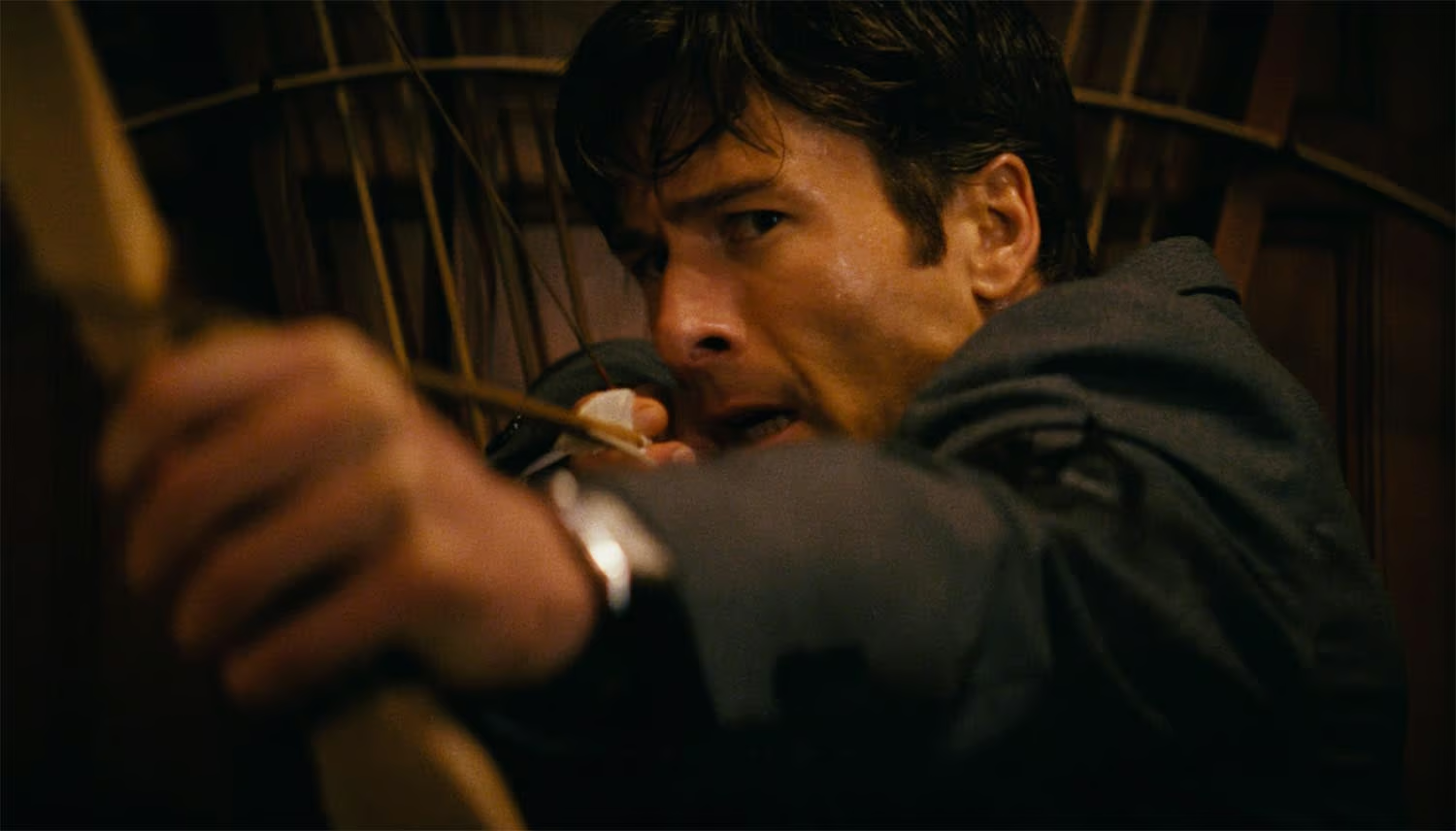
Writer-director John Patton Ford opens How to Make a Killing with a gesture that feels almost comfortingly familiar, the sort of opening crime movies have trained us to accept without resistance. A man sits on death row, staring down the end of his life, and begins to explain how it all went wrong. Becket Redfellow, played by Glen Powell, delivers his tangled account to a prison priest, a confession shaped as much by regret as by calculation. You recognize the setup instantly and that recognition is the point. Ford uses it as a quiet sleight of hand, lulling us into what seems like well-worn territory before steadily revealing just how strange, layered, and unruly this story intends to be.
Becket’s tragedy, the film insists, didn’t begin with a bad choice or a single fatal mistake. It began before he ever had a say in anything. He is conceived during a reckless encounter between a teenage heiress, portrayed by Nell Williams, and a struggling cellist, played by Damien Wantenaar. In a lengthy flashback that lingers with almost punitive insistence, his mother is cast out of her billionaire family’s estate for refusing to terminate the pregnancy. There’s something especially cruel about the way the film shows this expulsion not dramatic or explosive, but cold, procedural, and final. Before long, Becket is an orphan, denied entry back into the family home with nothing more than a sympathy card, shuffled into foster care, and left to absorb the lesson that money has rules, and love is rarely one of them.
Even death offers no reprieve. His mother’s request to be buried in the family crypt is ignored, and her final words to Becket urging him never to stop until he’s reclaimed what was stolen from him become a kind of curse. You can feel the weight of that charge settling over his life, shaping him into someone driven by grievance, persistence, and eventually violence. It’s a backstory steeped in resentment, one that all but guarantees the spiral to come.
Highly Recommended: The Girl with the Needle 2024 Parents Guide
The film leans into the melodrama of this origin story without apology. It’s unabashedly Dickensian, and the characters themselves point this out, name-checking David Copperfield as if to acknowledge the lineage. But where Ford takes things next is far less tidy. Becket’s adult life unfolds as a collision of tones and traditions: he begins systematically eliminating branches of his family tree, briefly stumbles into something like peace with a luminous stranger played by Jessica Henwick, and then gets pulled back into criminal schemes by his manipulative childhood crush, embodied with sly menace by Margaret Qualley.
What emerges is a film stitched together from a surprisingly wide range of influences. It’s part classic noir, soaked in fatalism and moral rot, and part twisted coming-of-age story, warped by money and entitlement. Ford even slips in a visual homage to Luis Buñuel, staging a moment with a rope around an unsuspecting limb that recalls Él. And hovering over everything is the unmistakable shadow of Citizen Kane, with the Redfellow estate transformed into a modern Xanadu, a monument to excess that feels less like a home than a mausoleum for empathy.
At its core, though, How to Make a Killing most clearly reimagines Kind Hearts and Coronets, the film that helped define British black comedy. In Robert Hamer’s original, Dennis Price’s Louis Mazzini murders his way through eight aristocratic relatives all memorably played by Alec Guinness in pursuit of a dukedom. That film’s cruelty is almost mathematical, draining sympathy until only cold satire remains. Ford borrows the framework but not the emotional temperature. He relocates those venomous aristocrats to a recognizably modern America and makes a pointed observation: today’s ultra-wealthy are desperate to appear relatable, insisting they’re no different from anyone else, even as they hoard unimaginable power.
In the process, Ford reshapes Mazzini’s icy superiority into something messier and more familiar. Becket is still a killer, but he’s also a hustler, a striver, a man who genuinely believes he’s been denied his rightful place. Powell plays him with an easy charm that invites empathy even when the character least deserves it. You find yourself rooting for him one moment and quietly savoring his setbacks the next. That tension between identification and judgment is one of the film’s sharpest pleasures.
Becket is, in many ways, a victim of a story America loves to tell itself: that success is owed to those who work hard enough, that merit always rises. It’s the mythology that fuels capitalism, and Ford is keenly aware of how destructive it can be. Becket chases wealth, status, and meaning along a crooked path that delivers fleeting victories and deeper losses. We know from the opening scene that none of it will last, yet the film makes each success feel exhilarating and each misstep feel inevitable. Often, they’re indistinguishable. Powell’s face tight, controlled, and acutely responsive to light can flicker from something chillingly sociopathic to quietly wounded in a heartbeat, and it’s hard not to watch for those shifts.
Highly Recommended: One Hundred Years of Solitude 2024 Parents Guide
The film itself mirrors that instability. Shot with glossy precision by Todd Banhazl, How to Make a Killing gleams with surface-level luxury. Ford directs with a light, confident touch, recalling the restrained energy of his debut, Emily the Criminal, but expanding it onto a grander canvas. Freed from the strict realism of that earlier film, this one luxuriates in polish, using beauty to suggest decay rather than disguise it. The script is surprisingly lean given its episodic structure, though the momentum does falter at times during its brisk runtime. Still, the ending lands with a sense of delayed precision, like a mechanism finally snapping into place, delivering its final blow exactly when it needs to.
As Becket continues narrating his tale, the dark humor he uses as armor starts to fracture. The weight of his actions becomes impossible to laugh away. Ford’s real strength lies in how he treats his characters’ fragility not as an excuse, but as an indictment. Their humanity is thin, brittle, and easily broken, and that’s where the film’s irony cuts deepest. In an era crowded with loud satires and shallow caricatures, How to Make a Killing feels almost defiantly classical. It resists easy mockery, favors moral unease over punchlines, and updates an old story about inherited power to reflect a distinctly American obsession: the relentless, often ruinous pursuit of more.
How to Make a Killing (2026) Parents Guide
Violence & Intensity: Violence is present throughout the film, though it’s rarely gratuitous or sensationalized. Much of it unfolds with a calculated calm that can feel more unsettling than outright brutality. There are murders and acts of physical harm tied to the protagonist’s criminal rise, some of which include visible blood. The film often emphasizes consequence over spectacle you can feel the weight of each act even when the camera pulls back. Emotional intensity is just as prominent, with themes of abandonment, revenge, and moral collapse creating a persistent undercurrent of unease.
Language: Characters use profanity in moments of anger, cynicism, and emotional stress. The tone is sharp and adult, reflecting the film’s noir sensibility and morally compromised characters. There are no prolonged tirades, but the language is consistent enough to justify the R rating.
Sexual Content / Nudity: The film references sexual relationships and includes brief intimate moments, handled more suggestively than explicitly. There is no extended nudity, and sexuality is treated as part of character motivation rather than as spectacle. Still, the material is adult in tone and context.
Drugs, Alcohol & Smoking: There are brief references to drugs, though substance use is not a central focus of the story. Smoking appears occasionally, consistent with the film’s neo-noir atmosphere.
Age Recommendations: This film is best suited for adults and older teens (17+) who are comfortable with morally complex narratives, crime-related violence, and mature themes.
Highly Recommended: Sonic the Hedgehog 3 Parents Guide
