Last Updated on March 2, 2026 by Monica Castillo
Hoppers is rated PG by the Motion Picture Association for action and peril, some scary images, and mild language.
There’s a scene near the beginning of Hoppers that tells you exactly what kind of movie this is. Early in Hoppers when a child stands in the presence of something older and quieter than her anger, and the movie seems to pause with her. Pixar has always known the power of stillness that a film can take a breath and invite you to do the same and here that pause tells you almost everything you need to know. This is a story about how fury feels powerful until it doesn’t, and about what happens when you finally let yourself belong to something larger than the fight you’re picking.
The film centers on Mabel Tanaka, first as a child and later as a 19-year-old college student, voiced with alert sincerity by Lila Liu and Piper Curda. As a kid, Mabel can’t stand the sight of animals confined to tanks and cages. She stages small, doomed rescues, including one involving a turtle named Crush a gentle wink to Finding Nemo, and the sort of affectionate self-awareness Pixar now wears easily. What fuels her isn’t cruelty or recklessness. It’s helplessness. She knows something is wrong and doesn’t yet know how to live with that knowledge.
Her grandmother, voiced by Karen Huie with quiet gravity, understands this instinctively. She takes Mabel to a glade trees, water, life moving at its own pace and asks her to do the hardest thing imaginable to an angry child: stop. Be still. Watch. Listen. The grandmother admits she used to be angry too. Then she says something that lands like a truth you didn’t realize you were waiting for. It’s hard to stay mad when you feel like you’re part of something big. The glade becomes more than a place. It becomes Mabel’s sense of home, the place where her nervous system remembers how to rest.
Recommended:Secret Level 2024 Parents Guide ( Episode 1-15)
Time passes. The grandmother dies. Mabel grows up. College-age Mabel skates through campus with a cast on her wrist and a sharpened edge to everything she says. Grief has reopened the old wound. When Jerry Generazzo the town’s tireless, glad-handing mayor, voiced by Jon Hamm—announces plans to run the Beaverton Beltway straight through the glade, Mabel erupts. Jerry insists the land is no longer an animal habitat. The wildlife is gone. From his perspective, he’s serving the community. From hers, he’s bulldozing it.
College finds Mabel older, sharper-edged, skating through campus with grief she hasn’t figured out how to carry. The glade is still there, but her grandmother isn’t, and that absence has a way of turning conviction into fury. Her professor, Samantha Fairfax voiced by Kathy Najimy with brisk affection studies beavers, specifically the quiet genius of how they build. Dr. Sam has taken that curiosity one step further, experimenting with a way to place her own consciousness inside a 3D-printed beaver so she can observe them from the inside out. Mabel clocks it instantly. “Like Avatar,” she says. Dr. Sam bristles. “Not like Avatar.” The movie smiles and lets the contradiction hang there, because of course it’s like Avatar just smaller, messier, and motivated by care rather than conquest. When Mabel impulsively hijacks the tech, it doesn’t feel like a plot convenience so much as an inevitability. This is what she does when she’s scared: she leaps before anyone can stop her.
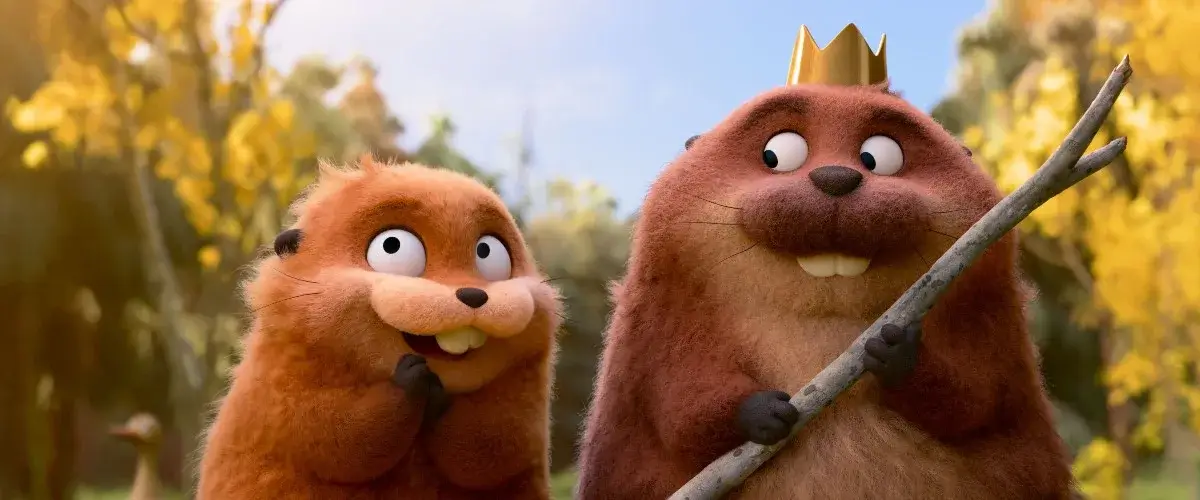
As a beaver, Mabel discovers she can understand every animal she meets. The film has fun with this, but it also treats it as a responsibility. She’s quickly befriended by George, the self-declared king of the mammals, voiced by Bobby Moynihan with disarming warmth. George wears a tiny crown and believes, without irony, in cooperation. His Pond Rules are simple: greet everyone by name, remember that predators eat prey a truth handled with the same plainspoken honesty found in The Lion King and never forget that survival is shared. The movie doesn’t flinch from this reality; some bugs don’t make it. A worm doesn’t either. It’s treated matter-of-factly, which feels right.
At first, Mabel can’t stand George’s optimism. It strikes her as naïve, maybe even irresponsible. Slowly, almost against her will, she begins to trust it. You can feel that shift happening, not through speeches but through small exchanges and moments of attention. When George gathers the kings and queens of the animal world to plan their response, the meeting collapses under the weight of competing needs and instincts. Cooperation, the film suggests, is harder than anger. It requires patience. It requires listening.
All of this converges with impressive control. Mabel’s battle with Jerry, her desperation to save the land, Dr. Sam’s frantic attempts to reclaim her technology and restore Mabel’s consciousness, and Mabel’s own reckoning with how her anger narrows her choices—they braid together in a final act that moves with real momentum. The action sequences are playful and sharply paced, inventive without becoming overwhelming. The voice cast adds texture throughout: Meryl Streep lends the insect queen a brittle authority; Dave Franco plays her scheming son as he evolves from caterpillar to butterfly and beyond. Alumni from Saturday Night Live, Vanessa Bayer and Melissa Villaseñor, appear briefly as a shark named Diane and a bear named Ellen, turning small roles into something unexpectedly resonant.
Recommended: Mufasa: The Lion King 2024 Parents Guide
Visually, the film lingers where it should. Leaves look touchable. Water feels cold. Beaver dams are rendered as feats of real engineering rather than cute obstacles, complex systems built with intention. Through Mabel and her grandmother’s eyes, nature becomes not a backdrop but a relationship a place that can steady you if you let it.
What stays with me most is the film’s patience with grief. Watch what happens to the grandmother’s jacket. Notice how Mabel’s anger flares most intensely when fear takes over, how it blinds her at the very moment she needs clarity. Even Jerry, initially framed as the obstacle, earns reconsideration. His commitment to his town is real, even if his vision is limited. The movie allows him complexity, and that generosity matters.
In a culture increasingly addicted to drawing lines us here, them there Hoppers quietly argues for something wider. The Pond Rules aren’t perfect. They’re aspirational. But by honoring the grandmother’s wisdom, the film reminds us that more gets done, and more gets saved, when “we” truly means everyone. Not just the loudest voices. Not just the most powerful. All of us, standing still long enough to notice what we’re part of.
Violence & Intensity: There are chase sequences, moments of environmental peril, and stretches where characters are in genuine jeopardy as construction machinery, flooding water, or animal conflicts collide. These moments are brief and not graphic, though sensitive younger viewers may notice them. Some scenes involving machinery, collapsing structures, or frantic escapes may feel tense, especially for children who are easily startled.
Language (Profanity, Slurs, Tone): There are a handful of low-level expressions—nothing stronger than what you’d expect in everyday conversation or other PG animated films. No slurs are used. The sharper edge comes more from tone than words: moments of anger, sarcasm, or frustration, particularly from the main character when she’s overwhelmed. It’s emotionally honest rather than hostile, and the film consistently frames anger as something to be examined, not celebrated.
Sexual Content / Nudity: There is no sexual content, or nudity. Relationships are familial, communal, or based on friendship and trust. The film’s emotional focus stays firmly on grief, belonging, and responsibility.
Drugs, Alcohol & Smoking: None. There is no depiction of alcohol, drugs, or smoking, nor any references to substance use.
Age Recommendations: Hoppers should be accessible and enjoyable for most children ages 7 and up, particularly those accustomed to Pixar films that balance humor with emotional weight. Younger children may enjoy the animals and visual energy but could find some of the perilous moments or themes of loss unsettling without parental context.
Recommended: Sonic the Hedgehog 3 Parents Guide
