Last Updated on March 29, 2026 by Monica Castillo
There’s a moment early on when a man sits in a psychiatrist’s office and talks himself into a corner. You can watch it happen in real time, the sentences tightening, the breath going shallow, the mind turning on itself with a kind of weary familiarity. It’s funny, but only just. The laughter catches in your throat. “Fantasy Life” keeps returning to that feeling, that uneasy overlap between humor and quiet panic, and for a while it feels like it knows exactly how to live there.
The man doing the unraveling is Sam Stein, played by the film’s writer-director, Matthew Shear. He’s a paralegal who loses his job and reacts as though it confirms every private fear he’s ever had about himself. Not just that he’s struggling, but that he was always going to. The panic attacks that follow aren’t exaggerated for effect; they arrive in fits, awkward and inconvenient, the way they do in life. Shear doesn’t ask for sympathy so much as recognition.
Recommended: You’re Dating a Narcissist Parents Guide
Across from him sits his therapist, played by Judd Hirsch, who listens with the calm of someone who has heard this song before. Hirsch brings a kind of lived-in patience to the role, never pushing for a laugh, never signaling wisdom. Then the movie swerves, lightly but decisively: Sam is hired, right there in the waiting room, by the therapist’s wife Andrea Martin to babysit her son’s kids. It’s absurd, but not in a way the film underlines. It just moves on.
That son, David, is played by Alessandro Nivola with an easy, slightly frayed charm. He’s a musician who might be on the cusp of something, or might have been saying that for a decade. The babysitting doesn’t go especially well no disasters, just a string of small misjudgments but David keeps inviting Sam back. There’s an openness there, or maybe just a lack of better options. Either way, Sam drifts into their orbit.
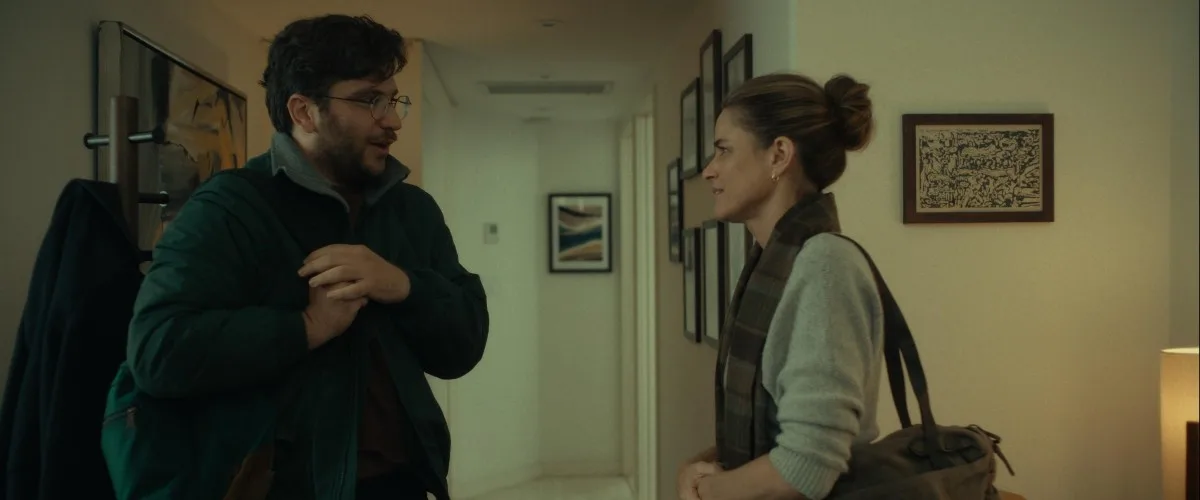
For a stretch, the film seems interested in that arrangement, in the idea of a man finding a foothold in someone else’s life. Then it quietly changes its mind. The children fade into the background, and the focus shifts to David’s wife, Dianne, played by Amanda Peet, and suddenly the movie feels more alert.
Peet plays Dianne like someone who has spent years being watched and hasn’t entirely decided whether she misses it. She’s quick, disarming, a little reckless in conversation. Stories spill out of her, some polished, some half-formed, and you get the sense she’s discovering them as she goes. There’s a scene where she and Sam talk in a kitchen that feels too small for the energy she brings into it, and he just… tilts toward her, almost imperceptibly at first. Not only attraction. Something closer to relief, like he’s found a frequency he didn’t know he could hear.
Recommended: Palestine 36 Parents Guide
That’s the movie at its best in those small, shifting exchanges where tone changes mid-sentence and nobody quite acknowledges it. Shear has a sharp ear for that. He lets scenes wobble a little. A joke lands, then hangs there. A glance lingers a beat too long. You start to notice what isn’t being said, which is usually where the interesting stuff lives.
But the film doesn’t build on those moments so much as hop between them. Time moves oddly. Weeks or months seem to pass in the space between conversations, and when we catch up, the characters refer to things we haven’t seen, emotional turns we’re asked to accept after the fact. It creates a stop-start rhythm that keeps interrupting whatever connection you’re beginning to form. I found myself leaning in during individual scenes, then stepping back again, trying to figure out what had shifted and when.
It doesn’t help that the characters remain a little indistinct once you look past their surface traits. Sam is anxious, yes, but the movie rarely pushes beyond that into something more specific. Dianne is captivating, but also elusive in a way that feels less like mystery and more like absence. Their relationship, which the film ultimately leans on, flickers rather than deepens. You can see what the movie wants it to be. You don’t always feel that it gets there.
Still, the film is rarely dull. A supporting cast that includes Holland Taylor, Jessica Harper, Zosia Mamet, and Bob Balaban keeps each scene alive in small, precise ways. They arrive, do something human and slightly off-center, and leave behind the sense that life is continuing just out of frame.
And Shear, surrounded by all this experience, doesn’t disappear. That’s not nothing. He leans into Sam’s discomfort without turning it into a routine, drawing on a tradition that runs through Albert Brooks and others who made anxiety their instrument. What’s different here is the hesitancy. The sense that even the film isn’t entirely sure how much of Sam it wants to reveal.
“Fantasy Life” doesn’t quite cohere. It reaches for something a portrait of insecurity, maybe, or of the strange ways we attach ourselves to people who seem more certain than we are and only sometimes manages to hold onto it. But there’s an honesty in the attempt, and a handful of scenes that linger longer than the structure surrounding them.
I left thinking less about what the movie is than about what it almost becomes in those fleeting, unguarded moments when two people talk and neither of them quite knows why it matters so much.
Fantasy Life (2026) Parents Guide
Violence & Intensity: There’s no physical violence to speak of. No fights, no threats, nothing that would qualify as traditionally intense. What the film does have is emotional unease — panic attacks, spiraling thoughts, the kind of internal pressure that can feel overwhelming if you’re not used to seeing it portrayed so plainly. A few scenes linger in that discomfort longer than expected, especially when Sam’s anxiety takes hold. It’s quiet, but it’s real.
Language and profanity: There’s frequent use of strong language nothing relentless, but it shows up often enough to notice. No major slurs, but the tone can get sharp, especially in moments of emotional friction. The humor leans dry and sometimes self-deprecating, occasionally at someone else’s expense.
Sexual Content / Nudity: There’s no explicit nudity or graphic sexual content, but the film does circle around adult relationships in a way that assumes a certain maturity. Conversations carry flirtation, suggestion, and emotional entanglement. It’s less about what’s shown and more about what’s implied, attraction, dissatisfaction, curiosity. The kind of material that might go over younger viewers’ heads, or land awkwardly if it doesn’t.
Drugs, Alcohol & Smoking: Drug use is brief and not glamorized. It appears casually, almost as background behavior rather than a focal point. Alcohol shows up in social settings drinks shared, conversations loosened, but again, nothing excessive or sensational. It reflects adult life more than it comments on it.
Age Recommendations: this feels right for 15 years old and up, maybe younger with context, but it’s not really made for them.
