Last Updated on March 4, 2026 by Monica Castillo
Dolly is Rated R by Motion Picture Rating (MPA) for strong violence, gore, grisly images, language and some nudity.
The first image that stuck with me isn’t the mask, or the blood, or even the scream. It’s the pause before the proposal the way the forest seems to lean in, curious, as if it knows something the couple doesn’t. I’ve seen that pause before in slashers, the breath held just long enough for dread to seep in. Dolly understands that instinctively. For a few minutes, it lets the quiet do the work. Then it shatters it.
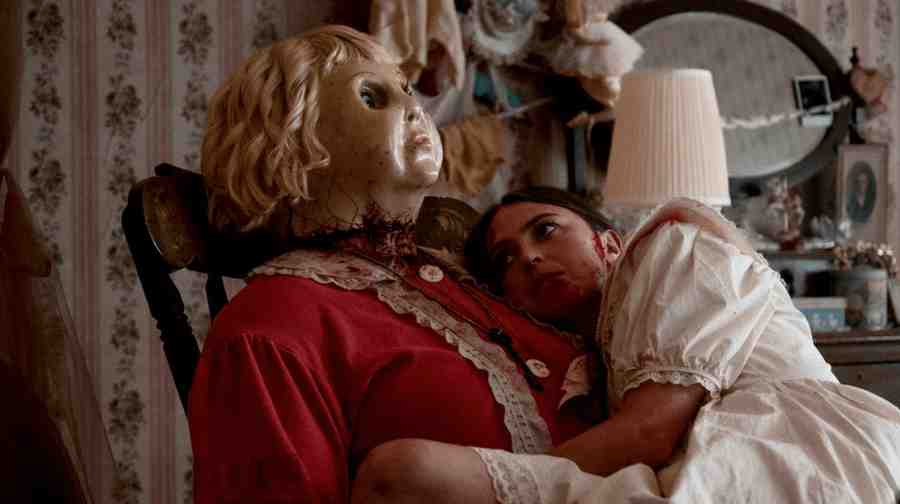
Macy and Chase head into the Tennessee woods carrying different kinds of fear. He wants to ask a question that will change his life; she worries about whether she deserves the future he’s offering wife, stepmother, a role that feels heavier than the ring he’s hiding. The film doesn’t underline this. It trusts us to catch it in glances, in the way Macy’s smile doesn’t quite land. When Dolly arrives huge, wordless, face hidden behind a porcelain doll mask that feels less like a disguise than a dare the movie snaps into motion. Chase falls. Macy disappears. What follows plays out in a house that looks like it was built to keep secrets and punish anyone who asks them out loud.
Steven C. Miller once said that horror movies tell you what a culture fears. Director Johnny Blackhurst seems to fear forgetting where the genre came from. Shooting on 16mm, he coats the movie in grit and scratches that recall the grimy affection of grindhouse pictures, the kind of movies that smelled like beer and dust. You can feel the influence of Robert Rodriguez, Quentin Tarantino, and the sweaty menace of Rob Zombie hovering in the frame. Blackhurst has history here he made the Amanda Knox documentary and helped birth the ill-fated Night Swim and you sense a director eager to prove he can play in the muck and still find meaning.
Highly Recommended: Hoppers (2026) Parents Guide
The opening stretch works because it commits. Old-school iris transitions bracket Macy’s first and last days in Dolly’s house, a visual rhyme that feels deliberate rather than cute. Then the movie starts to fidget. Modern flourishes creep in. The style loses its grip. A film this short 82 minutes that pass quickly enough can’t afford to wander, and yet it does, circling the same beats of capture, torment, escape, repeat.
The problem isn’t blood. When Dolly wants to hurt someone, Blackhurst doesn’t blink. Practical effects splatter with confidence. Some of it lands hard. Too hard. What’s missing is the wicked grin that usually accompanies this kind of excess. The violence often feels joyless, like a chore the movie thinks it owes us. Horror can punish, sure, but it should also seduce.
The script gestures toward something richer. Dolly’s desire to be a mother hovers at the edge of the story, an eerie echo of Macy’s fear that she won’t measure up as one. It’s a promising idea, the sort of parallel that could give the film a pulse beyond survival. Instead, the structure fractures it. Chapters arrive with names and themes, then vanish ten minutes later, replaced before they’ve had time to sink in. The movie keeps changing the subject just as it might have said something honest.
What saves Dolly from collapsing under its own intentions are the people inside it. Fabianne Therese, a genre regular going back to John Dies at the End and Starry Eyes, gives Macy a steadiness that never reads as bland. Fear flickers across her face, but so does resolve. She reacts the way real people do hesitant, angry at herself for hesitating, then moving anyway.
Opposite her, Max the Impaler makes an impressive acting debut as Dolly. The performance relies on posture and timing, on how long the character lingers in a doorway, on the strange tenderness of hands that also know how to destroy. When Dolly watches over Macy with something like care, the movie finally feels dangerous in an interesting way.
Highly Recommended: Scream 7 (2026) Parents Guide
I wouldn’t call Dolly a failure. It reaches for ideas about motherhood, identity, and inherited violence, then drops them in favor of carnage that doesn’t always earn its weight. Still, fragments linger. An image. A performance. A sense that the movie almost found its rhythm and then lost it in the woods. If the teased sequel ever arrives, I hope it listens to what this one whispers between screams. Sometimes the most frightening thing isn’t the monster chasing you. It’s the life you’re afraid you can’t live.
Dolly Parents Guide
Violence and intensity are the main event. This is a slasher that doesn’t cut away when things get ugly. Characters are stalked, beaten, stabbed, and mutilated, often at close range. Practical effects linger on broken bodies, exposed wounds, and the aftermath of violence rather than just the act itself. The threat never really lets up once the film gets going, and the tone is grim rather than playful. Captivity, torment, and fear are sustained for long stretches, which may be more upsetting than the body count alone.
The language is frequent and harsh. Expect repeated uses of strong profanity, including f-words and s-words, delivered in panic, anger, or cruelty. The dialogue isn’t witty or stylized; it’s raw and stressed, which makes it feel sharper even when it’s familiar. There are no slurs aimed at protected groups, but the verbal aggression matches the film’s relentless mood.
Sexual content and nudity are limited but not absent. There’s no explicit sexual activity, but brief nudity appears in a non-erotic, vulnerable context. The film also carries an undercurrent of bodily violation and control that may feel sexually charged even when it isn’t literal. This isn’t titillation it’s discomfort and younger viewers are likely to read it that way.
Drugs, alcohol, and smoking are minimal. Characters may drink casually or reference alcohol, but substance use isn’t a focus and doesn’t drive the story. The film’s intoxication comes from fear, not chemicals.
As for age recommendations, this is firmly for adults. Even seasoned horror teens may struggle with the film’s bleakness and graphic detail. The R rating isn’t decorative here; it reflects material intended for viewers 18 and up, especially those already comfortable with brutal slashers and emotionally punishing horror.
Highly Recommended: The Bluff 2026 Parents Guide
