Last Updated on February 22, 2026 by Monica Castillo
There’s a look that crosses Joe Leaphorn’s face early in the fourth season of Dark Winds not anger, not sorrow, but something quieter, heavier. The expression of a man who understands, before anyone else does, that the night is going to demand more than he has planned to give. I noticed myself leaning forward when it happened. That’s when I realized the show had me again. Not with plot. With presence.
Season four of Dark Winds doesn’t arrive with a mission statement or a new coat of paint. It doesn’t need one. After a third season that scattered its central trio across emotional and physical distances, this year brings Joe Leaphorn, Jim Chee, and Bernadette Manuelito back into shared space same rooms, same cases, same unspoken history humming beneath the dialogue. The mystery that reunites them begins simply: a teenage girl, Billie Tsosie, disappears from a reservation school. No fireworks. Just absence. And that absence pulls everyone inward before it starts pushing the story outward, the way this series prefers.
Loosely inspired by The Ghostway, the season expands into familiar Dark Winds territory: hired killers, buried alliances, money moving through bad hands. There’s even a brief relocation to Los Angeles, a shift that could have felt like a stunt but instead plays as disorienting in exactly the right way. Off the reservation, the characters look slightly unmoored, as if the ground itself has stopped speaking to them. The show understands that geography isn’t just setting. It’s pressure.
What continues to separate Dark Winds from standard mystery television is its comfort with complexity that isn’t explained away. Navajo culture isn’t introduced here; it’s lived in. Ceremonies, beliefs, and history exist alongside police work without apology or translation. Season four leans harder into the show’s supernatural shadows, particularly through Jim Chee’s storyline, and it works because it never asks the audience to choose between the spiritual and the procedural. Both matter. Both have consequences.
Highly Recommended: The Sticky 2024 Parents Guide & Review
Kiowa Gordon, who has been quietly sharpening his performance for seasons, finally gets the space to let Jim Chee fracture. The character is injured, grieving, in love, and circling parts of himself he’d rather not examine. Gordon doesn’t play any of this for effect. He lets Chee withdraw, snap, hesitate. Some of the most affecting moments arrive when he says almost nothing at all. Watching him this season feels less like observing a performance and more like spending time with someone who’s trying to stay upright while the ground shifts beneath him.
Zahn McClarnon remains the show’s moral compass, though that compass has grown less certain over time. Leaphorn’s scenes with Deanna Allison’s Emma carry a tired intimacy, the kind that forms when two people have survived the same storms and aren’t sure how many more they can take together. Jessica Matten continues to give Bernadette a sharp intelligence and emotional restraint, though the long-simmering romance between her and Chee loses some of its electricity once it moves into daylight. They were more compelling when everything went unsaid. The show seems to recognize this and quickly introduces new fault lines, restoring some tension before comfort can settle in.
If the season falters, it does so in the handling of its central mystery. Billie Tsosie begins as a haunting presence, a girl defined by fear and rumor, and then gradually slips out of focus as the plot balloons. The story keeps adding figures and conspiracies, but it does so at the expense of emotional weight. Twists arrive regularly some earned, some a bit eager and one major reveal announces itself so early that suspense drains from the wait. The shadowy antagonist hovering nearby never quite becomes more than a suggestion, echoing earlier villains without carving out a distinct identity. For a series that usually listens closely to its mysteries, this one occasionally feels like it’s moving pieces instead of following people.
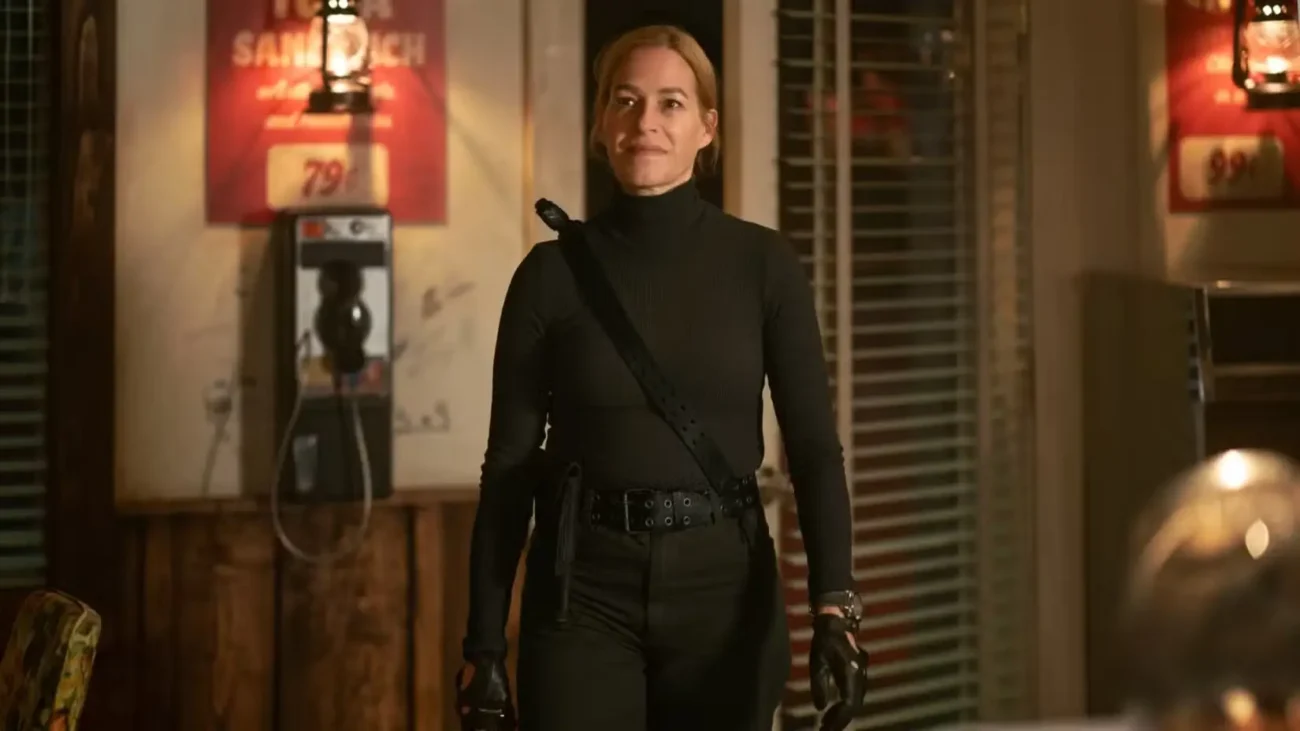
The exception, and perhaps the season’s secret weapon, is Franka Potente. As Irene, a German contract killer with her own private logic, she brings a focused calm that borders on unnerving. Potente plays her as someone who treats violence as labor, not pleasure, and that restraint makes her far more unsettling than any theatrics could. Her scenes with McClarnon crackle with mutual recognition two professionals measuring each other, aware that survival doesn’t require liking. Irene’s solo storyline rarely collides directly with the main case, but it deepens the season by showing how violence carries its own traditions, its own codes, wherever it goes.
Highly Recommended: The Last Thing He Told Me Season 2 Parents Guide
What ultimately carries Dark Winds through its rougher patches is its devotion to character. Chee’s reckoning with identity and belief gives the season its emotional spine, while Leaphorn’s strained personal life mirrors the show’s larger questions about responsibility and endurance. Even when the mystery wanders, the people never do.
Season four isn’t the show at its sharpest, but it may be the one that understands its soul most clearly. It knows when to sit with silence. It knows when not to explain. And it trusts that if it keeps watching its characters closely enough, we’ll stay right there with them, leaning forward, waiting for that look to cross someone’s face again.
Dark Winds Parents Guide
Dark Winds is rated TV-MA under the U.S. television ratings, and it earns that label without showboating. The series isn’t crude for shock value, but it doesn’t soften its edges either. This is adult television that assumes a certain emotional and moral maturity from its audience.
Violence and intensity are central to the show’s identity. Murders, assaults, and threats appear throughout the season, often framed with a slow, unsettling patience rather than quick bursts of action. Gun violence, physical injuries, and psychological intimidation recur, sometimes lingering longer than expected. The show is more interested in the weight of violence than its spectacle, but the cumulative effect can feel heavy, especially for younger viewers. Some scenes involving killers and supernatural elements may be disturbing even when little is shown outright.
Language is present but controlled. Characters swear when the situation calls for it, not out of habit. Expect moderate profanity, including strong language used in moments of anger or stress. There are occasional racial and cultural slurs tied to the show’s exploration of power, prejudice, and colonial tension. These moments are contextual and critical, not casual, but they may still hit hard.
Sexual content remains limited and understated. There is no explicit nudity, and sex is implied rather than depicted. Romantic relationships exist, including intimacy between adult characters, but scenes focus more on emotional consequence than physical detail. This isn’t a sensual series, and it doesn’t linger on bodies.
Drugs, alcohol, and smoking appear occasionally, mostly in realistic adult contexts. Characters drink socially or as coping mechanisms, and smoking appears in period-appropriate or stress-driven moments. Drug use is referenced more than shown, often tied to crime or exploitation rather than recreation.
Age-wise, this is best suited for mature teens and adults, roughly 17 and up.
| Dark Winds Season 4 Release Schedule | |
| Title | Release Date (Sundays @ 9 PM ET on AMC+) |
| Baptism by Fire | February 15 |
| Toward Their Unknown Paths | February 22 |
| That Which has been Torn Apart | March 1 |
| The New World | March 8 |
| Those Who Harmed One Another | March 15 |
| Those Who Were Searching For Me | March 22 |
| We Came Back | March 29 |
| The Glittering World | April 5 |
