Last Updated on April 17, 2026 by Monica Castillo
Directed by Josephine Decker | Written by Iliza Shlesinger
I’ll be honest I almost didn’t stick with Wasteman past the first fifteen minutes. Not because it’s bad. Because it’s uncomfortable in a way that made me want to look away, and that, I’ve learned, is usually the sign you should keep watching.
Taylor is not a man movies usually spend this much time on. Played by David Jonsson who you might remember from Industry or Alien: Romulus, though he’s doing something far more exposed here, he’s slight, jumpy, and visibly exhausted by the work of simply existing inside a prison. Thirteen years ago, he was selling pills at raves, not out of any particular ambition but because he had a baby and a woman who became a responsibility, and the money had to come from somewhere. The pills he sold one night killed two teenagers. He didn’t know they were bad. The court didn’t much care. Manslaughter. And now here he is older, hollowed out, quietly addicted to whatever narcotics he can get his hands on, cutting hair in his cellblock, running small errands for a low-level prison dealer named Paul and his enforcer Gaz, doing everything right by doing nothing at all.
And then the system, overcrowded and barely holding itself together, tells him he’s about to be released. Not because he’s earned it. Just because there’s no room. I watched Jonsson receive that news and found myself holding my breath, because you already know, even before the next scene, that something is about to take it away from him.
That something is Dee.
Tom Blythe walks into this film like he owns it, which is more or less how Dee walks into every room. He’s a transfer, a dealer, a man who appears constitutionally incapable of reading a room and adjusting accordingly. He’s funny, actually, Iliza Shlesinger’s script is sharper and more wryly observed than I expected, and there’s a moment early on where Dee trash-talks a prison guard with such casual, almost cheerful contempt that you understand immediately why Taylor finds him both magnetic and terrifying. Dee drafts Taylor as his new assistant. He doesn’t ask. He has friends on the outside, he mentions, almost offhandedly. Friends who know where Taylor’s fourteen-year-old son lives. Friends who know where the boy’s mother lives.
The thing about Dee is that he isn’t purely menacing. He lends Taylor his personal phone so the man can call his son. He shares his drugs. He performs a kind of friendship that is also, at every moment, a collar. Watching their scenes together, I kept thinking about how often manipulation works not through cruelty alone but through the mixture of cruelty and warmth, how that combination is so much harder to resist, or escape, than simple brutality would be.
Recommended: Mother Mary (2026) Parents Guide
Meanwhile, Dee’s arrival has upset the prison’s existing order. Paul and Gaz, who had something like a quiet monopoly before this, are furious in the way a small business owner is furious when a chain moves in across the street. They know who enabled this. And so Taylor, who just wants to survive the next few weeks without incident, finds himself squeezed from every direction. There’s a Mike Tyson line that feels apposite here: everybody has a plan until they get punched in the face. Dee has a great many plans.
What Josephine Decker does, and what she’s always done, from the frantic interiority of Madeline’s Madeline to the claustrophobic literary duel at the heart of Shirley, is find the emotional frequency underneath genre and stay tuned to it. Wasteman is more conventionally structured than her earlier work, more willing to operate within familiar prison-film rhythms, but she never loses sight of the two men at its center. By the film’s back half, Taylor has arrived at a kind of painful lucidity: he knows exactly what he is, exactly what Dee is, and he makes the decision to endure it because the only thing that matters is getting out alive and getting back to his son. It’s not a heroic arc in any traditional sense. It’s more honest than that.
Jonsson carries most of the film’s emotional weight, and he’s fully up to it. What strikes you, watching him, is how much he communicates without appearing to do anything at all. His eyes are constantly working, running calculations, registering fear, absorbing small shocks of grief, and during the phone calls with his son, there’s a particular quality to his expression that I found almost unbearable to watch. Love and loss operating at the same time, in the same face. Blythe, for his part, takes longer to fully appreciate because Dee’s confidence is such an effective mask. But watch the edges of his performance. There are moments where you catch something, a flicker of awareness, quickly suppressed, that suggests Dee knows, somewhere beneath all that swagger, that his position is more fragile than he’ll admit. It’s a quietly brilliant piece of work.
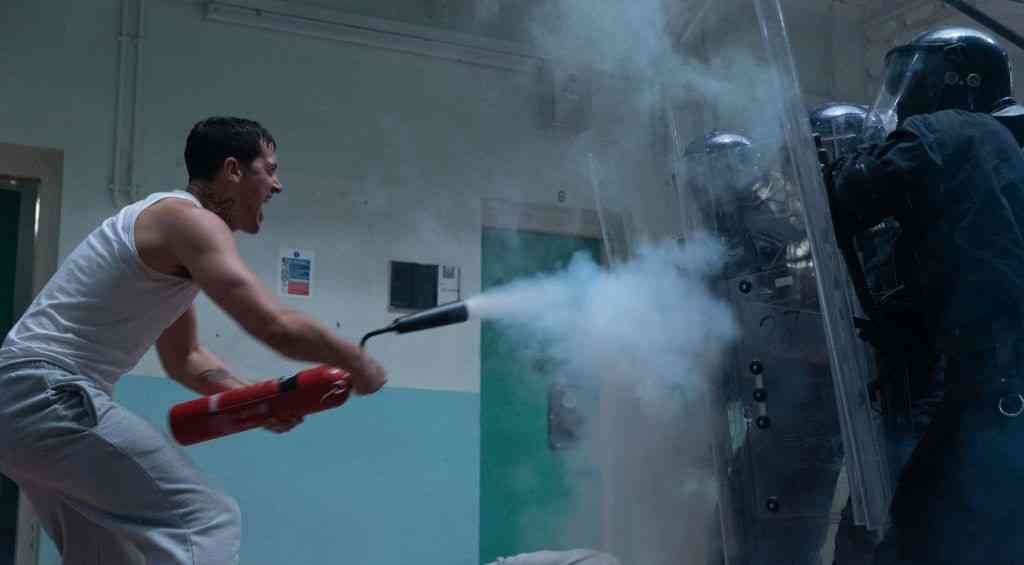
The film isn’t flawless. Decker reaches for music-driven montages a few too many times when the story needs bridging, and the handheld camera, which earns its rawness in most of the film occasionally tips from gritty into genuinely chaotic, particularly during fights that become so hectic you can’t follow the geography. These are real irritants, not minor ones. But they don’t sink the film.
Recommended: Erupcja (2026) Parents Guide
What stays with me, days later, are the details. Drones hovering outside cell windows, delivering contraband. Vertically filmed phone videos of beatings, shot by the perpetrators, posted online to humiliate victims and warn off rivals. Dee and Taylor’s cell filling up with merch and product displayed openly, almost defiantly, because the institution is too broken to police its own corridors. These aren’t flourishes. They’re a portrait of a system so strained it’s ceased to function as anything other than containment.
Wasteman runs ninety minutes and somehow feels longer, not because it drags, but because it accumulates. It’s a film made outside the usual channels, with modest resources and serious intentions, and it pulls off something genuinely difficult: it works as a tense, propulsive genre picture and as something sadder and more human underneath. Films like this don’t always find their audience right away. This one deserves to.
Wasteman Parents Guide
Violence & Intensity: The violence in this film is neither stylized nor comfortable. When men get beaten, and several do it doesn’t look cinematic. It looks like it hurts, and the film lingers just long enough to make that clear. There are close-quarters fights inside the prison that are shot with a handheld chaos that obscures some of the detail, though whether that makes it easier or harder to watch probably depends on the viewer. What hits hardest isn’t any single act of violence but the film’s sustained atmosphere of threat, the sense that Taylor is never more than one wrong moment away from something irreversible. That tension doesn’t really lift. There are also references to criminal violence outside the prison walls, including implicit threats made against a teenager and his mother, which carry a particular ugliness given the context. Younger or more sensitive viewers will find this genuinely distressing.
Language: The language is what you’d expect from a British prison drama made with no interest in softening its edges. Strong profanity runs throughout, the full range, used frequently and without apology. There are slurs present, deployed mostly within the context of prison culture and intimidation rather than as casual dialogue, but present nonetheless. The overall tone of the language is aggressive, transactional, and occasionally menacing. This is not a film where people speak carefully.
SexualContent & Nudity: This is one area where Wasteman is relatively restrained. There is no nudity and no sexual activity depicted on screen. There are passing references to Taylor’s past relationship with his son’s mother, framed in terms of circumstance and obligation rather than anything explicit. The film simply isn’t interested in that territory, it has other things on its mind.
Drugs, Alcohol & Smoking: Taylor’s addiction is one of the quieter tragedies running beneath the plot, and we see him using narcotics with a matter-of-factness that is more unsettling than any dramatic scene about drug use could be. The prison’s drug economy is central to the story; dealing, using, and the leverage that substances give people over one another are all depicted in considerable detail. Smoking appears throughout.
Age Recommendation: Wasteman is adult viewing, without question. I wouldn’t put it in front of anyone under sixteen, and honestly, for younger teenagers, the sustained psychological tension and drug content make it a conversation worth having before rather than after. For mature sixteen and seventeen year olds with the emotional grounding to sit with something genuinely bleak, there’s real value in what the film says about consequence, institutional failure, and the cost of surviving a system that was never designed for your benefit.
