Last Updated on April 16, 2026 by Monica Castillo
There’s a moment about forty-five minutes into “Mother Mary” where Anne Hathaway’s pop star character is trying to explain something I’m not sure what, exactly, and I’m not sure she is either and Michaela Coel’s fashion designer just stares at her. Not a theatrical stare. Not the kind an actor practices in a mirror. It’s the look of someone who has stopped listening to words and started listening to something else. Lowery holds on Coel’s face for what felt like ten seconds. Maybe it was fifteen. Long enough that people in my screening started to shift in their seats. Long enough that I realized I’d stopped breathing.
You might remember his last few films. “A Ghost Story” had that guy under a sheet eating pie for what felt like an eternity. “The Green Knight” had a fox that talked and a ending that dared you to call it happy. Lowery has always been interested in exhaustion as a storytelling tool not the bad kind, not the boring kind, but the kind that wears you down until you’re receptive to something you wouldn’t have noticed when you were fresh. “Mother Mary” opens with Coel narrating how she could feel Anne Hathaway’s character coming to her house before she arrived. And I remember thinking, Oh, we’re doing this. We’re doing the thing where time bends and logic takes a backseat and we just have to trust that Lowery knows where he’s going.
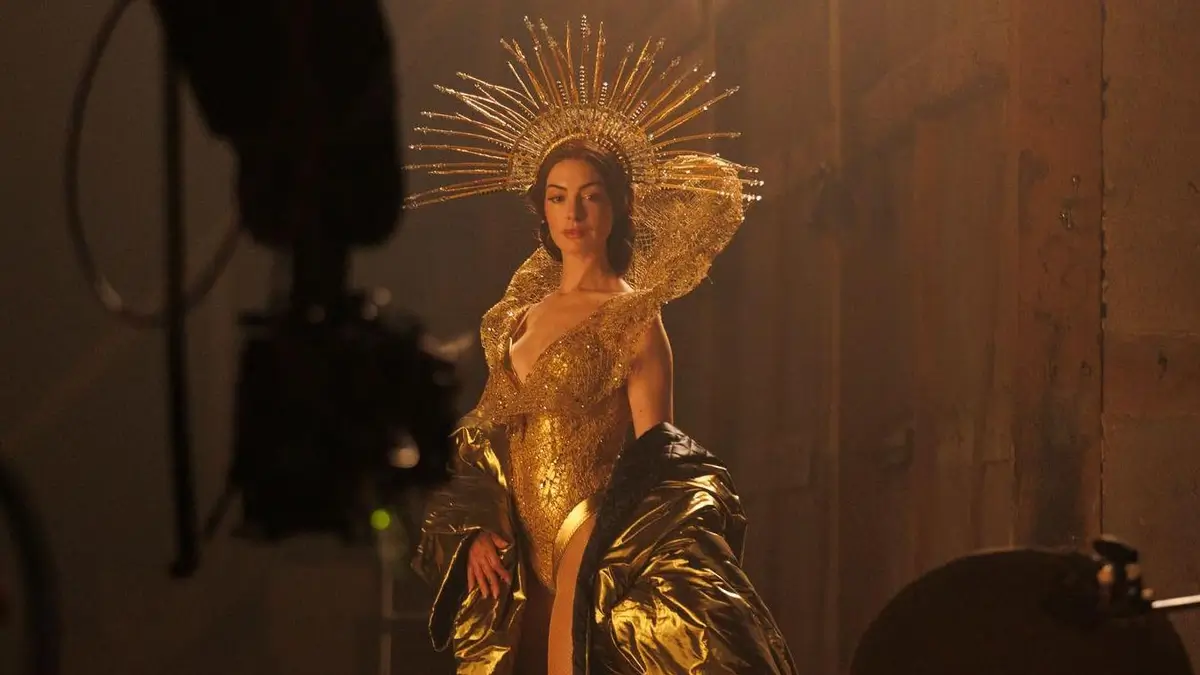
Hathaway plays Mary, a pop superstar think Lady Gaga’s incense-and-rosary phase crossed with the devotional intensity of a Beyoncé crowd. She’s preparing a comeback after some kind of accident (the film is wisely vague about the details, which I appreciated) and finds herself drawn back to Sam Anselm, the designer who helped create her visual identity back when she was just a rising singer with good instincts and no iconography. Sam is played by Michaela Coel, and I need to say this upfront: Coel is doing something here that deserves to be remembered. She was reportedly involved in the screenplay before she was cast, and you can feel it in the way she inhabits every line. She knows where the bodies are buried because she helped dig the graves.
Recommended: The Drama (2026) Parents Guide
The first hour is essentially a two-hander set in Sam’s barn-like studio. They talk. They circle each other. They revisit the old wound: Sam was given no credit for the religious imagery that made Mary a phenomenon the halos, the robes, the way Mary presents herself as something between a pop star and a patron saint. Mary left her behind when she got famous, and Sam has been nursing that betrayal like a pet that bites but she can’t bring herself to put down.
Lowery and his cinematographer Andrew Droz Palermo stay close to faces, but not in that careful, calculating way that announces this is an acting showcase. It’s more invasive than that. You can see the pores on Coel’s forehead. You can see the way Hathaway’s left eye twitches when she’s about to say something she knows is a lie. Coel in particular has this ability to shift from warmth to contempt in a single breath, I watched her do it three times in one scene, and each time it felt less like acting and more like something leaking out that she couldn’t control.
Hathaway is more of a problem. I say that as someone who has defended her in movies where other critics were cold. She’s doing a lot of work up there, the pregnant pauses, the hushed intensity, the way she seems to be communicating something profound by lowering her voice to a whisper. It’s the kind of performance that announces its own importance in every gesture. And yet. There’s a sequence about two-thirds of the way through where she dances alone in the studio with no music, just her body and the wood floor, and something shifts. She starts with what looks like a choreographed routine, sharp, practiced, the kind of thing you’d see on a stadium tour, and then it unravels. Her limbs start hitting the floor. She’s grunting. She’s sweating. By the end, she looks like she’s having a seizure or a vision or both. It’s the most honest she’s been in the entire movie, and it made me wish Lowery had found a way to keep her in that register.
The supernatural stuff is where “Mother Mary” lost me, then almost won me back, then lost me again. There’s a flowing red fabric that appears and disappears. There are visitations that might be ghosts or might be hallucinations or might be something else entirely. FKA Twigs shows up in the film’s most terrifying scene, I won’t spoil it, but I’ll say that Lowery has not forgotten how to make your skin crawl, and then the movie pivots into a kind of nightmare logic that feels less like storytelling and more like someone trying to explain a dream they had while hungover. Some of it works. Some of it doesn’t. I left the theater unsure which parts were which.
Here’s what I keep coming back to: the exhaustion. Mary says at one point, “These metaphors are exhausting,” and the audience in my screening laughed because by then we were all exhausted too. But here’s the thing about Lowery. He’s never been interested in making movies that leave you feeling refreshed. His films are meant to wear you down, to scrape against you until you’re raw enough to feel something you might have otherwise missed. “Mother Mary” is exhausting in ways that feel intentional and exhausting in ways that feel like failure. I’m not sure Lowery cares about the distinction.
The previews make this look like “Black Swan” for the pop music set. It’s not. “Black Swan” had a clarity of purpose that “Mother Mary” actively rejects. This is a movie that wants to be felt more than understood, that would rather you leave confused than leave certain. I respect that impulse. I’m not sure I liked the result.
But I haven’t stopped thinking about Coel’s face in that long silence. Or the sound of Hathaway’s elbows hitting the floor. Or the way Lowery holds a shot of a red curtain just long enough that you start to wonder if it’s just a curtain or if it’s something else entirely.
Maybe that’s enough. Maybe a movie doesn’t need to cohere to matter. “Mother Mary” is a mess a beautiful, frustrating, occasionally transcendent mess. I think I mean that as a compliment. I’m not entirely sure. Ask me again in six months.
Mother Mary (2026) Parents Guide
Let me be straight with you. The MPAA description says “some violent content and language,” and technically that’s accurate, but it’s like saying *The Green Knight* has “some medieval themes.” The violence in this movie isn’t the kind you’re used to warning your kids about. But there’s a sequence where Anne Hathaway’s pop star dances alone to no music, and by the end she’s hurling herself at the floor so hard you can hear her bones, and I had to look away. That’s the violence of this film. It’s the violence of bodies pushed past their limits. It’s the violence of someone dismantling themselves in real time.
Language: The profanity is moderate but pointed. You’ll hear several shits, a handful of fucks (I counted four), and one use of the word “bitch” that lands with real venom because of who says it and why. What’s more notable is the tone of the language characters don’t swear for shock value. They swear because they’re exhausted, because they’ve been holding something in for years, because the conversation has circled the same wound for forty-five minutes and they finally need to break something.
Sexual Content / Nudity: This is where the movie surprised me. Given that it’s about a pop star and a fashion designer, given that Lowery has never been shy about bodies in his previous work, I expected something more explicit. There’s no nudity. There’s one scene where two characters embrace in a way that could be read as romantic or could be read as two drowning people grabbing onto anything, and the film wisely refuses to clarify. A brief kiss. A lot of longing glances that last too long. That’s it. The sexuality here is almost entirely subtext which, honestly, might be more confusing for a teenager than actual nudity would be.
Drugs, Alcohol & Smoking: Very little. A character drinks wine in two scenes. Someone smokes a cigarette outside a studio, and the smoke curls into frame in that deliberate, artful way Lowery loves. No drugs, no partying, none of the backstage debauchery you might expect from a movie about a pop star. The film is more interested in the quiet self-destruction of the artist than the loud kind. If anything, the lack of substances feels like a choice—these characters are raw and damaged all on their own. They don’t need help.
Age Recommendation: The MPAA says R, and I agree. Not because of anything a 15-year-old hasn’t seen before, but because of how the movie shows what it shows. This is a film for viewers who understand that the scariest thing on screen isn’t a monster it’s a person falling apart and unable to stop. I’d say 16 and up, but only if the teenager in question has the patience for a movie that moves at Lowery’s pace and the emotional literacy to understand why a woman dancing alone on a wood floor might be the most violent thing they see all year.
