Last Updated on April 5, 2026 by Monica Castillo
There’s a line somewhere in the middle of Your Friends & Neighbors season 2 tossed off, almost accidental where a character accuses someone of being “missing a reason to exist.” Nobody laughs. The show doesn’t acknowledge it. But it sat with me for the rest of the episode, because the writers clearly didn’t intend it as self-description. And yet.
This is a show about rich people in a rich neighborhood doing rich-people things badly, which is a premise that can work, has worked, in the right hands, but which requires the show to have a firm opinion about its own characters. Your Friends & Neighbors does not. It keeps changing its mind. One scene wants you to laugh at these people, the next wants you to feel for them, and by the third you’ve stopped trying to calibrate your response and started thinking about what else you could be watching. The neighborhood is called Westmont Village, modeled on Westchester County, and it looks exactly like you’d expect: lawns that don’t apologize for themselves, kitchens that have never seen a bad meal, marriages that are rotting quietly behind very expensive doors.
Recommended: The Faithful: Women of the Bible Parents Guide
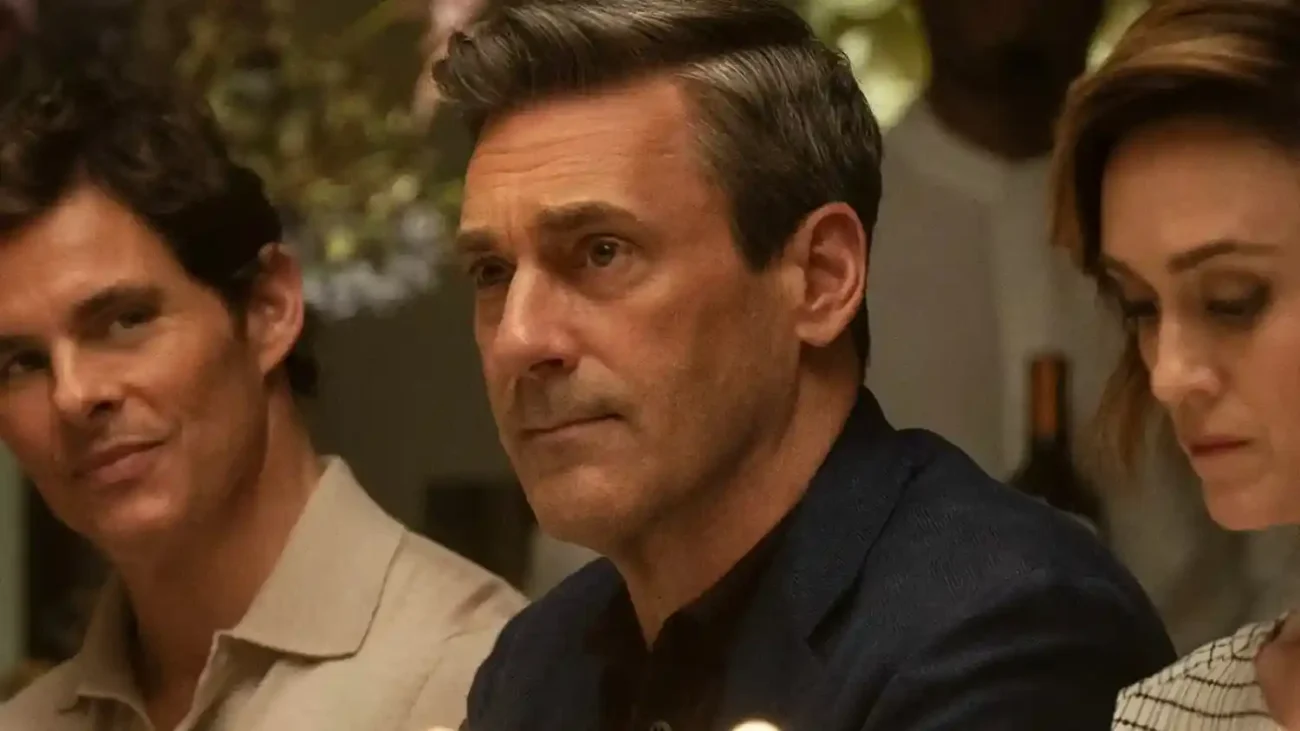
Jon Hamm is here, and for long stretches he’s the only reason to stay. I don’t say that to damn him with faint praise, Hamm is genuinely one of the better actors working in television, and he brings a quality of watchfulness to Coop that the show doesn’t always deserve. There’s something happening behind his eyes even when the scene around him is marking time. But the role itself keeps him tethered. Coop is essentially Don Draper with the self-destruction replaced by self-awareness, which makes him more functional as a human being and less compelling as a character to watch. Mad Men gave Hamm an abyss to stare into. This show gives him a neighborhood to navigate. You feel the difference.
James Marsden shows up this season as Owen Ashe, a billionaire, and the scenes he shares with Hamm are the most alive the show gets. They’re well-matched two actors who both know how to do a lot by doing very little and there’s a friction between their characters that hints at the kind of show this could have been if someone had pressed harder on it. Olivia Munn, returning from season one, is quietly doing her best work. She’s given actual emotional territory this season, and she doesn’t waste a moment of it.
What the show refuses to do, and this is where it loses me every time, is commit to its own identity. Season one arrived with some genuine menace under the polish. There was a crime element, actual stakes, the faint suggestion that something dark was going to surface from beneath all that conspicuous comfort. That version of the show felt like it was building toward something. Season two has largely dismantled it. The crime plot, such as it is, keeps getting shuffled to the back of the room while the ensemble melodrama takes up all the oxygen. At some point it stops feeling like a deliberate choice and starts feeling like a loss of nerve.
The supporting cast is where the unfocused tone does its most visible damage. There are a lot of people in Westmont Village, and the show can’t quite figure out what register to play them in. Some feel like targets, caricatures of a certain kind of wealthy obliviousness, and some feel like people the show genuinely wants you to care about, and the distance between those two approaches never gets resolved. It’s not that unlikable characters are a problem; television is full of wonderful ones. The problem is that these characters inflate their smallest frustrations into emergencies with the energy of people who have never faced a real one, and the show keeps asking you to find that sympathetic rather than funny, which it isn’t quite, and devastating, which it also isn’t quite. They’re stuck in the middle. So is the show.
Ten episodes is a long time to spend somewhere you’re not sure you want to be. There’s enough scattered throughout, a scene that lands, a performance that earns it, a moment between Hamm and Marsden that crackles, to keep you from switching off entirely. But the shape of the season doesn’t hold. Storylines that feel significant quietly dissolve. The finale arrives with the energy of a shrug, resolving things adequately without making you feel like anything that happened before actually mattered. Some of the bigger dramatic turns come out of nowhere in ways that register as random rather than surprising. It’s a show that confuses movement with momentum.
Recommended: Something Very Bad Is Going to Happen Parents Guide
I went into this season wanting it to work. I like Hamm too much not to. I remember the first season had a version of itself buried inside it that felt like it could have been genuinely uncomfortable and strange, the kind of suburban-rot drama that makes you feel slightly implicated for watching. That version still seems to be somewhere in the building. Whether season three finally lets it out is the only question I’m still curious about.
Your Friends & Neighbors Season 2 Parents Guide
Violence & Intensity: The show’s version of danger lives in boardrooms and dinner tables — financial threats, quiet coercion, and the specific cruelty of people who use leverage instead of fists. The crime elements are there, technically, but the show keeps them at arm’s length. Tense conversations, implied consequences, the occasional moment where something genuinely uncomfortable surfaces.
Language: The f-word is part of the furniture here, casual, argumentative, sometimes weaponized. The usual rotation of profanity fills the gaps. But it’s less about the individual words and more about the register these characters operate in: cutting, cold, the kind of dialogue where people say exactly the wrong thing and mean every word of it.
Sexual Content & Nudity: Infidelity runs through the season like a second plot. Sexual encounters appear regularly, nudity surfaces without much ceremony, and the whole thing is shot with the matter-of-fact frankness of a show that considers this behavior completely normal for its characters.
Drugs, Alcohol & Smoking: People drink at dinner, at parties, mid-afternoon, mid-argument. The show never frames it as a problem — it’s just what Westmont Village runs on. Drug use appears a few times with the same casual shrug. Nobody bottoms out. Nobody learns anything. It’s handled less like a warning and more like a lifestyle detail, which in some ways is more insidious than if the show made a whole thing of it.
Age Recommendation: Sixteen absolute minimum, and even then it depends on the teenager. The sex and drinking alone push this into adult territory, but more than that, this is a show about the particular exhaustion of middle-aged people who have everything and feel nothing, and that specific flavor of misery genuinely requires some life experience to read correctly.
Your Friends & Neighbors season 2 premieres April 3, 2026 on Apple TV+, with new episodes dropping each Friday through June 5.
