Last Updated on March 20, 2026 by Monica Castillo
Vampires of the Velvet Lounge is Rated R Motion Picture Rating (MPA)by for strong bloody violence, gore, language and brief nudity.
There’s a particular kind of bad movie that doesn’t offend so much as it confuses you. You don’t lean forward in outrage or sink back in delight you just sit there, quietly rearranging the pieces in your head, wondering if you missed a reel somewhere. I kept having that feeling during Vampires of the Velvet Lounge, like I’d walked into a rehearsal that no one ever bothered to turn into a performance.
The first clue arrives in the voice. Dichen Lachman plays Cora, a vampire hunter with a past she’d rather narrate than dramatize, and that narration comes out in a rasp so aggressive it sounds less like a stylistic choice and more like a cry for lozenges. It’s the kind of voiceover that insists on its own importance without earning it, dropping lines about redemption and failure as if they were chiselled in stone, when really they feel scribbled in the margins.
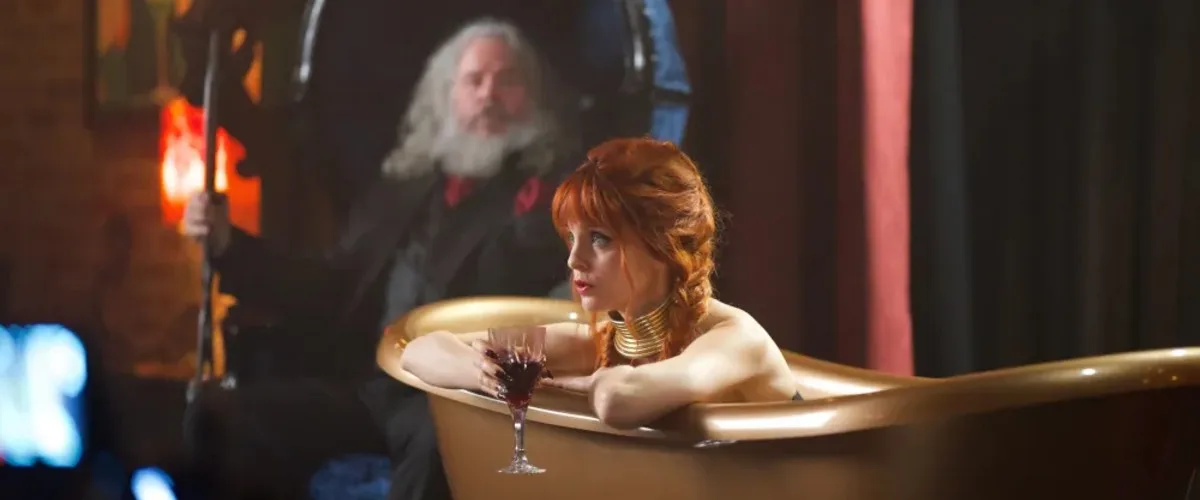
Adam Sherman, who writes and directs, seems less interested in building characters than in sketching the idea of them. You can sense the outlines: a centuries-old vampire aristocrat, a reckless protégé, a haunted soldier. But the lines never connect. Mena Suvari’s Elizabeth borrowed loosely from the real-life specter of Elizabeth Báthory enters with the promise of something decadent and dangerous. The film even opens with a barrage of text explaining her supposed infamy, like a PowerPoint that got lost on its way to a history lecture. Yet once the story gets moving, that history just evaporates. This Elizabeth doesn’t seem particularly obsessed with youth, or power, or much of anything beyond the next vaguely sinister outing.
Recommended: I Can Only Imagine 2 (2026) Parents Guide
She’s paired with Joan, played by India Eisley, who drifts through the film with the air of someone waiting for her character to be explained. Their relationship mentor, lover, co-conspirator, take your pick never settles into anything you can hold onto. They circle each other, exchange looks that suggest meaning, and then move on before that meaning has a chance to form.
Instead, the film detours into a half-hearted seduction plot involving a trio of men who seem to have wandered in from a different, less gloomy movie. Tyrese Gibson plays Luke, recently divorced and permanently crestfallen, while Stephen Dorff’s Randall talks like a man who’s never met a conversation he couldn’t flatten. They exist mostly to be prey, though even that feels like an afterthought. The film spends so much time meandering around them that you start to suspect it’s forgotten what it planned to do in the first place.
And then, briefly, it wakes up.
There’s a sequence a chaotic, blood-slick joyride that finally taps into something resembling personality. Someone yells, “I told you not to light her on fire!” as if that were a reasonable boundary to have set in advance, and for a moment the movie flirts with a kind of deranged energy it desperately needs. Bodies pile up, the tone tilts toward the absurd, and you catch a glimpse of a different film hiding underneath this one. Not a good film, necessarily. But at least a lively one.
It doesn’t last.
What follows returns to the same murky drift, peppered with ideas that sound provocative until you realize they lead nowhere. Characters talk about dating apps and AI as tools of the rich and predatory, which might be an interesting angle if the movie had any interest in exploring it. Instead, it drops the notion like a prop that’s no longer needed, leaving you to wonder why it was introduced at all.
Cora’s relationship with her own protégé, Alexis (Rosa Salazar), fares no better. The film gestures toward a bond teacher and student, maybe something like surrogate family but it’s all suggestion, no substance. Alexis drifts into an online flirtation with a vampire, though the film never convinces you why she would. When their inevitable confrontation arrives, it lands with a dull thud, cushioned slightly by a splash of blood that feels less like a payoff and more like compensation.
Recommended: The Girl with the Needle 2024 Parents Guide
Visually, the film aims for a kind of neon-drenched sleaze and lands somewhere closer to dim inconvenience. The strip-club aesthetic promises decadence but delivers flat lighting and compositions that look as though they were chosen out of obligation. Even the moments that should feel excessive like Mark Boone Junior appearing with a pair of absurdly large pruning shears to dispatch victims come off less like bold swings than like desperate grabs for attention.
I kept thinking about other films that mix elegance with carnage Interview with the Vampire, From Dusk Till Dawn and how confidently they commit to their worlds, no matter how strange those worlds become. Vampires of the Velvet Lounge never finds that confidence. It hovers in a half-state, too self-serious to be fun, too undercooked to be involving.
There’s a version of this movie that leans into its excess, that embraces the ridiculousness of immortal predators prowling through late-night decadence. You can almost see it flickering at the edges, especially in that one unhinged sequence. But the film we get keeps pulling back, second-guessing itself, sanding down its own sharpest edges.
By the end, I wasn’t angry or amused. Just curious about the decisions, the detours, the things left unsaid and unexplained. Curious, in fact, about everything except what was actually happening on screen.
Vampires of the Velvet Lounge Parents Guide
The film carries an R rating from the MPA for strong bloody violence, gore, language, and brief nudity, and none of that is misleading, though not all of it lands with equal force.
Violence comes in bursts, not rhythms. When it arrives, it’s messy, sometimes even gleeful heads roll, bodies tear, and blood sprays with a kind of desperate enthusiasm, as if the movie is trying to wake itself up. There’s a chaotic sequence involving fire and dismemberment that briefly crosses into something memorable, if only because it feels so much louder than everything around it. Still, much of the violence lacks tension. It happens, then it’s over, leaving behind more confusion than shock.
The language is what you’d expect from a film that wants to sound hard-edged but isn’t quite sure how. Characters swear with regularity nothing especially inventive, just a steady stream of familiar profanity delivered in flat, half-interested tones. No heavy use of slurs, but the overall mood leans coarse rather than sharp.
Sexual content drifts in and out without much conviction. There are moments of nudity and a lingering strip-club aesthetic that suggests something more provocative than what actually appears on screen. It’s all implication and surface suggestive poses, a bit of skin, some predatory flirting but very little that feels genuinely charged or intimate. The film gestures toward eroticism without ever quite arriving there.
Alcohol and smoking are part of the atmosphere more than the story. Characters drink, linger in dimly lit spaces with glasses in hand, and move through environments where indulgence feels like the default setting. Drug use isn’t a major focus, but the overall tone leans into that hazy, late-night sense of excess.
As for age, this isn’t a film made with younger viewers in mind, and not just because of the rating. The violence, the scattered nudity, and the general sense of moral drift make it better suited for adults, though even then, maturity won’t necessarily make it more rewarding. Teenagers drawn in by the promise of vampires and chaos might find themselves more bored than shocked.
