Last Updated on March 19, 2026 by Monica Castillo
There’s a moment early in “Power Ballad” when two men who have no real reason to trust each other fall into a song like they’ve been sharing it for years. No grand stage, no audience to impress just a room, a couple of beers, and that fragile, electric sense that something honest might happen if neither of them ruins it. I kept thinking about that scene long after the movie ended, maybe because the rest of the film spends so much time asking what happens when that kind of moment gets… repackaged.
John Carney has always believed in music the way some people believe in fate. Not casually, not ironically. His films tend to treat songs like lifelines things that pull people toward each other when language fails them. “Power Ballad” still carries that belief, but it’s more guarded this time, a little bruised. The question hanging over the film isn’t just whether music connects us. It’s what gets lost when that connection becomes a product.
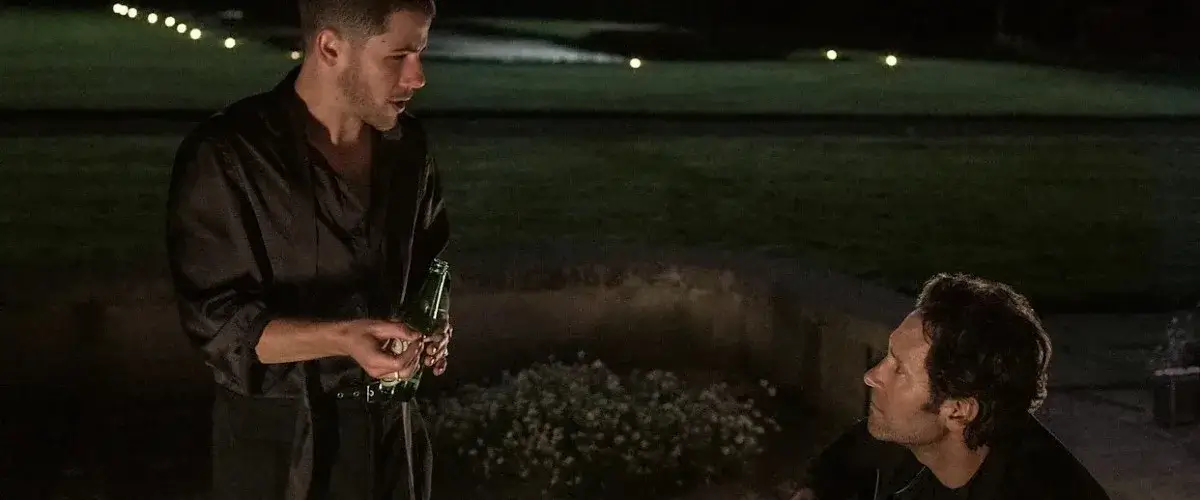
The setup sounds almost too neat: Rick, played with a weary, slightly rumpled charm by Paul Rudd, is an American living in Ireland, fronting a wedding band and clinging to the idea that he’s still got a real song in him. One night, he meets Danny, a former boy-band face trying to rebrand himself as something more serious, played by Nick Jonas with a kind of glossy sadness that sneaks up on you. They click. Not instantly, not magically but enough. Enough to sit down later and trade stories, chords, fragments of who they are when nobody’s watching.
Highly Recommended: Scarpetta (2026) Parents Guide
Carney and cinematographer Yaron Orbach shoot that encounter like it matters. Because it does. The room feels alive in a way the rest of the film rarely allows. Outside, the world is dim, distant, already complicated. Inside, there’s only possibility. Rick plays a song he’s been nursing for years, something personal, something unfinished. You can feel how much of himself he’s folded into it. You can also feel, even then, how easily it could slip out of his hands.
And it does.
Months later, that same song polished, rebranded, streamlined into something shinier—reappears as Danny’s comeback hit. It’s everywhere. The kind of song people sing without thinking about who wrote it, or why. Rick hears it the way you might hear your own voice played back to you, altered just enough to feel like a violation. So he goes to Los Angeles, dragging along his loyal, slightly bewildered friend Sandy, looking for something that resembles justice.
This is where the film could have turned simple. Villain, victim, confrontation. But it doesn’t. Not quite. Jonas, in particular, refuses to let Danny settle into easy contempt. There’s something hollowed out about him, something trained. The film understands fame not as a reward but as a system one that teaches you to mine your own life for content until you’re not entirely sure what belongs to you anymore. Danny isn’t innocent. But he isn’t entirely in control either.
That tension between agency and environment, between who we are and what we become when the stakes change gives the film its pulse. Rick, for all his righteous anger, isn’t immune to compromise himself. Watching the two men circle each other, reshape themselves, justify things they might once have rejected… that’s where the movie gets uncomfortable in a way that feels earned. There’s a line Rick throws at Danny “You were just out of context” and it lands like a quiet accusation aimed at both of them. Maybe at all of us.
Not everything works. The film narrows its focus so tightly on these two that the people orbiting them start to feel like afterthoughts. Peter McDonald brings warmth to Sandy, and Beth Fallon has a gentle presence as Rick’s daughter, but they’re mostly left reacting to Rick’s choices rather than living lives of their own. You notice the absence more as the story goes on.
Highly Recommended: Project Hail Mary (2026) Parents Guide
The music itself is a mixed blessing. Rick’s song, in its various forms, never quite hits that lightning-strike feeling Carney has captured before, but there’s something scrappy and sincere about it that fits the character. Danny’s tracks, by contrast, are slick, immediate, built to travel far and fast. They’re catchy. They’re also a little empty by design. The film knows it, and that self-awareness keeps it from feeling like it’s overselling the illusion.
I walked out of “Power Ballad” thinking less about who was right and more about what gets traded away in the pursuit of being heard. Not just in music, but in life. We like to believe our best selves are the truest ones, that the moments when we’re generous or inspired define us. The film isn’t so sure. Maybe those are the exceptions. Maybe context is everything.
Or maybe it’s simpler than that. Maybe a song can start as something private and still mean something real to a stranger. Even after it’s been bent out of shape. Even after it stops belonging to the person who wrote it.
That first scene lingers because it feels untouched. For a few minutes, nothing’s been taken yet.
Power Ballad (2026) Parents Guide
Violence & Intensity: Nothing here turns physical. No fights, no real sense that anyone’s in danger. What lingers instead is the discomfort of watching trust crack. Conversations get tense, especially once Rick realizes what’s been taken from him, and there’s a quiet sting to those moments that can sit heavier than any thrown punch. It’s emotional strain, not spectacle. The kind that leaves a mark without raising its voice.
Language and profanity: This is where the film earns its rating. The dialogue is loose, unfiltered, and often profane in that absentminded way people slip into when they’re tired or irritated or trying to prove something. It’s constant enough that you notice it, but not showy. No slurs, no targeted ugliness—just a steady current of swearing that reflects bruised egos and frayed patience.
Sexual Content / Nudity: Carney keeps things fairly chaste. There are a few passing references to sex, the kind that come up in conversations about relationships or life on the road, but nothing explicit. No nudity, no scenes designed to provoke.
Drugs, Alcohol & Smoking: Alcohol shows up often shared beers, late nights, the familiar rhythm of musicians unwinding or avoiding something they don’t want to face yet. There’s also some drug use, brief and almost casual. The film doesn’t linger on it or dress it up as anything glamorous. It’s just there, part of the ecosystem these characters move through, neither condemned nor celebrated.
Age Recommendations: Fifteen or sixteen feels about right, depending on how much language you’re willing to tolerate. There’s nothing visually extreme, but the film assumes a certain emotional maturity an understanding that people can disappoint you, and that sometimes they don’t even realize they’re doing it.
Highly Recommended: War Machine (2026) Parents Guide
