Last Updated on March 18, 2026 by Monica Castillo
Forbidden Fruits is Rated R by the Motion Picture Association (MPA) for strong violent content and gore, sexual content, nudity, pervasive language, and brief drug use.
There’s a moment early on down in that basement, the air thick with incense and performance when one of the girls closes her eyes like she’s about to feel something real. Not pretend. Not rehearsed. Just real. And the film never quite lets her have it. That’s when I started to understand what Forbidden Fruits is really circling, even as it’s busy being clever, glossy, and a little bit wicked.
The hook is irresistible in the way a mall window display is irresistible. Three girls Apple, Fig, Cherry working retail at a boutique called Free Eden, the kind of place that sells identity along with clothes. After hours, they slip downstairs and play at witchcraft, though “play” might be too dismissive. They’re chasing something. Power, maybe. Control. Or just the illusion that their bond means more than it does. Then a fourth girl arrives, Pumpkin, and the whole delicate ecosystem starts to tilt.
I went in expecting blood and jokes, maybe a little mischief with practical effects. The film gives you that, eventually. But it spends most of its time somewhere more interesting and more uncomfortable watching these women perform closeness the way they perform everything else.
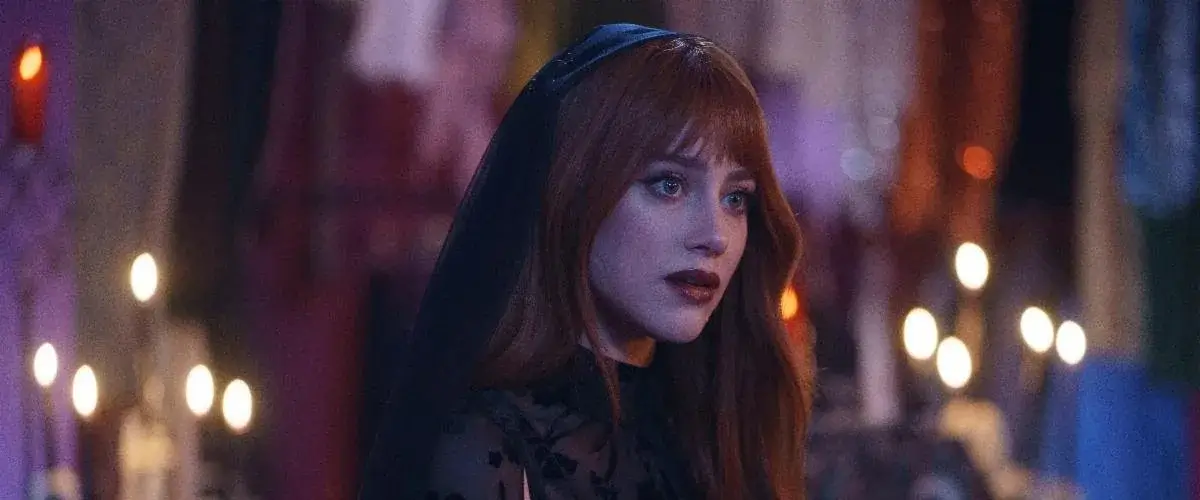
On the sales floor, they’re flawless. They read customers like case studies, selling not just outfits but the promise of becoming someone better. You can feel the calculation behind every smile. Lili Reinhart’s Apple runs the show with a kind of serene authority that borders on eerie; she speaks like she’s always aware of being watched. There’s something brittle underneath it, though, like she might shatter if anyone asked her a question she couldn’t answer with a slogan.
Recommended: Ready or Not 2: Here I Come (2026) Parents Guide
Fig, played by Alexandra Shipp, is softer around the edges, though not necessarily kinder. She has the look of someone who wants to believe in the group’s mythology, even as she senses the cracks. And then there’s Cherry Victoria Pedretti gives her a buoyancy that feels almost desperate, like she’s smiling to keep from sinking. You don’t need the film to spell out her loneliness; it hangs on her like a shadow she can’t quite shake.
Pumpkin, played by Lola Tung, doesn’t so much enter the story as slip into it, the way you drift into a group you’re not entirely sure you belong in. She watches before she speaks. Smiles at the right moments. You can feel her studying them, figuring out the rules, deciding which parts of herself to show. And yet, for all that quiet calculation, the film keeps her slightly out of focus. I kept waiting for her to push back, to reveal something messy or inconvenient about who she is, something that would disrupt the careful rhythm of the group. Instead, she mostly reflects them like a mirror that hints at depth but never quite lets you see what’s behind the glass.
What director Meredith Alloway understands, and leans into, is the language of curated intimacy. These girls talk about empowerment and sisterhood with a fluency that sounds convincing until you listen closely. It’s all phrasing. Carefully chosen words that gesture toward connection without ever quite landing there. They worship Marilyn Monroe like a patron saint, which tells you everything you need to know about the gap between image and reality they’re living inside.
And that’s where the film gets under your skin. Not with the rituals or the bloodletting those come later, and when they do, they’re messy and a little thrilling but with the idea that even rebellion can become another costume. Even sisterhood can turn into a brand.
There’s a scene no spoilers, but you’ll know it when you see it where the four of them dance, bodies loose, faces lit with something that almost looks like joy. For a second, it feels like they’ve broken through the performance. Then it slips. Just a flicker. And we’re back to watching them watch each other.
The film isn’t particularly interested in traditional scares, at least not until the final stretch. It’s closer in spirit to something like Mean Girls if it wandered into the territory of The Craft after midnight less concerned with who gets cursed than with why anyone wanted the power in the first place. When the horror does arrive, it feels less like an escalation and more like an inevitability. Of course it was going to end this way. Of course.
I did find myself wishing the film pushed certain ideas further. The chemistry between the women hums with something that never quite gets named. There are glances, touches, moments that suggest desire or at least curiosity, but the story keeps redirecting toward safer, more familiar territory. It’s a strange hesitation for a film that otherwise seems eager to poke at boundaries.
Still, there’s a sharpness to its observations that lingers. The way judgment creeps in disguised as concern. The way insecurity gets dressed up as confidence and sold back to you. The way longing for connection, for validation, for something that feels true can drive people into arrangements that only deepen the emptiness they’re trying to escape.
Recommended: Reminders of Him (2026) Parents Guide
By the time the final act arrives, with its twists and consequences, I wasn’t shocked so much as… satisfied, in a complicated way. The film doesn’t hand out easy answers about whether what we’ve seen is magic or something more human and more mundane. It doesn’t need to. Sometimes the difference hardly matters.
Walking out, I kept thinking about that basement. About the version of themselves these girls created down there, and how badly they seemed to need it. And how, for all the rituals and declarations, none of them ever quite found what they were looking for in each other.
Forbidden Fruits (2026) Parents Guide
Violence & Intensity: The horror elements are mostly held until the final act, but when they hit, they’re messy and sharp. Blood, ritualistic scenes, and shocking twists land hard. It’s not constant, but it’s effective enough to make younger viewers squirm.
Language: The dialogue is casual, sometimes biting, and often loaded with profanity. Characters speak bluntly, sometimes cruelly, and there’s an undercurrent of sharp social commentary. Slurs are minimal, but the tone is mature and unfiltered.
Sexual Content / Nudity: There’s a strong undercurrent of sexuality, flirtation, and tension between the women, though it rarely crosses into explicit depiction. Nudity appears in brief, non-gratuitous moments tied to rituals or character vulnerability, not just titillation.
Drugs, Alcohol & Smoking: Occasional drug and alcohol use is present, mostly in ritualistic or party settings. Nothing is glamorized these moments feel like part of the story’s darker, chaotic texture rather than casual indulgence.
Age Recommendations: Definitely for mature teens and adults. The themes performative relationships, loneliness, desire, and moral ambiguity require some life experience to fully register. It’s a film that works best with viewers who can sit with discomfort, question motivations, and appreciate that the “fun” is wrapped in messy, human stakes.
