Last Updated on March 10, 2026 by Monica Castillo
Some people like to argue that real self-sacrifice doesn’t exist. Scratch the surface of any supposedly noble act, they say, and you’ll find at least a trace of self-interest underneath. But that argument always raises another question: if a person happens to feel joy while helping someone else, does that somehow make the gesture less meaningful? If giving brings satisfaction, does that cancel the generosity? You might wonder if we’re built this way on purpose whether evolution, or faith, or simple human instinct shaped us to feel fulfilled when we devote ourselves to something larger than our own survival. It’s a quietly beautiful possibility.
The film Project Hail Mary takes that philosophical knot and tightens it one more turn. What happens when sacrifice isn’t freely chosen? What if helping others is thrust upon you an obligation rather than a moral ideal? In the hands of directors Phil Lord and Christopher Miller, adapting Andy Weir’s novel, the answer emerges with surprising tenderness.
The film suggests that our humanity shows itself most clearly in the moments when we must act against our own instinct for self-preservation so someone else might have a future.
Drew Goddard, who previously adapted Weir’s The Martian, has constructed a screenplay that stretches toward the cosmic ambition of Interstellar and 2001: A Space Odyssey, yet retains the playful, human-scaled charm you might associate with E.T. the Extra‑Terrestrial or even the odd-couple warmth of Planes, Trains & Automobiles. For filmmakers best known for anarchic comedy like The Lego Movie, Lord and Miller approach the material with genuine sincerity. The result is a science-fiction story that openly grapples with our anxieties about the planet’s future while still leaving space for wonder, humor, and the quiet thrill of discovery.
If the great sci-fi canon is a crowded hall of giants, Project Hail Mary makes a strong case for finding a seat among them.
The screenplay preserves much of the buoyant curiosity that made Weir’s novel such a pleasure to read. Again and again the film pauses to savor the process of thinking—of experimenting, hypothesizing, testing, and failing. It’s an odd choice for a story built around an extinction-level crisis, but it works beautifully. The premise itself is stark: the sun is fading. Earth’s temperatures are dropping, crops are beginning to fail, ecosystems are buckling. Entire species will vanish. Eventually the global supply chains that keep civilization alive will collapse, and the fragile scaffolding of society will go down with them.
Recommended: War Machine (2026) Parents Guide
Humanity, in other words, is on a clock. Thirty years, give or take.
That estimate assumes an unprecedented level of global cooperation—something that Eva Stratt, played with steely urgency by Sandra Hüller, doesn’t believe will happen. Stratt operates as a shadowy emissary for an emergency international coalition trying to understand the source of the crisis: a strange, microbe-like alien organism that appears to be draining energy from the sun before making mysterious journeys between the star and Venus. Whatever its purpose, the side effect is catastrophic for Earth.
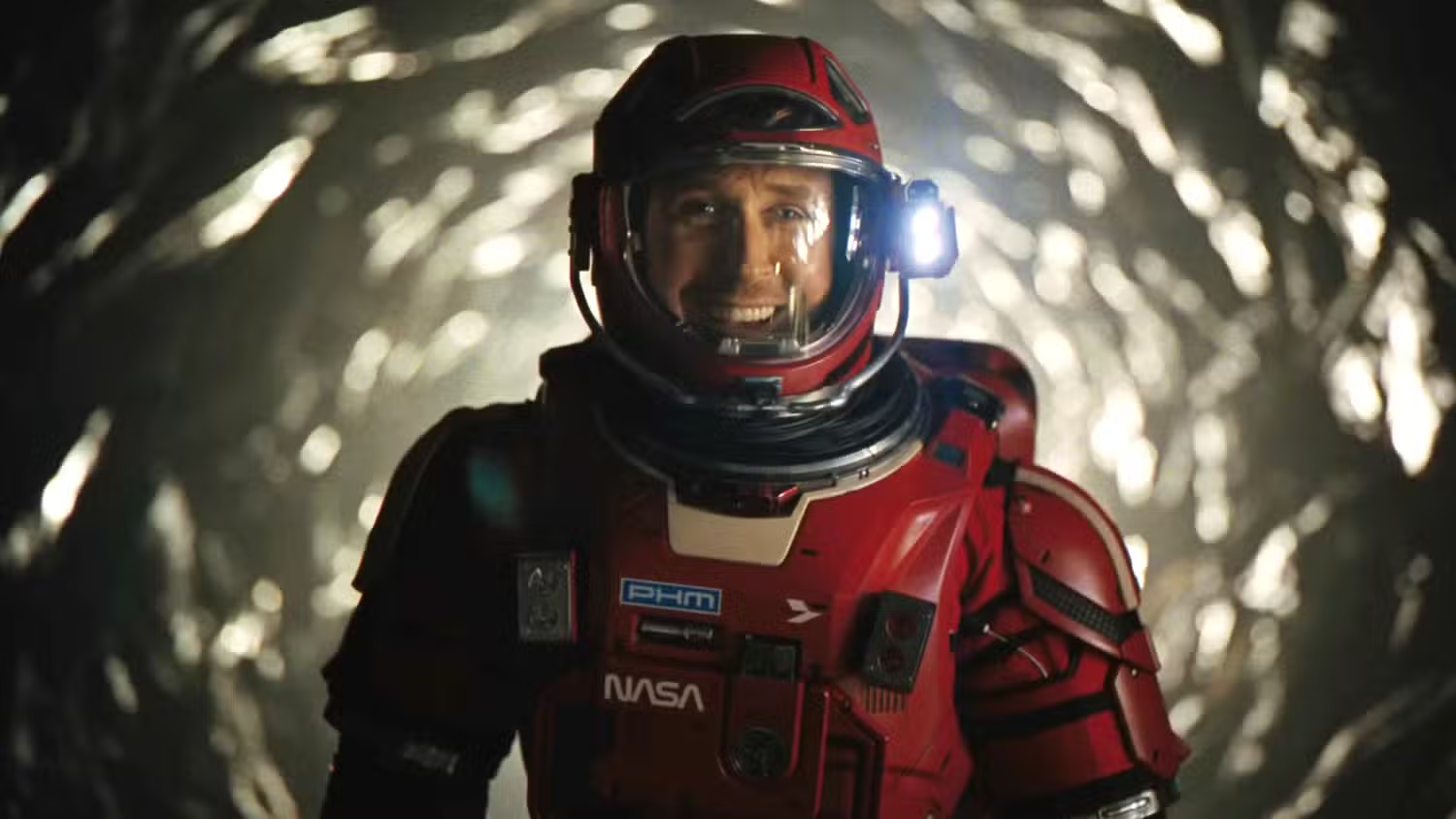
Into this nightmare steps Dr. Ryland Grace, portrayed by Ryan Gosling. Grace isn’t an astronaut or a renowned astrophysicist anymore. He’s a middle-school science teacher, quietly removed from academia after earlier work that some considered… unconventional. Years ago he speculated that extraterrestrial life might survive without water—an idea that clashed with prevailing scientific assumptions. Now, suddenly, that speculation seems less ridiculous than it once did.
Stratt tracks him down because of it. Grace might not be respected in the academic community anymore, but his thinking could be useful. Soon, despite his reluctance, he’s drawn into a top-secret research program studying a sample of the strange organism—nicknamed “astrophage,” a glossy black cluster that resembles a handful of boba pearls.
All of this arrives through a structure of carefully placed flashbacks. In the present timeline, Grace awakens alone aboard a spacecraft in a distant solar system, disoriented and freshly emerged from a coma. His beard and tangled hair give him the faintly messianic look of someone who’s been wandering the wilderness for years. The visual isn’t accidental. Whether he intended to or not, this man has become a kind of sacrificial figure for the survival of the human race.
The problem is, he can’t remember how he got here.
What follows is one of the film’s most engaging narrative tricks. As Grace slowly regains fragments of his memory little bursts of recognition triggered by the work he’s doing we learn the story alongside him. The technique, lifted directly from Weir’s novel, creates the uncanny sensation that we’re trapped on the ship with him, piecing together the mission step by step. The stakes are enormous, but the experience is oddly exhilarating. Watching Grace run experiments, calculate trajectories, and test hypotheses becomes its own form of cinematic suspense.
You might think watching someone do advanced math and physics would feel inert on screen. Lord and Miller prove otherwise. There’s a tactile joy to the film’s depiction of problem-solving—the clatter of equipment, the scribbled equations, the flashes of inspiration that send Grace scrambling back to the lab bench. Composer Daniel Pemberton underscores these moments with a playful, inquisitive score that almost recalls the educational cheerfulness of old Schoolhouse Rock segments. The sound of curiosity becomes part of the movie’s personality.
Recommended: Rooster (2026) Parents Guide
What’s especially refreshing is the film’s tone. For years now, much of mainstream science fiction has been steeped in melancholy or dread. Movies like Ad Astra mirror our present-day fears of ecological collapse and cosmic indifference. Project Hail Mary acknowledges those anxieties—it never pretends the crisis is trivial but it filters them through a stubborn belief that human beings are capable of cooperation and ingenuity.
In lesser hands that optimism might feel cloying, even naïve. Here it lands as something surprisingly moving. The movie seems to argue, again and again, that knowledge itself is a form of hope that education, curiosity, and shared effort are not luxuries but survival tools.
And then there’s Gosling.
This may be the most quietly impressive performance of his career. Much of the film belongs to him alone: a man wandering the corridors of a ship, running tests, recording observations, talking aloud simply to hear a human voice. The Russian theatre master Konstantin Stanislavski once suggested that even the act of combing one’s hair can be dramatically compelling if performed with sincerity. Gosling proves that principle repeatedly here. Watching him concentrate, panic, celebrate small victories it becomes unexpectedly absorbing.
Recommended: The Bride! (2026) Parents Guide
If every human being contains a universe of thoughts and contradictions, Gosling allows us to inhabit Ryland Grace’s for the better part of two and a half hours.
Of course, the film’s visual texture helps enormously. Cinematographer Greig Fraser, whose work on Dune and The Batman showed his gift for sculpting atmosphere out of light and shadow, surrounds the Hail Mary spacecraft with a luminous, almost hypnotic turquoise glow. Space feels vast and lonely but also strangely inviting a place where discovery waits just beyond the next calculation.
Yet even stripped of that visual beauty, the film’s core idea would remain powerful. At heart, Project Hail Mary is about connection. It suggests that survival true survival, not just biological persistence depends on reaching beyond ourselves. Through music, through language, through the small gestures that allow strangers to recognize one another across unimaginable distances.
Project Hail Mary (2026) Parents Guide
Rated PG-13 by the Motion Picture Association for some thematic material and suggestive references.
Violence & Intensity: The film’s tension comes less from physical violence and more from the looming weight of extinction. The central crisis the slow dimming of the sun and the global catastrophe that follows creates a persistent atmosphere of dread. We hear about collapsing ecosystems, future famine, and the potential breakdown of civilization, ideas that may feel heavy for younger viewers. There are also several moments of danger aboard the spacecraft: mechanical failures, hazardous scientific experiments, and life-threatening situations where the protagonist must think quickly to survive. None of it is graphic or exploitative. The intensity is mostly psychological—the kind that builds from isolation, pressure, and the realization that one person may be responsible for saving an entire species.
Language and profanity: Language in the film is relatively mild. A few scattered uses of stronger words appear when characters are under extreme stress, though profanity is never constant or aggressive. There are no slurs or hateful language. Much of the dialogue, particularly from Ryan Gosling’s Ryland Grace, leans toward humor and exasperated self-talk as he works through scientific problems alone. The tone tends to be conversational and sometimes playful, reflecting the character’s personality and the film’s sense of intellectual curiosity.
Sexual Content / Nudity: Sexual material is minimal. The PG-13 rating largely reflects brief suggestive remarks and light innuendo rather than explicit situations. There is no nudity, and the story itself has little interest in romance or physical intimacy. The focus remains firmly on survival, discovery, and human connection in a broader sense rather than relationships of a sexual nature.
Drugs, Alcohol & Smoking: Substance use is largely absent. Characters occasionally reference ordinary adult behavior such as drinking, but there are no notable depictions of drug use or smoking. The narrative is much more concerned with scientific problem-solving, exploration, and the global stakes of the mission.
Age Recommendations: For most families, the film will likely feel appropriate for viewers around 10–12 and up, depending on a child’s tolerance for suspense and big existential ideas. The story is rich with science concepts, problem-solving, and moments of discovery that older kids especially those interested in space or science may find genuinely exciting.
Project Hail Mary opens in IMAX theaters on March 20, 2026.
