Last Updated on March 8, 2026 by Monica Castillo
Stories set on college campuses have always held a certain narrative magic. The environment itself almost invites storytelling young adults standing at the crossroads of who they’ve been and who they might become. It’s a place where ambitions collide with insecurities, where people chase knowledge, identity, love, or sometimes just a clearer sense of themselves. That’s why tales about higher education never seem to age out; each generation walks into that space believing it’s the first to experience the chaos of self-discovery.
The new HBO comedy Rooster leans directly into that tradition, though it approaches the idea of personal reinvention from a slightly sideways perspective. The series arrives courtesy of Bill Lawrence, working under his deal with Warner Bros. Television, and you can feel his creative fingerprints all over it. Like several of his earlier shows, the series mixes jokes with bruised emotions, treating comedy less as an escape and more as a way to process the messiness of life.
The premise begins with a family crisis that quickly spills into campus life. Katie, played by Charly Clive, discovers that her husband Archie Phil Dunster has been unfaithful. The betrayal involves a graduate student named Sunny, portrayed by Lauren Tsai, and the revelation lands with enough emotional force to send Katie’s father rushing in like a self-appointed rescue squad.
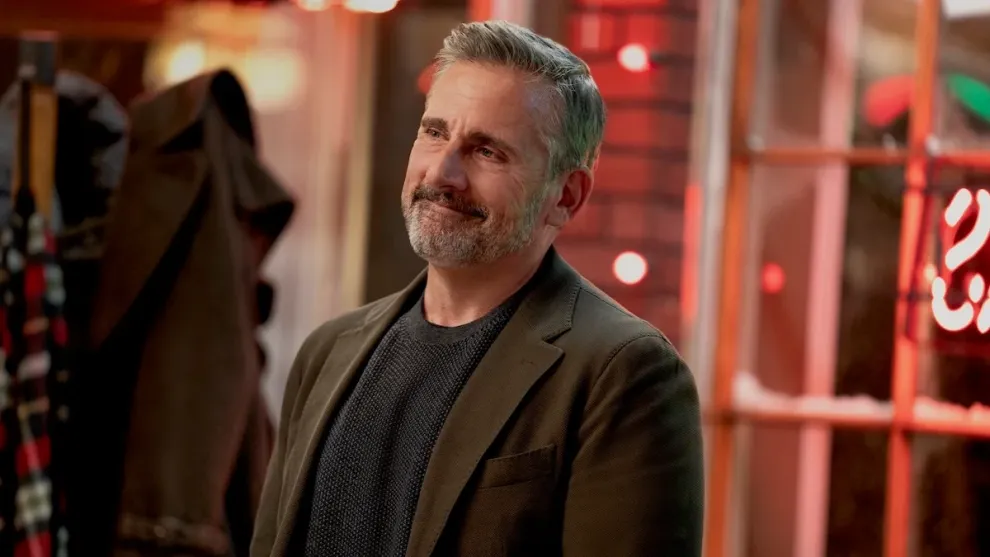
That father is Greg Russo, played by Steve Carell, a successful pulp novelist whose fame rests on a long-running series of crime books about a rugged antihero known simply as Rooster. These novels have the swagger of vintage hardboiled fiction you can almost picture them sitting next to the work of Donald E. Westlake on a used bookstore shelf—complete with cover art that imagines a far more muscular version of Carell than reality has ever produced.
Greg decides the best way to help his daughter is to physically insert himself into her world. Under the pretense of giving a reading from his novels, he shows up at the university where Katie works. It’s a father’s attempt at protection that is both sincere and a little ridiculous, the sort of impulsive decision people make when they don’t quite know how else to help.
Of course, once he arrives, leaving becomes difficult.
Encouraged by the university’s overzealous bureaucrat Walter Mann played by John C. McGinley Greg ends up accepting a position as writer-in-residence. Suddenly the aging novelist finds himself wandering through lecture halls and student lounges, navigating a modern academic culture that feels very different from the world he understands. The arrangement flips expectations in amusing ways: the supposed teacher often seems just as lost as the students he’s meant to guide.
Among those students is Dylan, the campus literary professor played by Danielle Deadwyler, whose sharp wit and grounded presence quickly make her one of the show’s most engaging characters. Deadwyler has a way of delivering a line that lands somewhere between amused and exasperated, and many of the show’s best moments come when Dylan finds herself reacting to Greg’s well-meaning but often clumsy attempts to navigate academia.
In its early episodes, “Rooster” occasionally leans a little too hard on sentimental storytelling. HBO provided critics with six of the season’s ten installments, and across those episodes you can feel the show trying to calibrate its emotional tone. Fans of Lawrence’s earlier work particularly Ted Lasso, Shrinking, and the long-running sitcom Scrubs will recognize the formula. His shows thrive when humor and melancholy sit comfortably side by side, and “Rooster” is clearly reaching for that same balance.
Highly Recommended: Vladimir (2026) Parents Guide
What becomes increasingly clear is that the comedy is only part of the equation. Beneath the jokes sits the real emotional engine of the show: the relationship between Greg and Katie. Years earlier, Greg and Katie’s mother Beth played by Connie Britton went through their own painful separation. Now Greg watches as his daughter’s marriage threatens to follow the same path, and that possibility hangs over every conversation between them.
The father-daughter dynamic gives the series its most authentic heartbeat. Carell brings warmth and quiet regret to Greg, a man who has clearly made mistakes in his own life and now hopes to spare his daughter from repeating them. Opposite him, Clive delivers a performance that feels remarkably natural. Her comedic instincts are sharp, but what really stands out is how easily she moves between humor and vulnerability. For viewers unfamiliar with her earlier work in the UK, this performance feels like the arrival of a major talent.
The series arguably works best when it allows its sadness to surface. Carell has spent years proving that his comedic persona can carry real emotional weight, and “Rooster” gives him plenty of opportunities to explore that range. Yet the show’s real revelation may be Clive herself. Her performance has an ease that suggests years of experience, even though she only began appearing onscreen relatively recently.
That’s not to say the show forgets to be funny. Some of the most effective jokes come from Greg’s awkward attempts to adapt to the cultural climate of a modern university. In one particularly memorable moment, he casually references the white whale from Moby-Dick, only to have a student interpret the comment as body-shaming. The misunderstanding snowballs into a disciplinary hearing, turning what should have been a harmless literary reference into a full-blown campus controversy.
Importantly, the show doesn’t frame the moment as a cheap jab at politically aware students. Instead, the humor grows out of generational miscommunication. Greg’s worldview belongs to an earlier era, while the students around him have grown up in a culture that scrutinizes language more closely. The result isn’t mockery it’s awkwardness, confusion, and eventually a kind of reluctant understanding.
Deadwyler continues to shine throughout these moments, often serving as Greg’s sharp-eyed foil. And as with most Bill Lawrence productions, the supporting cast adds layers of personality to the story. Alongside McGinley and Dunster, the show features comedic regulars like Annie Mumolo, Alan Ruck, Rory Scovel, and Scott MacArthur, each bringing their own brand of eccentricity to campus life.
By the end of the six episodes provided to critics, “Rooster” feels like a show that has just begun to discover its real identity. The early chapters lay down the emotional groundwork, but the later episodes hint at deeper conflicts and more complex character dynamics. With four installments still unseen, it’s difficult to predict exactly where the season will land.
Still, the momentum is encouraging. If Lawrence and co-creator Matt Tarses continue to explore the emotional terrain they’ve opened up particularly the delicate push and pull between Greg and Katie the series has the potential to grow into something genuinely resonant.
Highly Recommended: Outlander Season 8 Parents Guide
After all, the best television about life doesn’t pretend everything is simple. It acknowledges that humor and heartbreak often occupy the same space. And in “Rooster,” thanks largely to the easy chemistry between Carell and Clive, that messy, honest mixture feels surprisingly true.
Sometimes going back to school isn’t about learning something new. Sometimes it’s about understanding what you should have known all along.
Rooster (2026) Parents Guide
Rating: The series is rated TV-MA by the Motion Picture Association. The mature rating mostly reflects adult language, relationship themes, and frank discussions about infidelity and sexuality rather than extreme content.
Violence & Intensity: Violence is not a major component of Rooster. The show is primarily a character-driven comedy-drama centered on family relationships and life on a modern college campus. Most of the tension comes from emotional situations marital betrayal, awkward academic confrontations, and the uncomfortable process of watching loved ones make painful life decisions.
There are occasional heated arguments, particularly between family members navigating the fallout from an affair, but physical violence is largely absent. The show’s intensity tends to be emotional rather than physical, focusing on heartbreak, disappointment, and the complicated dynamics between parents and adult children.
Language and Profanity: Strong language appears regularly throughout the series, which is typical for HBO comedies aimed at adult audiences. Characters sometimes use profanity in moments of frustration or during casual conversations, particularly when discussing relationships or campus controversies.
The tone of the dialogue can be sharp and sarcastic, especially when characters clash over generational misunderstandings or personal mistakes. While the language isn’t constant in every scene, parents should expect frequent adult-level dialogue consistent with the show’s TV-MA rating.
Sexual Content / Nudity: Sexual themes are central to the story, though they are generally discussed rather than shown explicitly. The main storyline revolves around a husband’s affair with a graduate student, and characters openly talk about relationships, attraction, and infidelity.
There are conversations that reference sexual behavior and adult relationships, and some scenes carry flirtatious or suggestive undertones. However, the show focuses more on the emotional fallout of betrayal rather than explicit sexual imagery. Nudity is not a major feature in the episodes provided.
Drugs, Alcohol & Smoking: Alcohol appears occasionally in social settings, such as campus gatherings or casual conversations between adults. Characters may drink while discussing personal problems or celebrating events, reflecting the typical adult environment surrounding university life.
Drug use is not a significant element of the series. Smoking appears rarely, if at all, and substance use generally stays in the background rather than driving any storylines.
Age Recommendations: Because of its adult language, mature relationship themes, and discussions of infidelity, Rooster is best suited for older teens and adults.
