Last Updated on March 4, 2026 by Monica Castillo
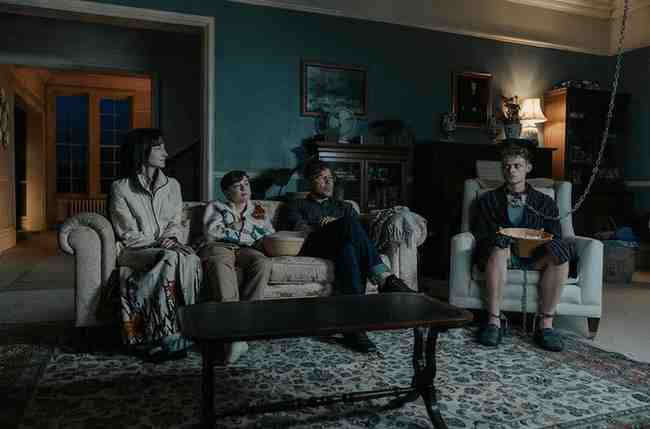
There’s a moment early in Heel when I caught myself leaning forward instead of recoiling, and that realization unsettled me more than anything the film explicitly does. The image is simple enough: a young man chained to a ceiling in a basement. Cinema has taught us how to respond to that sight. Outrage. Fear. Moral clarity. Yet Jan Komasa quietly nudges us into a far more dangerous position. He asks us to listen. Worse, he asks us to consider agreement.
Before we ever see the chains, though, the film takes its time poisoning the well.
Tommy, played with unnerving volatility by Anson Boon, enters the story like a bruise you don’t remember earning. He drives drunk, bullies strangers, ricochets through London nights with a sense of consequence-free entitlement that curdles into menace. There’s sex that feels negotiated by chemicals rather than consent, cruelty delivered as sport, and an emptiness behind his eyes that suggests this isn’t rebellion so much as rot. By the time the film reveals that he’s been abducted and imprisoned, any reflexive sympathy has already burned away. That’s not an accident. It’s the foundation of the film’s moral trap.
The people who’ve trapped him aren’t monsters in the traditional sense, which is precisely the problem. Chris, the household’s patriarch, is played by Stephen Graham with a chilling calm that recalls how persuasive authority can sound when it believes itself to be right. He doesn’t rant. He explains. He doesn’t beat Tommy into submission. He corrects him. The house operates less like a torture chamber than a grimly organized program, complete with rules, incentives, and a belief spoken softly but held tightly that what’s being done here is necessary.
Recommended: Dolly Parents Guide
Kathryn, his wife, hovers through the film like a ghost who forgot how to haunt. Andrea Riseborough gives her a stillness that feels post-catastrophic, as though grief has already hollowed her out and left only habit behind. Whatever shattered this family did so before the movie began, and Komasa resists the urge to diagram it for us. Instead, it seeps out through her vacant stares and the way her body seems present only out of obligation.
What Chris proposes is rehabilitation. Not metaphorical rehabilitation. Literal, incremental behavior correction. Tommy watches footage of car wrecks. He’s forced to confront videos of his own online cruelty. He earns privileges the way a lab animal earns treats. A toilet arrives. Books follow. Later, even movement rails along the ceiling that allow him to traverse the house like a tethered thought. The horror isn’t that this system is sadistic. It’s that it’s orderly. Persuasive. And, against our better judgment, effective.
Boon threads an extraordinarily delicate needle here. Tommy doesn’t transform into a saint, nor does he remain the feral presence we met in the opening act. He softens in fits and starts. He listens when it benefits him. He bonds, awkwardly, with the family’s young son, and develops a tentative attraction to the housemaid, whose presence becomes quietly unsettling the longer she stays. She isn’t there to rescue anyone. She’s there to observe, adapt, and decide how much compromise a paycheck is worth. The film follows her just enough to remind us that this experiment requires consent from more than just its captive and that moral contamination spreads faster than anyone admits.
The relationship between Chris and Tommy tightens with each scene. Graham and Boon play their shared moments like a chess match where both players believe they’re teaching the other how to win. Chris insists on fairness. Tommy tests boundaries. Somewhere along the way, captivity begins to resemble structure, and structure starts to feel like care. That’s where Heel becomes genuinely disturbing. The film doesn’t argue against Stockholm syndrome. It demonstrates its appeal.
I kept waiting for the film to pull back, to clarify its position, to condemn what we’re watching with a firmer hand. It never quite does. The ending arrives without the sense of reckoning the story seems to promise, leaving certain threads loose and certain implications unresolved. You could argue that this refusal to tidy things up is intentional. You could also argue that it dodges responsibility.
Recommended: Hoppers (2026) Parents Guide
What I can’t argue with is how effectively Heel forces you to sit inside an ugly question and resist the comfort of easy answers. Komasa, whose earlier work leaned toward overt provocation, opts here for something colder and more intimate. The film doesn’t ask whether Chris is right. It asks how easily we might start to think he is, given the right provocation, the right target, the right fear.
When the lights came up, I didn’t feel enlightened. I felt implicated. And that feeling followed me longer than I expected, like the echo of a door locking somewhere below the floorboards, long after you’ve convinced yourself you’re free to leave.
Violence & Intensity: Heel is built around captivity, control, and moral pressure rather than splatter or spectacle, but that doesn’t make it gentle. A young man is kidnapped, chained, and psychologically broken down in stages. There are threats, intimidation, and moments where violence feels imminent even when it isn’t enacted. The tension is constant, low-level, and suffocating. This is the kind of film where the most unsettling moments come from calm voices explaining why cruelty is “necessary.”
Language (Profanity, Slurs, Tone): The language is coarse and aggressive, especially early on when the central character is introduced as volatile and deliberately abrasive. Expect frequent profanity, shouted insults, and language meant to demean or provoke. The tone matters as much as the words: speech is often used as a weapon, whether through verbal abuse or icy, controlled lectures designed to assert dominance.
Sexual Content / Nudity: Sex appears briefly but uncomfortably. Early scenes include drug-fueled sexual encounters that feel transactional and poorly negotiated, with consent left deliberately murky. There’s no romantic framing and little nudity, but the intent is to unsettle rather than arouse. Sexuality here reflects recklessness and emotional emptiness, not intimacy.
Drugs, Alcohol & Smoking: Heavy alcohol use is central to the opening act, including drunk driving and binge drinking. Drug use appears in club settings and is tied directly to poor judgment and self-destruction. Substance abuse isn’t glamorized; it’s shown as part of a wider pattern of chaos, but it’s still prominent enough to warrant caution.
Age Recommendations: This film is firmly for adults. Not because of graphic excess, but because of its moral content and psychological cruelty. Teens may grasp the surface story, but the film’s real impact comes from how it implicates the viewer in ethically troubling ideas about punishment, rehabilitation, and control. Recommended for mature audiences only 18+ and even then, best watched by viewers prepared for something cold, unsettling, and deliberately unresolved.
Recommended: Scream 7 (2026) Parents Guide
