Last Updated on March 1, 2026 by Monica Castillo
There’s a moment at the end of the premiere of Marshals when Kayce Dutton looks at his son and sounds tired in a way television characters rarely are. Not the gruff exhaustion of a man who’s seen too much, but the quieter fatigue of someone who realizes he’s been circling the same idea for years and still hasn’t found an exit. He tells Tate he never meant to drag him back into the gravitational pull of the Dutton name. He wanted out. He fought for it. And yet here they are again, living under a sky darkened by a century of inherited consequence.
It’s a good scene. It’s intimate. It promises a show about choice, about whether bloodlines dictate destiny or just whisper suggestions we can ignore if we’re stubborn enough.
Then Tate all but vanishes from the next two episodes, and the promise evaporates.
Marshals wants very badly to feel like a fresh start for Kayce. New job. New badge. New people who don’t automatically flinch when they hear his last name. The problem is that it can’t stop glancing backward, as if afraid to lose sight of Yellowstone altogether. Every step forward comes with a reminder of where Kayce came from, what his family did, how feared they once were, how radioactive the name still is. The series keeps insisting it’s letting him stand on his own while constantly tugging him back by the collar.
Highly Recommended: Dreams (2025) Parents Guide
I should probably admit that I’m not steeped in Dutton mythology. I know the outlines land, legacy, violence disguised as necessity but I don’t carry the emotional inheritance. In theory, that shouldn’t matter. A spinoff shouldn’t require a family tree taped to the wall. And early on, Marshals seems willing to meet newcomers halfway.
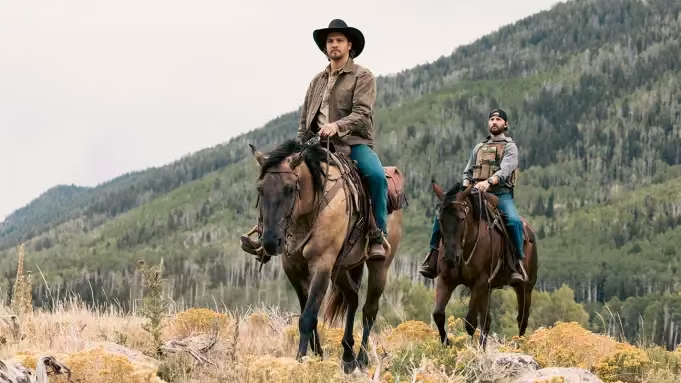
Kayce lives alone now at East Camp, surrounded by open land and the kind of quiet that feels earned but not entirely peaceful. His days belong to horses. His nights belong to memories that show up uninvited. When an old Navy SEAL friend, Calvin, arrives asking for help with a case involving women targeted near the Broken Rock reservation, Kayce agrees without debate. When that help expands into monitoring an anti-mining protest his son plans to attend, he agrees again. The show barely pauses before nudging him toward a marshal’s badge, as if this was always the next square on the board.
Logan Marshall-Green gives Calvin an easy decency that makes sense as a recruiting tool. He believes in the work, in the idea that order can be maintained by people who care enough to show up clean. Arielle Kebbel brings a guarded steadiness to Belle, another person shaped — and misshaped by family history. Ash Santos has fun as Andrea, a Bronx transplant who treats the local bar like an anthropological exercise. Kayce, of course, declines every invitation. He’d rather go home and eat cereal alone, which the show treats less as a quirk than as a moral stance.
Watching the episodes back-to-back, a pattern settles in quietly. Cases begin with a sense of restraint, then stretch until restraint snaps. A conversation turns tense. A chase breaks out. A gun comes up. Kayce reacts faster than everyone else, and by the end of the hour, someone is dead. The show always makes sure the math adds up: he had no choice, no alternative, no time to think. He doesn’t enjoy it, but he doesn’t carry it either. The weight evaporates as soon as the body hits the ground. In a genre that sometimes tries awkwardly, imperfectly to grapple with power and consequence, Marshals keeps its hands clean by insisting its heroes never make the wrong call, only insufficiently forceful ones.
What does linger is the family sermon. Characters keep explaining the Duttons to Kayce, as if he somehow missed growing up inside that story. They tell him how brutal his people were, how feared, how diminished they’ve become. He listens with that familiar clenched-jaw patience, like a man trapped in a looped recording. When someone tells him he’s different, he holds onto it like a flotation device.
Highly Recommended: The Gray House 2026 Parents Guide
The trouble is that the show doesn’t replace that absence with anything solid. Kayce is defined almost entirely by refusal: not his father, not that legacy, not those choices. Beyond competence, stoicism, and a talent for sanctioned violence, the series hasn’t yet figured out who he is when the past finally shuts up.
Maybe it will. Television is generous with time, and there are hints of a story about a man learning how to belong without surrendering himself. For now, though, Marshals feels caught between devotion and reinvention, unwilling to break fully from the thing that birthed it.
It keeps telling us the future doesn’t have to look like the past. It just hasn’t learned how to stop staring at it long enough to prove that’s true.
Marshals (2026) Parents Guide
Marshals is rated TV-MA, and it earns that rating less through shock than through sheer consistency. Gunfights, chases, and on-screen killings occur regularly, often once per episode, and the show takes pains to justify them as necessary.
Language is present but not relentless. Expect regular use of strong profanity, including F-words and other adult language, delivered in a matter-of-fact, workplace tone rather than for shock or humor.
Sexual content is minimal. There are some flirtation, innuendo, and casual references to adult relationships, but no explicit sex scenes and no nudity. Romance exists more as background texture than as a narrative driver, and the show is far more interested in work and violence than intimacy.
Alcohol appears socially characters drink at bars or after work but it’s not glamorized or central to the plot. Drug use is referenced primarily in the context of crime and law enforcement, not recreation. Smoking is rare.
For age recommendations, this is firmly adult television. While there’s nothing especially graphic in isolation, the cumulative effect of frequent killings, morally uncomplicated violence, and mature language makes it inappropriate for children and most younger teens.
Highly Recommended: Lead Children (2026) Parents Guide
