Last Updated on February 28, 2026 by Monica Castillo
I keep thinking about the opening shot of Michel Franco’s Dreams: a lone truck barreling across a desert under a sun so hot it almost hurts to look at. And then, night falls, and we hear voices—shouts muffled by metal and fear before the camera finds one figure stepping away from the huddled masses. He walks, slow, deliberate. That figure is Fernando Rodriguez (Isaac Hernández), a dancer with the kind of body that seems built to command a room, and already the film asks you to notice what it asks you to notice: movement, desire, escape. But beyond that, what it wants to make you feel is murky, almost evasive. Franco, who once carved into the raw heart of social fracture in New Order, now seems to be trying something like a social experiment disguised as a melodrama and it’s one that never quite lands.
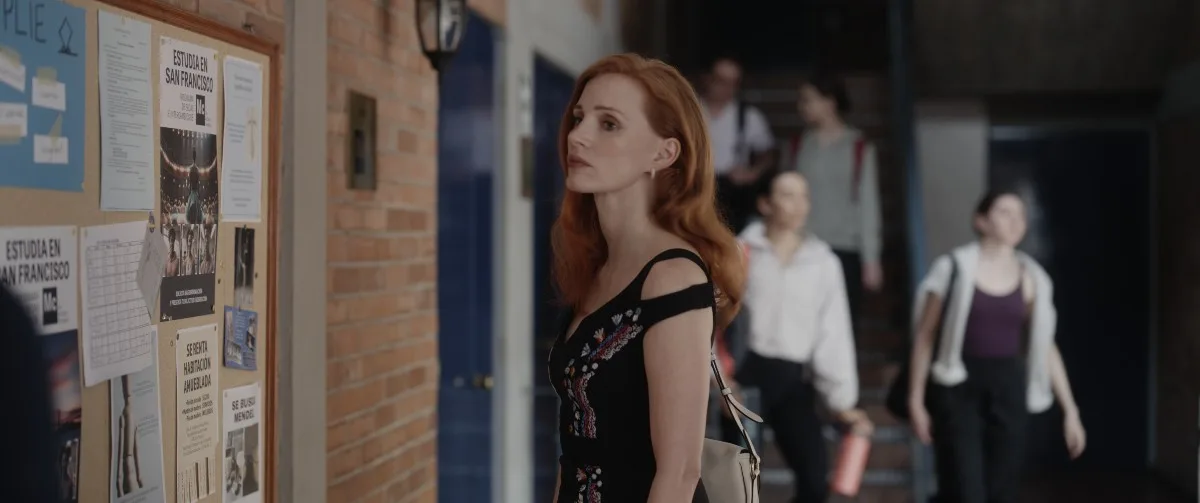
Fernando’s path takes him to San Francisco, into the home of Jennifer McCarthy (Jessica Chastain), his lover from Mexico, now living a life cushioned by wealth and expectation. Franco quickly establishes the tension: Jennifer’s father, Michael (Marshall Bell), and her brother, Jake (Rupert Friend), are the gatekeepers of privilege, the invisible walls Fernando cannot cross. She doesn’t say it, but she doesn’t need to Fernando feels the weight of their judgment. He leaves, hoping to carve out his own existence, but the film seems less interested in the mechanics of their world than in the shorthand of desire.
The sexual chemistry between Fernando and Jennifer is explicit, unflinching. Franco lingers on it, not coy but clinical, as if the passion itself should be the message. It almost reads like a thought experiment: can attraction survive the ledger of social inequality? But what should feel combustible instead fizzles. Jennifer feels like a cipher her wealth, her privilege, her choices distilled into gestures and sighs. Fernando is mostly a body in motion, a presence rather than a person. By the time the movie leans into their repeated encounters, you realize the film has traded character for abstraction, and the abstraction is cold.
Highly Recommended: Undercard 2026 Parents Guide
Franco seems to be testing us, setting up Jennifer and Fernando like pieces on a moral chessboard. He wants us to squirm under the weight of their differences, to notice the hypocrisies of a world that preaches openness but polices desire. And yet, when the story leans into that tension, it falters. Jennifer becomes less a person than a symbol, and the film’s final act, which turns violently sexual, hits with the impact of a moral lesson delivered in a whisper. You don’t recoil because you’re horrified by her choices you recoil because the movie doesn’t care enough to make you feel anything at all. There’s no fury, no heartbreak, no messy human truth just the quiet, persistent hum of indifference.
There are moments, brief and flickering, where you sense what Franco might have been reaching for: Fernando moving through the city streets, Jennifer’s eyes lingering on him with conflicted longing, the quiet desperation of someone caught between worlds. But the camera holds its distance, emotionally aloof, and you’re left watching events unfold with the detachment of someone observing a diagram. You register it, you understand it, and then you forget it.
By the end, Dreams lives up to its title in the most frustrating way: it lingers only in memory’s peripheral vision, half-formed and slippery. It’s a movie that wants to be urgent, controversial, electric but instead it’s almost studiously cool, emotionally anesthetized. I left the theater thinking about how a story so charged with desire, wealth, and power could feel so vacant, and I haven’t stopped turning it over since.
Dreams (2025) Parents Guide
Dreams is not rated R by the MPA, though it contains material that many parents would consider mature and challenging.
Violence & Intensity: The film contains scenes of sexual assault and moments of psychological tension that can be disturbing. The opening sequence with the truck full of immigrants is harrowing, with fear and desperation conveyed through sound and the camera’s lingering gaze. The intensity is more emotional than physical, but it is persistent.
Language: Profanity is minimal, and there are no overt racial slurs, but the tone throughout can feel cold, clinical, and emotionally harsh. Characters express disdain or judgment in ways that carry a sting without shouting. It’s more the social cruelty than the words themselves that hits.
Sexual Content / Nudity: Sexual content is frequent and explicit. Scenes on the physical relationship between Fernando and Jennifer in a way that is central to the story. Nudity is present, and sexual encounters are graphic by contemporary standards. Some sequences, particularly later in the film, depict sexual violence that is intense and potentially traumatizing.
Drugs, Alcohol & Smoking: The film makes only minor references to alcohol and social indulgence, but drug use is not depicted, and smoking is minimal or incidental.
Age Recommendations: Dreams is best suited for mature teens and adults. Its focus on explicit sexuality, social tension, and emotionally cold depictions of power and desire make it inappropriate for younger viewers.
Highly Recommended: Psycho Killer (2026) Parents Guide
