Last Updated on February 24, 2026 by Monica Castillo
The Bluff is rated R by the Motion Picture Association for strong bloody violence.
I kept thinking about the year 1846 while watching The Bluff, and not just because the film itself insists on it. There’s something perversely comforting about anchoring a movie to a specific moment in history. It suggests intention. Weight. A sense that the story might brush up against something larger than itself. 1846, after all, gave us Neptune, the saxophone, the Donner Party’s slow nightmare, and the birth of the Associated Press. It was a year that couldn’t sit still.
This movie, sadly, can.
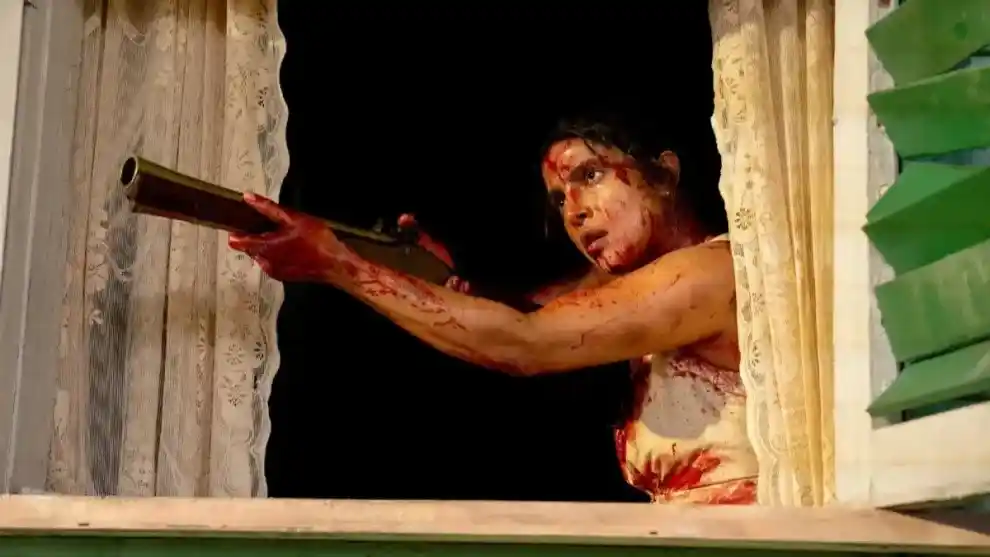
Directed by Frank E. Flowers, The Bluff wants to be a scrappy, salt-stung throwback a pirate picture made on a sensible budget, with practical stunts, sweaty combat, and a righteous streak of domestic fury. It stars Priyanka Chopra Jonas as Ercell, a retired pirate who has traded the open sea for a quiet island life with her husband and children. That peace lasts exactly as long as it takes for Captain Connor, played with grim enthusiasm by Karl Urban, to arrive with cannons, grudges, and an endless supply of men eager to die messily.
There’s an early stretch at sea brief, functional, and over too quickly that hints at a livelier film. Ships creak. Steel flashes. For a moment, it feels like the movie might actually want the ocean as more than decorative wallpaper. Then everyone disembarks, the water disappears, and the rest of the story unfolds on dry land, as if the production quietly remembered how expensive waves are.
What follows is straightforward to the point of austerity. Connor wants gold. The gold leads him to Ercell’s Island. He kidnaps her husband, threatens her children, and triggers the inevitable response: a former killer forced to remember who she used to be. The film doesn’t belabor this transformation because it doesn’t really believe in it. Ercell flips the switch almost immediately, and the movie treats violence less as a moral compromise than as muscle memory.
Highly Recommended: Midwinter Break (2026) Parents Guide
To Chopra Jonas’s credit, she sells it. She moves like someone who knows what her body can do and doesn’t need the camera’s help to convince you. A rapier feels natural in her hand. So does a pistol. So does a punch. There’s an early fight brutal, close, and personal that lands with a thud of real danger. For a few minutes, I leaned forward.
Then the film relaxes. Too much.
After that first eruption, the action settles into a dependable rhythm: bad men arrive, bad men fall, rinse, repeat. The choreography grows cautious. The camera starts cutting away just as something interesting might happen. You can sense the movie eyeing bigger, bolder ideas a sustained shot, a messier brawl, a moment of visual bravado before backing down and choosing safety instead. Efficient. Bloodless. Fine.
And fine is the problem.
There’s a location called the Bluff itself, rigged with traps and explosives, and the title suggests a cleverness the film never quite earns. Nobody outsmarts anyone. Nobody lies convincingly enough to matter. Strength solves everything. It works, but it works the way a well-maintained machine works: reliably, without surprise, without delight.
Worse, the pirate trappings start to feel optional. Strip away the period costumes, swap the gold for any other shiny incentive, and you’d have the same movie a protector standing between family and faceless aggressors. The absence of the sea begins to matter. So does the scarcity of danger. So, frankly, do the crocodiles. There should always be more crocodiles.
I didn’t dislike The Bluff. That’s the faintly tragic part. It’s earnest. It’s watchable. It knows what it wants to be, even if it never reaches for more. In a cinematic landscape that has mostly abandoned pirates to theme parks and nostalgia, this may qualify as the best pirate movie in years by default. But defaults are lonely victories.
Highly Recommended: Psycho Killer (2026) Parents Guide
When the credits rolled, I found myself thinking again about 1846 not the date on the screen, but the idea of it. A year crowded with discovery, invention, catastrophe. A reminder that even modest moments in history can hum with consequence. The Bluff passes the time. It swings its sword. It hits its marks. Then it drifts away, like a ship that never quite leaves the harbor.
The Bluff 2026 Parents Guide
Violence & Intensity: The film is built almost entirely around sustained combat: sword fights, gunshots, stabbings, explosions, and bodies hitting the ground hard. Blood is visible and frequent, though not lingered over in a sadistic way. People are shot at close range, slashed with blades, blown apart by traps, and in one memorable flourish, fed to wildlife. The violence has weight but little reflection; it’s meant to feel efficient and relentless rather than shocking for shock’s sake. Still, the body count is high, and younger viewers will feel it.
Language: Profanity shows up regularly, mostly in the form of harsh insults, threats, and battle-ready swearing. Expect strong language consistent with an R-rated action film, though it’s not especially inventive or constant. There are no slurs used for shock value, but the tone is aggressive, hostile, and often angry, especially when villains are asserting control.
Sexual Content / Nudity: There’s no explicit nudity and no sex scenes. Some brief intimacy between married characters appears early on, handled quickly and without detail. The film’s focus stays firmly on survival and violence, not sexuality.
Drugs, Alcohol & Smoking: Alcohol appears in a historical context characters drink rum and spirits, usually in passing or as part of pirate culture. There’s no drug use, and drinking is not glamorized, though it is normalized within the setting.
Age Recommendations: This is not a movie for kids or younger teens. The sustained violence, bloodshed, and peril involving family members make it most appropriate for adults and older teens (17+) who are already comfortable with hard-edged action films. For parents, the concern isn’t shock but volume: the film keeps returning to violence as its primary language, and it rarely pauses to catch its breath.
